Industry-Verified Manufacturing Data (2026)

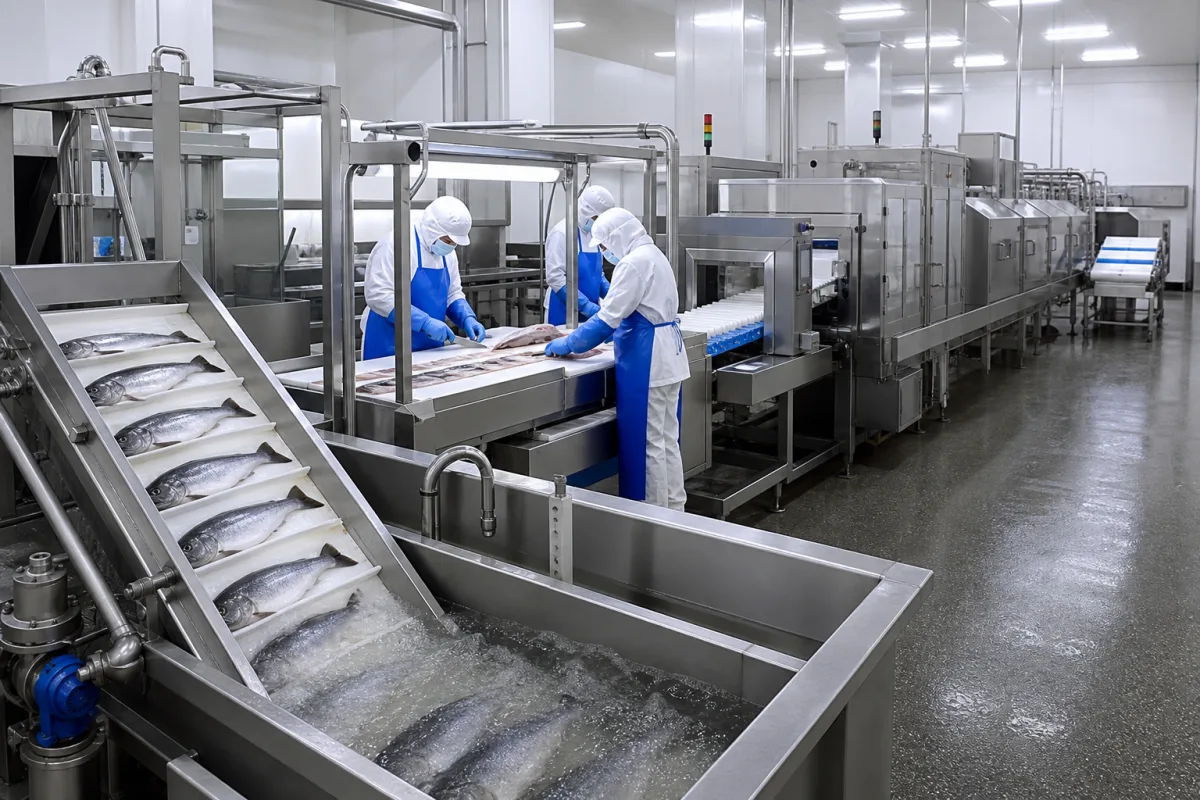
Modular Fish Processing and Preservation Line

Based on aggregated insights from multiple verified factory profiles within the CNFX directory, the standard Modular Fish Processing and Preservation Line used in the Processing and Preserving of Fish sector typically supports operational capacities ranging from standard industrial configurations to heavy-duty production requirements.

Technical Definition & Core Assembly

A canonical Modular Fish Processing and Preservation Line is characterized by the integration of Infeed and Sorting Module and Multi-Stage Washing and Sanitizing Tunnel. In industrial production environments, manufacturers listed on CNFX commonly emphasize Stainless Steel (AISI 304/316) construction to support stable, high-cycle operation across diverse manufacturing scenarios.

Integrated industrial line for automated fish processing, preservation, and packaging.

Product Specifications

Technical details and manufacturing context for Modular Fish Processing and Preservation Line

Definition
A coordinated multi-module industrial solution designed for the continuous processing and preservation of fish, crustaceans, and molluscs. It integrates sequential operations from initial handling through final packaging into a single, automated production line. This system is engineered for high-volume B2B food processing facilities, enhancing throughput, yield, and product safety while reducing labor costs and contamination risks. It serves as a critical capital asset in the seafood supply chain, enabling processors to meet stringent hygiene and quality standards for fresh, frozen, and value-added products.
Working Principle
The system operates on a continuous flow principle, where raw seafood is conveyed through a series of specialized, interlinked processing modules. Each module performs a specific function (e.g., washing, grading, filleting, freezing, packaging) in a controlled sequence. Programmable Logic Controllers (PLCs) and sensors coordinate the timing, speed, and environmental conditions (like temperature) between modules to maintain product integrity and optimize the overall line efficiency.
Common Materials
Stainless Steel (AISI 304/316), Food-Grade Plastics (HDPE, PP), Industrial-Grade Conveyor Belting
Technical Parameters
  • Maximum rated throughput capacity of the integrated line (kg/hour) Standard Spec
  • Total footprint length of the complete system layout (meters) Standard Spec
Components / BOM
Engineering Reasoning
0.1-0.8 MPa hydraulic pressure, 0-5°C processing temperature, 85-95% relative humidity
Hydraulic pressure exceeding 1.2 MPa causes seal rupture, temperature above 8°C initiates bacterial growth, humidity below 80% leads to product dehydration
Design Rationale: Hydraulic system failure due to Pascal's law pressure transmission exceeding material yield strength, thermal failure from Arrhenius equation bacterial growth kinetics, moisture transfer via Fick's law diffusion principles
Risk Mitigation (FMEA)
Trigger Hydraulic fluid contamination exceeding ISO 4406 Class 18/16/13
Mode: Proportional valve stiction causing position control error of ±2.5 mm
Strategy: Install 3 μm absolute filtration with differential pressure monitoring at 0.15 MPa
Trigger Refrigerant charge loss of 15% mass from nominal 2.8 kg R404A
Mode: Evaporator coil frosting reducing heat transfer coefficient from 45 to 12 W/m²·K
Strategy: Implement refrigerant mass flow sensors with 0.01 kg/s resolution and automatic charge compensation

Industry Taxonomies & Aliases

Commonly used trade names and technical identifiers for Modular Fish Processing and Preservation Line.

Industrial Ecosystem & Supply Chain DNA

Complementary Systems
Downstream Applications
Specialized Tooling

Application Fit & Sizing Matrix

Operational Limits
pressure: 0.5 to 3 bar (pneumatic systems), 1 to 6 bar (hydraulic wash systems)
flow rate: 500 to 5000 kg/hour (fish throughput)
temperature: -5°C to 40°C (processing ambient), -30°C to 5°C (preservation zones)
slurry concentration: Up to 15% solids in waste/effluent streams
Media Compatibility
✓ Saltwater fish (cod, salmon, tuna) ✓ Freshwater fish (tilapia, catfish) ✓ Shellfish (shrimp, scallops)
Unsuitable: Highly acidic marinades or brines (pH < 4.0)
Sizing Data Required
  • Maximum hourly throughput (kg/hour)
  • Primary fish species and size distribution
  • Required preservation method (freezing, chilling, vacuum packing)

Reliability & Engineering Risk Analysis

Failure Mode & Root Cause
Corrosion and pitting
Cause: Exposure to saltwater, fish juices, and acidic cleaning chemicals leading to material degradation, particularly in stainless steel components and welds.
Bearing and seal failure in conveyor systems
Cause: Continuous moisture ingress, temperature fluctuations, and particulate contamination from fish scales and debris, causing lubrication breakdown and mechanical wear.
Maintenance Indicators
  • Unusual grinding or squealing noises from conveyor motors or gearboxes, indicating bearing wear or misalignment.
  • Visible rust spots, discoloration, or pitting on stainless steel surfaces, especially around joints and welds, signaling corrosion progression.
Engineering Tips
  • Implement a rigorous post-shift cleaning and drying protocol using pH-neutral cleaners to remove salt and organic residues, followed by thorough drying to prevent corrosion initiation.
  • Establish a preventive maintenance schedule for lubrication of bearings and seals using food-grade, waterproof lubricants, and install protective covers or shields in high-splash zones to reduce contamination.

Compliance & Manufacturing Standards

Reference Standards
ISO 22000:2018 - Food safety management systems ANSI/NSF 4-2021 - Commercial cooking, rethermalization and powered hot food holding and transport equipment CE Marking - Machinery Directive 2006/42/EC
Manufacturing Precision
  • Conveyor belt alignment: +/- 1.5mm over 10m length
  • Temperature control in preservation chambers: +/- 0.5°C
Quality Inspection
  • Microbiological surface swab testing for hygiene compliance
  • Pressure decay test for vacuum sealing systems integrity

Factories Producing Modular Fish Processing and Preservation Line

Verified manufacturers with capability to produce this product in China

✓ 93% Supplier Capability Match Found

P Procurement Specialist from Germany Feb 28, 2026
★★★★★
"Great transparency on the Modular Fish Processing and Preservation Line components. Essential for our Processing and Preserving of Fish supply chain."
Technical Specifications Verified
T Technical Director from Brazil Feb 25, 2026
★★★★★
"The Modular Fish Processing and Preservation Line we sourced perfectly fits our Processing and Preserving of Fish production line requirements."
Technical Specifications Verified
P Project Engineer from Canada Feb 22, 2026
★★★★★
"Found 31+ suppliers for Modular Fish Processing and Preservation Line on CNFX, but this spec remains the most cost-effective."
Technical Specifications Verified
Verification Protocol

“Feedback is collected from verified sourcing managers during RFQ (Request for Quote) and factory evaluation processes on CNFX. These reports represent historical performance data and technical audit summaries from our B2B manufacturing network.”

14 sourcing managers are analyzing this specification now. Last inquiry for Modular Fish Processing and Preservation Line from USA (13m ago).

Frequently Asked Questions

What materials are used in the construction of this fish processing line?

The line is constructed with food-grade materials including stainless steel (AISI 304/316) for durability and hygiene, food-grade plastics (HDPE, PP) for components in contact with product, and industrial-grade conveyor belting for reliable operation.

What is the throughput capacity of this modular fish processing line?

The throughput capacity is measured in kg/hour, with specific rates depending on configuration. The modular design allows for scaling to meet production demands from medium to high-volume fish processing operations.

How does the Controlled Atmosphere Packaging (CAP) station preserve fish quality?

The CAP station modifies the atmosphere inside packaging by replacing oxygen with inert gases like nitrogen or carbon dioxide mixtures. This slows oxidation and microbial growth, extending shelf life while maintaining fish texture, color, and freshness.

Can I contact factories directly on CNFX?

CNFX is an open directory, not a transaction platform. Each factory profile provides direct contact information and production details to help you initiate direct inquiries with Chinese suppliers.

Get Quote for Modular Fish Processing and Preservation Line

Request technical pricing, lead times, or customized specifications for Modular Fish Processing and Preservation Line directly from verified manufacturing units.

Your business information is encrypted and only shared with verified Modular Fish Processing and Preservation Line suppliers.

Thank you! Your message has been sent. We'll respond within 1–3 business days.

Need to Manufacture Modular Fish Processing and Preservation Line?

Connect with verified factories specializing in this product category

Add Your Factory Contact Us
Previous Product
Industrial Fish Filleting Machine
Last Product