What should you specify first?
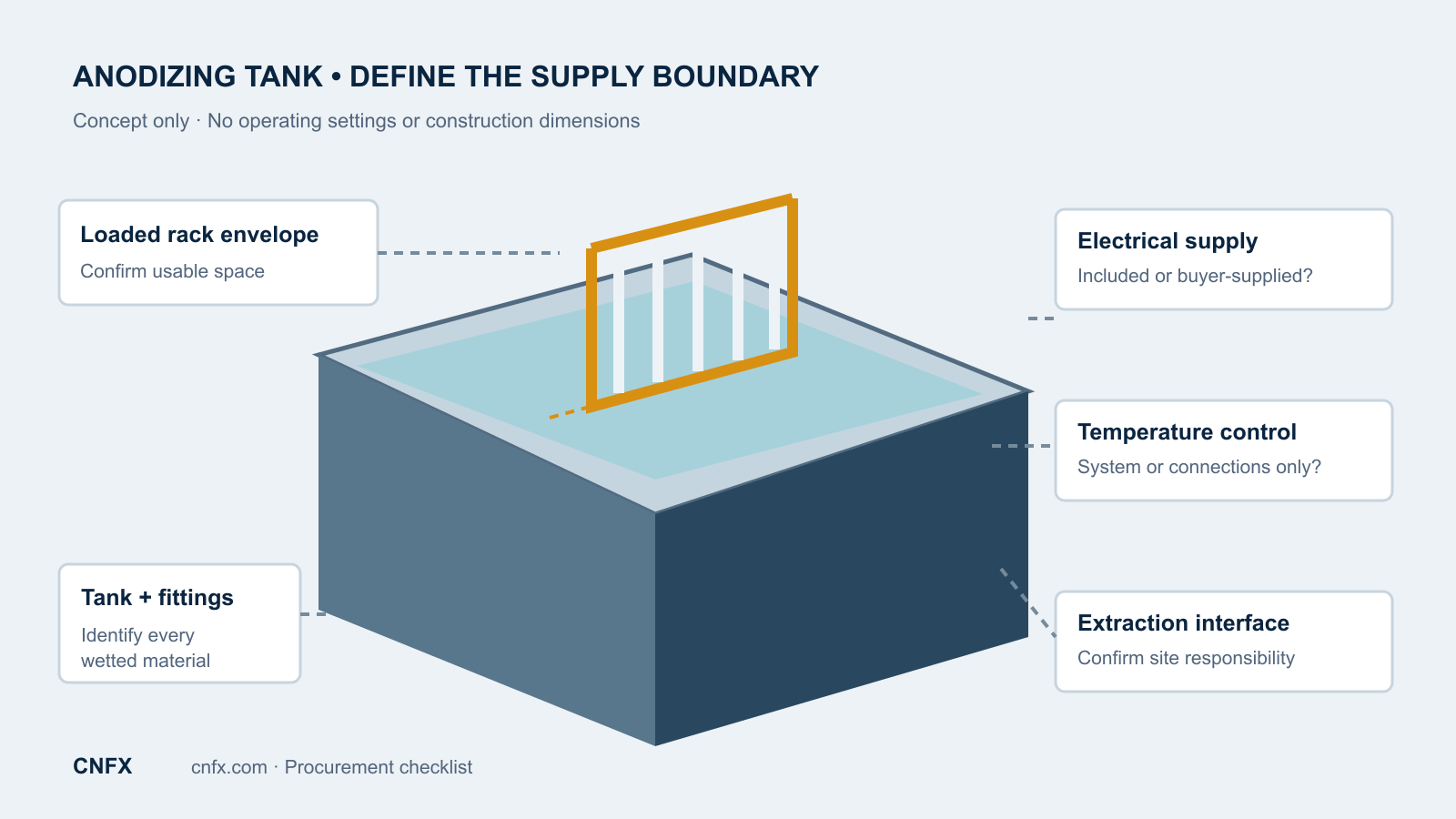
Specify the process before choosing the tank material. Give suppliers the exact bath chemistry, concentration and temperature envelope; the loaded rack dimensions; and whether you need a vessel alone, a fitted module or a complete line. Ask them to return a written material recommendation and an itemized scope against the same information.
“Acid-resistant,” “PP tank” and a nominal capacity are not enough to approve a purchase. The chemical, mechanical and installation conditions belong in the selection decision. Röchling’s tank-material guidance explicitly includes chemical composition, concentration, tank design, static stress and construction conditions.
Scope: this guide helps industrial buyers prepare and review quotations for aluminum anodizing equipment. It is not a bath recipe, electrical design, structural calculation or authorization to commission a chemical process. A qualified process engineer and the responsible site specialists must approve those items.
1. Decide what the quotation actually covers
| Purchase boundary | What to have priced explicitly | Question that prevents a gap |
|---|---|---|
| Vessel only | Tank body, support arrangement, openings, fittings and drawings. | Who supplies every connection and completes the installation? |
| Fitted tank module | Vessel plus the named rack supports, instruments and process interfaces. | Does “ready for a chiller” include the chiller, piping and controls—or only connection points? |
| Integrated line | Named stages, handling, electrical and thermal systems, extraction interfaces, controls and acceptance responsibilities. | Which utilities and environmental systems remain the buyer’s responsibility? |
This is a quotation comparison framework, not a universal equipment classification. Manufacturer offerings show why the distinction matters: Protank lists tank bodies, rack supports, electrical connections and fume-system provisions separately. A mounting provision is not evidence that the associated machine is included.
2. Compare a material specification, not just a material name
Suppliers offer thermoplastic tanks and lined or composite constructions. STEP’s equipment overview, for example, distinguishes PP, PVC, lined stainless steel and FRP options. That list identifies possible constructions; it does not establish that each one suits your bath.
| Quoted description | Ask the supplier to identify | Do not accept as proof |
|---|---|---|
| PP, PVC, HDPE or another thermoplastic | Exact grade, manufacturer, joining material, service conditions and basis for the structural design. | A generic chemical-resistance chart with no matching concentration or temperature. |
| FRP or dual-laminate construction | The liquid-contact layer, resin or liner specification, supporting structure and inspection method. | “Fiberglass” without identifying what actually contacts the bath. |
| Lined metal vessel | Liner material and attachment, seams, penetrations, inspection access and repair approach. | The metal shell grade alone, with no liner specification. |
| Valves, seals and connected pipework | Each wetted material and its suitability for the same declared service. | Approval of the tank sheet treated as approval of every accessory. |
Use this checklist to request a signed-off selection, not to choose a polymer yourself. Röchling describes chemical, thermal and mechanical demands together; a material name cannot replace the design review. Do not turn a supplier’s maximum temperature for one configuration into a general operating limit.
A cathode is not the tank wall
A search for “anodizing tank material” can return advice about the electrode inside the tank. Keep the two specifications separate. Equipment specialist Larry Chesterfield’s cathode discussion addresses electrode materials and process-dependent arrangements—not blanket approval of the same metal for an unlined vessel. Ask the electrical designer to identify cathodes, contacts, isolation and current paths on the drawing.
3. Draw the usable envelope before comparing capacity
Send the supplier a drawing of the loaded rack, not only the largest loose part. Request a returned layout showing the agreed working liquid level, rack movement, electrodes, internal equipment and maintenance access. Have the supplier distinguish the outside footprint, inside dimensions and usable processing space.
For a replacement module, add the existing lifting route and all fixed connection locations. For a new line, ask for both the tank layout and the installation layout. Mark dimensions that must match existing equipment as fixed; let the supplier identify proposed alternatives separately.
Do not use liters or gallons as a proxy for output. Ask each bidder to explain its proposed load and cycle assumptions against your product mix. STEP identifies part size, racking, temperature control and accessories as distinct equipment considerations. The procurement task is to get those assumptions onto one drawing and one quotation.
4. Send this RFQ information pack
Copy these field labels into your inquiry. Where a fact is unknown, write “to be confirmed” and name the person who will confirm it; do not fill the gap with a guessed value.
- Duty and finish: existing process specification, required finish and which stage this tank serves. State whether this replaces equipment or starts a new process.
- Bath information: chemical supplier’s documents, exact formulation or proprietary product reference, concentration envelope and approved temperature conditions. Share confidential recipes through the agreed private channel.
- Workpieces: alloy and temper, representative drawings, dimensional range, loaded-rack drawing and finish acceptance criteria.
- Production basis: product mix, expected loading pattern and required output. Request the bidder’s assumptions rather than an unexplained capacity claim.
- Site constraints: available footprint, access route, lifting interface, service access and utility information confirmed by the site team.
- Supply boundary: item-by-item responsibility for vessel, rack supports, rectifier, thermal system, circulation, instruments, extraction, pipework and controls.
- Evidence and acceptance: drawings, material identification, agreed fabrication and inspection records, test plan, documentation language and handling of deviations.
- Commercial comparison: separate prices for the base scope, options, installation, commissioning support, spares and exclusions; warranty conditions and the agreed delivery basis.
Alloy and temper are relevant inputs, not paperwork extras: the Aluminum Anodizers Council explains that they affect finished appearance even under the same process. Tank purchase alone cannot guarantee a particular finish.
5. Review quotations with a four-step hold-point check
- Normalize the scope. Put each bidder’s response beside the same eight RFQ fields. Mark every unpriced item and buyer-supplied system. Request written clarification before ranking total prices.
- Reconcile the documents. Confirm that the quotation, layout, material list and stated operating envelope refer to the same revision. Send conflicting descriptions back as questions; do not resolve them by assumption.
- Agree what must be demonstrated. Record the inspection or test, who performs it, what counts as acceptance, and the evidence to be delivered. Separate vessel workmanship checks from process-performance acceptance.
- Close deviations before release. Have the responsible buyer, supplier and engineering reviewers resolve exceptions. Installation and chemical commissioning need their own site-approved procedures; a photograph of a filled tank is not permission to operate it.
A simple comparison register works well: requirement → supplier answer → evidence reference → unresolved point → owner. Retain it with the accepted quotation so a later material or component substitution is visible.
Common buying mistakes
- Using one “acid tank” description for several process stages. Issue a separate duty sheet for each bath; do not assume cleaning, anodizing and sealing share a material decision.
- Comparing outside dimensions with working dimensions. Ask for the loaded rack and internal equipment to be shown on the same layout.
- Confusing connection points with supplied systems. List every machine and installation task as included, optional or buyer-supplied.
- Accepting an unqualified lifetime or corrosion-proof promise. Request the conditions and exclusions in writing, and the material-selection evidence behind it.
- Copying settings from another installation. Send the actual process specification for review instead; this article provides no universal bath recipe or operating setpoint.
Questions buyers ask
Is polypropylene always the best anodizing tank material?
No single material can be approved from the word “anodizing” alone. Obtain a recommendation tied to the actual chemistry, service conditions, grade and vessel design. The material and tank manufacturers should identify the limits of their recommendation.
Can one tank serve both conventional anodizing and hardcoat?
Do not assume interchangeability. Give the equipment supplier both approved duty envelopes and the changeover requirements. Ask for written confirmation covering the vessel, electrical supply, thermal system and process controls. Treat an unanswered requirement as an open engineering issue.
Is 5052 aluminum good for anodizing?
The Aluminum Anodizers Council identifies the 5xxx series as generally well suited to anodizing, while emphasizing that alloy and temper affect appearance. For a particular 5052 part, agree the finish and acceptance sample with the anodizer rather than promising a color from the alloy number alone. AAC alloy and temper guidance.
Does the tank price include the rectifier and cooling equipment?
Only if the accepted quotation says so. Ask for the supplied equipment list, model references where chosen, interfaces, installation responsibility and exclusions. Keep the tank and the connected systems visible as separate purchasing items.
Sources and editorial responsibility
Prepared by CNFX; source pages checked on 13 September 2026. This is a document-based procurement guide, not a site inspection or an engineer-reviewed design. Primary material and equipment sources are linked next to the relevant claims. The comparison tables and RFQ review sequence are CNFX’s editorial synthesis, not a published engineering standard.
Use the current project specification and the supplier’s written acceptance of your service conditions for purchase decisions. Contact CNFX to report an error in this guide.