Industry-Verified Manufacturing Data (2026)

Rectifier Power Supply

Based on aggregated insights from multiple verified factory profiles within the CNFX directory, the standard Rectifier Power Supply used in the Fabricated Metal Product Manufacturing sector typically supports operational capacities ranging from standard industrial configurations to heavy-duty production requirements.

Technical Definition & Core Assembly

A canonical Rectifier Power Supply is characterized by the integration of Main Transformer and Rectifier Stack/Bridge. In industrial production environments, manufacturers listed on CNFX commonly emphasize Silicon Steel (for transformer core) construction to support stable, high-cycle operation across diverse manufacturing scenarios.

A specialized power conversion device that converts alternating current (AC) to direct current (DC) for electrochemical processes.
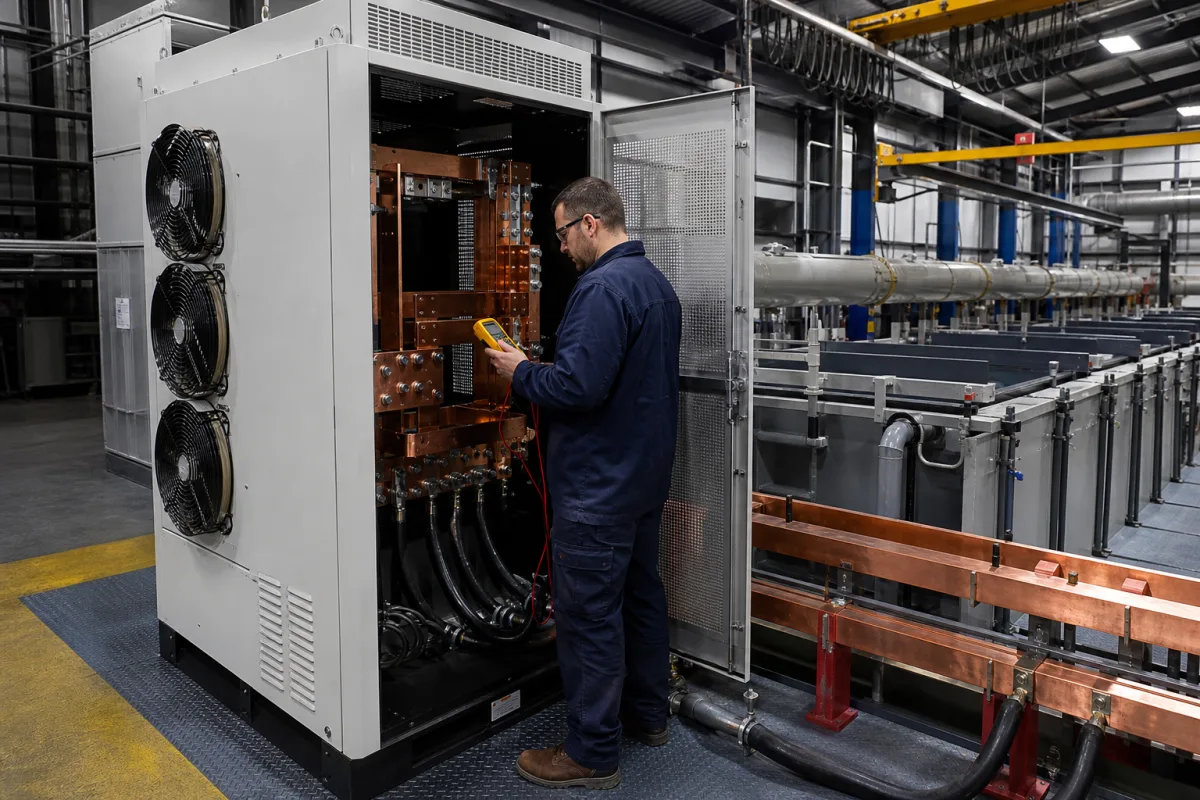
Product Specifications

Technical details and manufacturing context for Rectifier Power Supply

Definition
A critical component within an Aluminum Profile Anodizing Production Line, the rectifier power supply provides the precisely controlled direct current (DC) required for the anodizing electrolytic bath. It ensures stable voltage and current to form the protective oxide layer on aluminum surfaces.
Working Principle
The rectifier power supply receives standard AC input from the mains. It uses a transformer to adjust the voltage, then semiconductor-based rectifier circuits (such as diodes or thyristors) convert the AC to pulsating DC. Filtering circuits smooth the output, and sophisticated control systems regulate the final DC voltage and current to meet the specific requirements of the anodizing process.
Common Materials
Silicon Steel (for transformer core), Copper (for windings), Semiconductor Chips (e.g., Silicon Diodes, Thyristors), Aluminum (for heat sinks), Insulating Materials
Technical Parameters
  • Rated output power (kW), DC output voltage range (V), and DC output current range (A) are the primary specifications defining the rectifier's capacity for the anodizing line. (kW, V, A) Customizable
Components / BOM
  • Main Transformer
    Steps down or adjusts the incoming AC voltage to the required level for rectification.
    Material: Silicon Steel, Copper
  • Rectifier Stack/Bridge
    Converts the adjusted AC voltage into pulsating DC using an array of semiconductor diodes or thyristors.
    Material: Silicon Semiconductor Chips
  • Filtering Circuit (Choke & Capacitors)
    Smooths the pulsating DC output to reduce ripple, providing a stable DC current.
    Material: Ferrite Core/Steel Laminations (for choke), Aluminum/Plastic (for capacitor casing)
  • Control Panel & PCB
    Houses the control logic, user interface, and protection circuits to set and regulate output parameters (voltage, current).
    Material: FR4 (PCB substrate), Electronic Components
  • Heat Sink & Cooling System
    Dissipates heat generated by the rectifier stack and other components to maintain operational temperature.
    Material: Aluminum Alloy
Engineering Reasoning
85-265 VAC input, 0-1000 VDC output, 0-500 A continuous current
Input voltage exceeding 275 VAC for >100 ms, output current exceeding 550 A for >10 ms, junction temperature exceeding 150°C
Design Rationale: Thermal runaway in silicon carbide MOSFETs due to excessive switching losses at high current densities, dielectric breakdown in DC-link capacitors at overvoltage conditions
Risk Mitigation (FMEA)
Trigger AC line voltage transient exceeding 4000 V peak for 1 μs
Mode: Primary rectifier bridge semiconductor avalanche breakdown
Strategy: Metal oxide varistor (MOV) with 275 V clamping voltage and 40 kA surge rating in parallel with input filter
Trigger Cooling fan bearing wear increasing friction torque to 0.15 N·m
Mode: Forced convection heat sink thermal resistance increasing from 0.25 to 0.85 K/W
Strategy: Dual redundant ball-bearing fans with vibration monitoring and automatic switchover at 2.5 mm/s RMS velocity

Industry Taxonomies & Aliases

Commonly used trade names and technical identifiers for Rectifier Power Supply.

Industrial Ecosystem & Supply Chain DNA

Complementary Systems
Downstream Applications
Specialized Tooling

Application Fit & Sizing Matrix

Operational Limits
pressure: Atmospheric (non-pressurized enclosure)
other spec: Input voltage: 380-480V AC ±10%, 3-phase; Output ripple: <3% RMS; Efficiency: >92% at full load; Cooling: Forced air or liquid cooling depending on power rating
temperature: 0°C to 40°C (operating ambient), -20°C to 70°C (storage)
Media Compatibility
✓ Electroplating baths (nickel, copper, zinc) ✓ Anodizing processes (aluminum, titanium) ✓ Electrowinning cells (copper, zinc)
Unsuitable: Chlorine or hydrochloric acid electrolysis (due to corrosive off-gases)
Sizing Data Required
  • Required DC output current (kA)
  • DC output voltage range (V)
  • Process duty cycle (continuous/intermittent)

Reliability & Engineering Risk Analysis

Failure Mode & Root Cause
Diode thermal runaway
Cause: Inadequate cooling, excessive ambient temperature, or dust accumulation leading to overheating and semiconductor junction failure.
Capacitor electrolyte degradation
Cause: High operating temperatures, voltage spikes, or prolonged use causing drying, swelling, or leakage, reducing filtering efficiency and output stability.
Maintenance Indicators
  • Audible humming or buzzing from transformer or capacitors indicating loose components or arcing
  • Visible discoloration, bulging, or leakage on capacitors or heat sinks suggesting overheating or component failure
Engineering Tips
  • Implement regular thermal imaging inspections to identify hot spots early and ensure cooling systems (fans, heatsinks) are clean and functional
  • Install surge protection devices and maintain stable input voltage within specifications to prevent electrical stress on diodes and capacitors

Compliance & Manufacturing Standards

Reference Standards
ISO 9001:2015 - Quality Management Systems IEC 61000-6-2 - Electromagnetic Compatibility (EMC) for Industrial Environments UL 508 - Industrial Control Equipment Safety Standard
Manufacturing Precision
  • Output Voltage Regulation: +/- 1% of nominal voltage
  • Ripple Voltage: < 3% of DC output voltage
Quality Inspection
  • Load Regulation Test - Verifies voltage stability under varying loads
  • Dielectric Strength Test - Ensures insulation withstands high voltage without breakdown

Factories Producing Rectifier Power Supply

Verified manufacturers with capability to produce this product in China

✓ 92% Supplier Capability Match Found

P Procurement Specialist from United States Jan 27, 2026
★★★★★
"As a professional in the Fabricated Metal Product Manufacturing sector, I confirm this Rectifier Power Supply meets all ISO standards."
Technical Specifications Verified
T Technical Director from United Arab Emirates Jan 24, 2026
★★★★★
"Standard OEM quality for Fabricated Metal Product Manufacturing applications. The Rectifier Power Supply arrived with full certification."
Technical Specifications Verified
P Project Engineer from Australia Jan 21, 2026
★★★★★
"Great transparency on the Rectifier Power Supply components. Essential for our Fabricated Metal Product Manufacturing supply chain."
Technical Specifications Verified
Verification Protocol

“Feedback is collected from verified sourcing managers during RFQ (Request for Quote) and factory evaluation processes on CNFX. These reports represent historical performance data and technical audit summaries from our B2B manufacturing network.”

13 sourcing managers are analyzing this specification now. Last inquiry for Rectifier Power Supply from UAE (54m ago).

Supply Chain Compatible Machinery & Devices

Hydraulic Press Brake

Industrial machine for bending sheet metal using hydraulic force.

Explore Specs →
Sheet Metal Guillotine Shear

Industrial machine for straight-line cutting of sheet metal

Explore Specs →
Metal Plate Rolling Machine

Industrial machine for bending metal plates into cylindrical or conical shapes

Explore Specs →
Hydraulic Cylinder Piston Rod

Precision-machined rod that transmits force in hydraulic cylinders.

Explore Specs →

Frequently Asked Questions

What makes this rectifier power supply suitable for fabricated metal product manufacturing?

This rectifier is specifically designed for electrochemical processes in metal fabrication, featuring durable materials like silicon steel transformer cores and copper windings that withstand industrial environments while providing stable DC output for consistent results.

How does the cooling system ensure reliable operation in metal manufacturing applications?

The integrated heat sink and cooling system uses aluminum components to efficiently dissipate heat generated during high-current DC conversion, preventing overheating and ensuring continuous operation in demanding metal fabrication settings.

What maintenance is required for the rectifier power supply in industrial use?

Regular inspection of the rectifier stack, cleaning of heat sinks to prevent dust accumulation, and monitoring of semiconductor components are recommended. The robust construction with quality materials minimizes maintenance needs while ensuring long service life.

Can I contact factories directly on CNFX?

CNFX is an open directory, not a transaction platform. Each factory profile provides direct contact information and production details to help you initiate direct inquiries with Chinese suppliers.

Get Quote for Rectifier Power Supply

Request technical pricing, lead times, or customized specifications for Rectifier Power Supply directly from verified manufacturing units.

Your business information is encrypted and only shared with verified Rectifier Power Supply suppliers.

Thank you! Your message has been sent. We'll respond within 1–3 business days.

Need to Manufacture Rectifier Power Supply?

Connect with verified factories specializing in this product category

Add Your Factory Contact Us
Previous Product
Punch Tool
Next Product
Robotic Arm