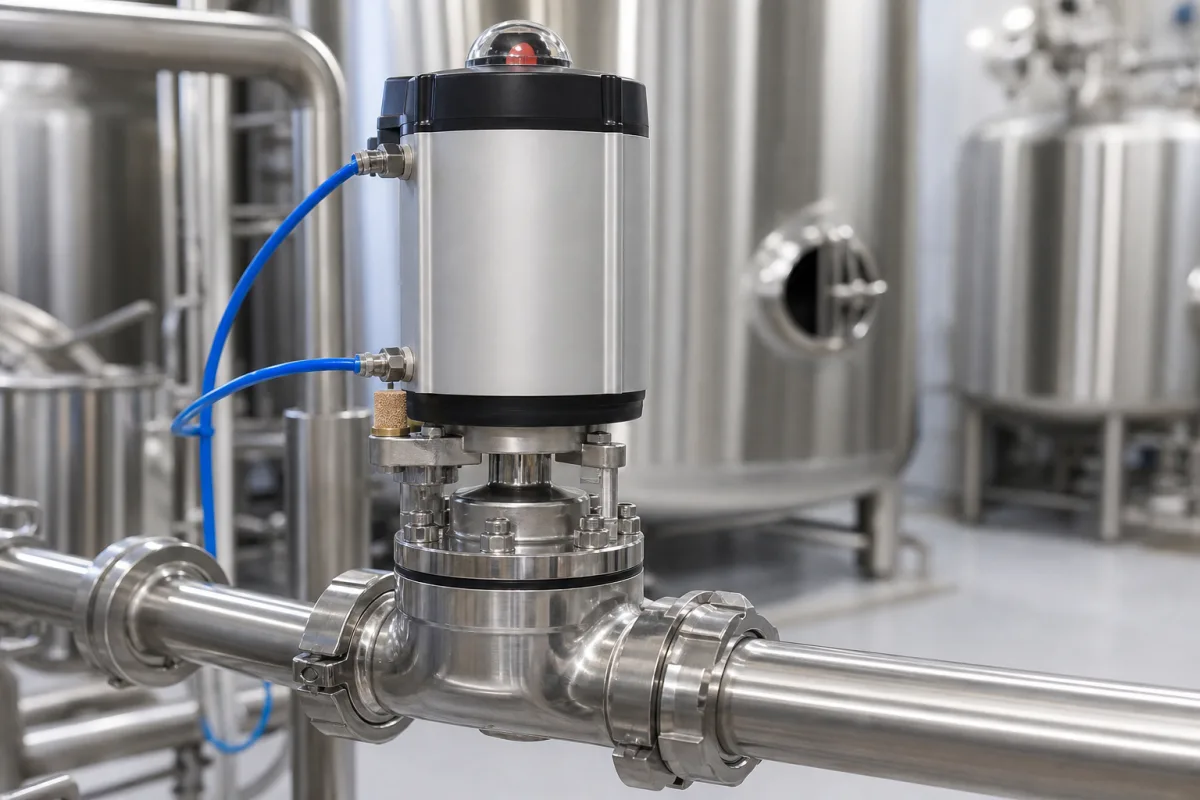
Pneumatic actuator for sanitary diaphragm valves: fail-closed, fail-open and double-acting heads
The pneumatic head on a hygienic diaphragm valve · fail-closed, fail-open or double-acting, 4–8 bar control air, the line pressure it can shut against, and how tall and heavy it is
A sanitary diaphragm valve is opened and closed by the head mounted on its bonnet: a handwheel, or in automated lines a pneumatic actuator, which drives the compressor that presses the diaphragm onto the weir. The actuator is chosen separately from the body and diaphragm. Three choices matter: the control function (spring-closed, spring-open or double-acting), the control air pressure it needs against the line pressure it must hold, and its size, weight and air connections on a crowded pipe rack.
Pneumatic actuators for hygienic (sanitary) weir-type diaphragm valves in beverage, food, dairy and pharmaceutical lines: control functions, control air pressure, the line pressure they close against, sizes, weights and accessories such as stroke limiters and position indication. Diaphragm materials, body drainability and the valve as a whole are covered on the Sanitary diaphragm valve for dairy processing page; angle-seat control valves with integrated positioners are covered on the Sanitary flow control valve page, and actuators and positioners of hygienic seat-type regulating valves on the Hygienic pneumatic regulating valve page; this page covers only the head that drives a weir-type diaphragm valve. Tank relief valves are covered on the Sanitary pressure relief valve page and clamp gaskets on the Food-grade sanitary gasket page. Industrial lined diaphragm valves are outside this page.
CNFX editorial research · Sources checked October 12, 2026 · 3 sources
Spring-closed, spring-open or double-acting, and the control air each one takes
The control function sets the valve's position when air is lost and the pressure band the actuator should be fed with.
SED warns that on NO and DA actuators a control pressure higher than required may shorten the life of the working diaphragm. [2] Saunders publishes curves of the operating air needed to open its NC actuators fully at each line pressure, separately for elastomer and PTFE diaphragms, measured at 100% pressure drop. [1]
INOXPA lists accessories on the actuator side: a stroke limiter, an external switch, a control box with switches and solenoid valves, and a controller with positioner for flow control duty. [3] Editorial note: a fail-closed actuator needs air to open and closes when air is lost, a fail-open actuator opens when air is lost, and a double-acting actuator needs air to move either way, so state the required position on air failure for every valve.
State for each valve the required position on air failure, the plant air pressure range at the valve (minimum and maximum), whether a solenoid, control top or positioner sits on the actuator, and the feedback signals needed.
02
Line pressure the closed actuator holds: 10 bar with rubber, 8 bar with PTFE, 16 bar in a stronger head
Makers state the line pressure a closed valve holds for each actuator; in these tables it is lower with PTFE than with rubber diaphragms and, for INOXPA, lower in larger sizes.
Saunders and SED both state their figures with pressure on one side of the closed weir only (100% ΔP); Saunders offers data for pressure on both sides on request. [1][2] SED notes that higher working pressure can be reached with a different actuator. [2] INOXPA's pressure table applies to EPDM; with a stainless bonnet and handle, its manually operated valves are rated 10 bar from DN 6 to DN 40 and 6 bar at DN 50, and it states the valve is not suitable for vacuum. [3]
Editorial calculation: at DN 50 the Saunders Power actuator raises the rubber-diaphragm closing rating from 10 to 16 bar, 60% more, for a weight of 8.8 kg against 6.0 kg for the Lite version, about 47% heavier.
INOXPA VeeValv, stainless pneumatic actuator, by size
8 bar (DN 6–10), 6 bar (DN 15–40), 4 bar (DN 50), as read from the datasheet table [3]
—
Give the actuator supplier the maximum line pressure on the upstream side, whether pressure can stand on both sides of the weir (for example in CIP or tank bottom valves), the diaphragm material, and the available air pressure.
03
Actuator height, weight, air ports and diaphragm sizes on a crowded valve rack
Automated heads are much taller and heavier than handwheels, which matters for valve blocks, tank bottoms and pipe spacing.
Editorial calculation: on INOXPA's largest size (Nº4, 2 in), the pneumatic actuator stands 127 mm taller than the handle version (287 − 160 mm). Saunders' DN 100 Lite actuator weighs 13 times its DN 25 actuator (33.5 ÷ 2.6).
Item
Published value
Saunders S360 Lite NC weight
0.5 kg (DN 8), 2.6 kg (DN 25), 6.0 kg (DN 50), 33.5 kg (DN 100) [1]
Saunders air ports
1/8 G or BSP for DN 8–50; 1/4 G or BSP for DN 65–100 [1]
INOXPA VeeValv height B, stainless pneumatic actuator vs handle
Nº1 111 vs 68 mm; Nº2 143 vs 105 mm; Nº3 211 vs 134 mm; Nº4 287 vs 160 mm [3]
SED KMA 395 diaphragm sizes
MA 25 for DN 15–25, MA 40 for DN 32–40, MA 50 for DN 50 [2]
Temperature
SED: max. working temperature 160 °C depending on application; INOXPA stainless actuator with EPDM −20 to +90 °C, 140 °C SIP for max. 30 min [2][3]
Check head clearance above each valve, the support of heavy actuators on thin-wall tube, the air-port size and tubing, and whether a stroke limiter or control top adds further height.
04
Data for a sanitary diaphragm valve actuator
Paste it into your enquiry below or into an email to a maker, then replace every bracket.
Valve: [make and body; DN; diaphragm size; diaphragm material (EPDM, PTFE)]
Control function: [NC, NO or double-acting; position on air loss]
Pressure: [maximum line pressure; one or both sides of weir]
Air: [plant air pressure range; port size]
Accessories: [stroke limiter; position indication; control top; solenoid; positioner]
Environment: [CIP/SIP temperature and duration; washdown]
Space: [height limit; valve spacing]
Explore company information and manufacturing capabilities, then discuss the scope of your project with a relevant supplier.
Share this page
Compiled and source-reviewed by the CNFX editorial team.
Each manufacturer above links to the page on that company's own website where the product is listed, with the date we checked it. How we source and review
· Page last updated 13 October 2026
Buyer questions
What air pressure does a sanitary diaphragm valve actuator need?
SED gives 4.5–7 bar for fail-closed and 4–5 bar for fail-open or double-acting KMA 395 actuators; INOXPA specifies 6–8 bar compressed air for VeeValv. [2][3]
How much line pressure can a pneumatic diaphragm valve close against?
Saunders rates its S360 Lite NC actuators at 10 bar with rubber and 8 bar with PTFE diaphragms from DN 15 to 100, and the S360 Power at 16 bar from DN 15 to 50, with pressure on one side of the weir. [1]
Can a higher control pressure damage the diaphragm?
SED warns that on fail-open and double-acting actuators, more control pressure than required may shorten the working diaphragm's life. [2]
Sources and what still needs a direct check
Sources checked 2026-10-12. Crane (Saunders), SED Flow Control and INOXPA publish data for their own actuators and valves; figures apply to the models named.