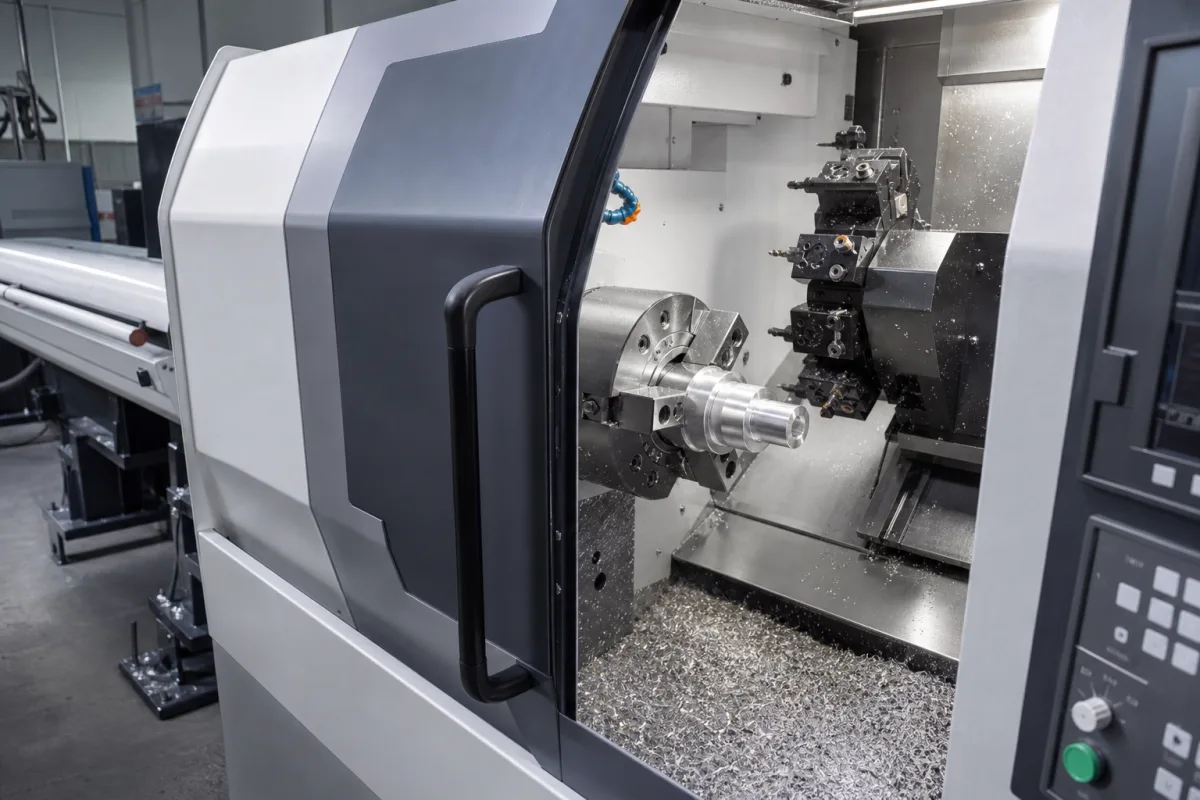
Bar-fed CNC turning centre for aluminium parts: spindle speed for PCD and carbide tools, bar feeder and spindle liners
Turning centres set up for aluminium bar work · PCD cutting speeds up to 1,500 m/min and the spindle rpm that implies, carbide speeds against built-up edge, bar feeders taking 8–100 mm bar with liners within 5 mm
An aluminium CNC turning centre is a CNC lathe with a turret, on this page fed with bar stock, set up so that aluminium parts are turned at the very high cutting speeds the material allows. The machine's limit is then less its swing than its spindle speed on small bar diameters, the tooling that keeps aluminium from welding to the edge, and how bars are fed and supported through the spindle. Start from the alloy and the bar sizes, convert the cutting speed you need into spindle rpm, and size the bar feeder and liners to the spindle bore.
CNC turning centres used for aluminium bar and billet parts, with high-speed spindles, turrets, bar feeders and spindle liners, and the cutting-speed and tooling data that set their spindle and feed requirements. Sizing a CNC lathe from the part, chuck clamping force and turning envelope is covered on the Universal CNC lathe page; flat-bed economy CNC lathes with four-position tool posts are covered on the Economic CNC lathe page. Milling aluminium parts on BT30 high-speed vertical machining centres is covered on the Aluminum CNC milling machine page; this page is about turning bar stock on a lathe spindle. Swiss-type sliding-head lathes and machining services are outside this page.
CNFX editorial research · Sources checked October 12, 2026 · 3 sources
PCD and carbide cutting speeds on aluminium, converted to spindle rpm for small bars
Mitsubishi Materials' PCD grade MD220 data show how far cutting speed on aluminium falls as silicon content rises; on small diameters the conversion of those speeds to rpm decides which spindle is fast enough.
Editorial calculation: spindle speed n = 1,000 × v / (π × d). At 800 m/min, a 20 mm bar needs about 12,700 rpm and a 50 mm bar about 5,100 rpm; at 1,000 m/min the figures are about 15,900 rpm and 6,400 rpm; at 200 m/min, the bottom of the PCD range, a 20 mm bar needs about 3,200 rpm. Compare these with the spindle's maximum speed and with the speed the chuck is rated for at your clamping force.
Mitsubishi notes that MD220 is not suitable for steel, and shows chip-breaker inserts with the breaker formed on the PCD tip giving controlled chips in dry cutting of an aluminium alloy at 340 m/min, 0.1 mm/rev and 0.1 mm depth of cut. [1]
With carbide, a 2023 study turning a cast Al-12Si-0.1Sr alloy at 200, 300 and 400 m/min and 0.05–0.15 mm/rev found built-up edge and built-up layer on both uncoated and TiAlN-coated carbide inserts; both decreased with higher cutting speed and higher feed, while cutting force and surface roughness fell with speed and rose with feed. Uncoated inserts gave lower cutting force, roughness, built-up edge and built-up layer than the TiAlN-coated ones. [2]
Give the machine supplier the alloy (and its silicon content), the smallest and largest bar or part diameters, the cutting speed and tool material you plan to use, and the finish required; ask for the spindle's maximum rpm, its power and torque at that speed, and the chuck's speed rating.
02
Bar sizes, 1,600 mm bar length and spindle liners no more than 5 mm over the bar
On a bar-fed aluminium cell the bar feeder sets the bar sizes and lengths, and the liner in the lathe spindle keeps a thin bar from whipping at speed.
Editorial calculation: for a 20 mm aluminium bar the liner bore would be at most 25 mm under the MAGIC guidance; with the optional bushing, a lathe with a 1,100 mm spindle length could take bars up to 1,600 mm, the feeder's limit.
200–1,600 mm; maximum workable length equals the lathe spindle length [3]
A longer headstock lets longer bars run.
Spindle extension
Optional bushing system adds 500 mm to the spindle length [3]
Supports bars that would protrude from the back of the spindle.
Spindle liner
Internal diameter not more than 5 mm larger than the bar; fixed by a flange bolted to the rear of the lathe [3]
One liner per bar size; the rear of the spindle needs a mounting face.
Feed and changeover
Feed speed up to 80 m/min; diameter change in 60 s by entering the new diameter [3]
—
Service access
Rails allow 800 mm radial or axial displacement of the feeder [3]
Leave floor space behind or beside the headstock.
Send the bar feeder supplier the lathe model, spindle bore and spindle length, chuck or collet type, the bar shapes, diameters and lengths you will run, and the maximum spindle rpm, so liners and channels can be matched.
03
Data for an aluminium turning centre and bar feeder
Paste it into your enquiry below or into an email to a maker, then replace every bracket.
Parts: [alloy and Si content; diameters; lengths; tolerances; finish]
Cutting: [tool material (PCD or carbide); planned cutting speed; coolant]
Spindle: [maximum rpm; power and torque at speed; bore]
Workholding: [chuck or collet; speed rating]
Bar feed: [round, hex or square sizes; bar length; liners per size]
Chips: [chip conveyor and coolant filtration for aluminium]
Output: [cycle time; unattended hours]
Explore company information and manufacturing capabilities, then discuss the scope of your project with a relevant supplier.
Share this page
Compiled and source-reviewed by the CNFX editorial team.
Each manufacturer above links to the page on that company's own website where the product is listed, with the date we checked it. How we source and review
· Page last updated 13 October 2026
Buyer questions
What cutting speed is used for turning aluminium with PCD?
Mitsubishi recommends 1,000 m/min for aluminium and 800 m/min for alloys with up to 16% Si with its MD220 PCD grade, falling to 600 m/min above 16% Si. [1]
Does cutting speed affect built-up edge on aluminium?
In a 2023 study on Al-12Si-0.1Sr at 200–400 m/min, built-up edge decreased with higher cutting speed, and uncoated carbide showed less than TiAlN-coated carbide. [2]
How big should a spindle liner be for bar feeding?
Top Automazioni advises a liner bore no more than 5 mm larger than the bar for its MAGIC bar feeder. [3]
Sources and what still needs a direct check
Sources checked 2026-10-12. Mitsubishi Materials gives cutting data for its own PCD grade; Top Automazioni describes its own bar feeder; the Al-12Si-0.1Sr figures come from a peer-reviewed study abstract.