Editorial Technical Reference

CNC Controller

This page explains how CNC Controller is classified within Machinery and Equipment Manufacturing. Technical values and manufacturer relationships are research references; confirm the current specification and supplier evidence for each order.

Technical Definition & Core Assembly

A specialized computer system that interprets G-code programming to command and coordinate the motion of machine tool axes and auxiliary functions in CNC machinery.

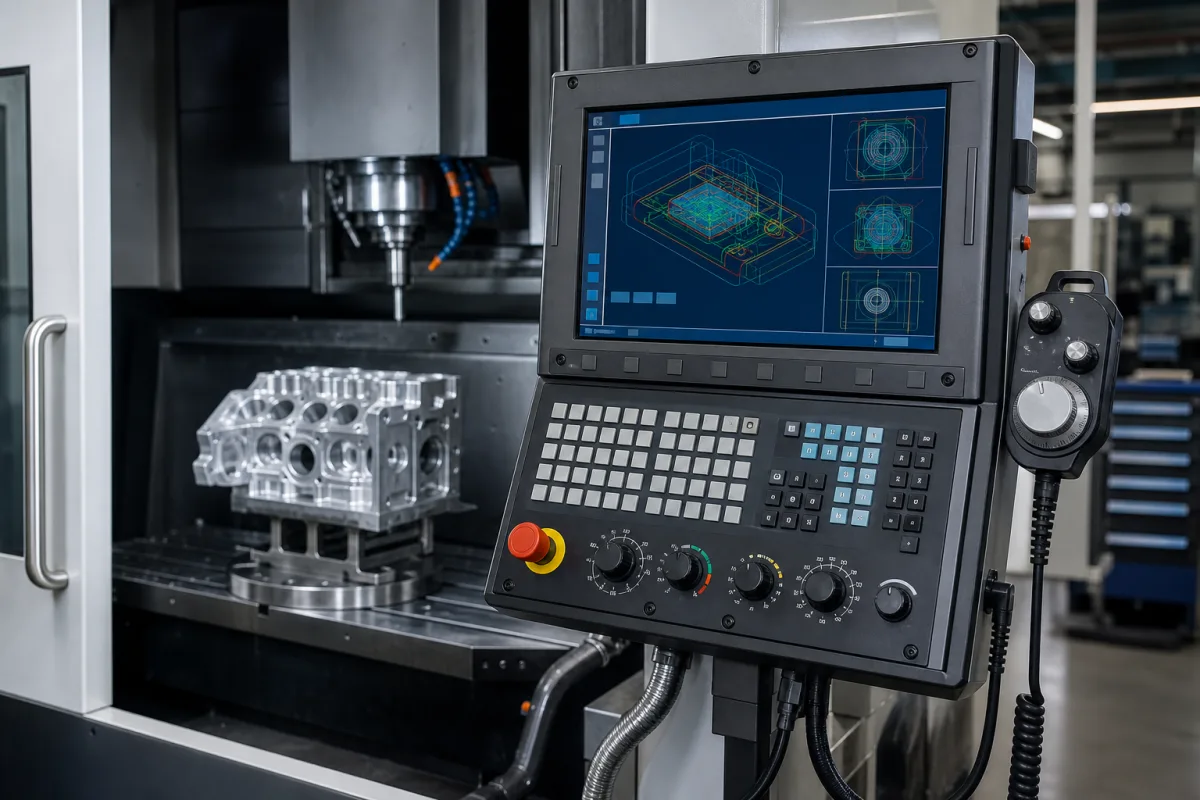
Representative product image. Confirm appearance and specifications with the manufacturer.

Product Specifications

Technical details and manufacturing context for CNC Controller

Definition
Within an industrial system, the CNC Controller serves as the central processing unit that executes machining programs, precisely controlling servo motors, spindle speed, tool changes, coolant flow, and other machine functions to transform raw materials into finished components according to programmed specifications. It is a component used in machinery and equipment manufacturing, typically housed in an aluminum enclosure with a heat sink and a printed circuit board. The controller manages multiple axes (typically 3 to 5) and supports simultaneous interpolation for complex machining operations. It offers a maximum spindle speed ranging from 8000 to 15000 rpm, rapid traverse rates of 20 to 60 m/min, and positioning accuracy of ±0.005 to ±0.02 mm (with repeatability of ±0.002 to ±0.01 mm) as per ISO 230-2. Control resolution can be as fine as 0.001 to 0.0001 mm. The processor speed ranges from 1 to 4 GHz, and memory capacity is 512 MB to 4 GB. The display size is 8.4 to 15 inches, and communication interfaces include Ethernet, USB, RS-232, and RS-485 (per IEC 61158). It provides 24 to 128 I/O points, operates on 24 V DC ±10% (per IEC 61131-2), and functions in ambient temperatures of 0 to 55°C. Protection rating is IP54 to IP65 (per IEC 60529), and cooling is via natural convection or forced air. Housing material is aluminum alloy (e.g., 6061-T6), PCB is FR-4 (glass epoxy), and heat sink is aluminum 6063-T5. Weight ranges from 5 to 15 kg, MTBF is 20000 to 50000 hours (per IEC 61709), and backup battery life is 5 to 10 years. Environmental limits include relative humidity of 10 to 90% non-condensing, vibration ≤0.5 g (10-500 Hz), shock ≤15 g (11 ms), and EMI/RFI compliance with IEC 61000-6-2. Always verify model-specific values and standards with the legal manufacturer or supplier.
Working Principle
The CNC Controller physically operates by receiving digital G-code instructions, processing them through its microprocessor, and generating electrical signals. These signals are sent to servo drives and amplifiers that power servo motors, which physically move machine axes (X, Y, Z) and control spindle rotation. Feedback devices like encoders provide real-time position data back to the controller, creating a closed-loop system for precise motion control. The controller also manages auxiliary functions such as tool changers and coolant flow, coordinating all actions to execute the machining program accurately.
Common Materials
Printed Circuit Board (PCB), Aluminum Housing, Heat Sink
Technical Parameters
ParameterTypical rangeNotes & selection driver
Number of Controlled Axes3–5 axes3–5 — Simultaneous interpolation for 3-axis to 5-axis machining centers.
Maximum Spindle Speed8000–15000 rpm8000–15000 — Depends on spindle motor and drive capability.
Rapid Traverse Rate20–60 m/min20–60 — For linear axes; higher for high-speed machining.
Positioning Accuracy±0.005–±0.02 mm±0.005–±0.02 — Typical for standard CNC; high-precision may be ±0.002 mm.ISO 230-2
Repeatability±0.002–±0.01 mm±0.002–±0.01 — Consistency of positioning over repeated cycles.ISO 230-2
Control Resolution0.001–0.0001 mm0.001–0.0001 — Minimum programmable increment; 0.0001 mm for ultra-precision.
Processor Speed1–4 GHz1–4 — Higher speed for complex contouring and high-speed machining.
Memory Capacity512 MB – 4 GB512 MB – 4 GB — For part programs and tool data; expandable via USB/network.
Display Size8.4–15 inch8.4–15 — LCD or TFT; touchscreen optional.
Communication InterfacesEthernet, USB, RS-232, RS-485Ethernet, USB, RS-232, RS-485 — For networking, data transfer, and peripheral devices.IEC 61158
Input/Output (I/O) Points24–128 points24–128 — Digital inputs/outputs for limit switches, solenoids, etc.
Power Supply24 V DC ±10% V24 V DC ±10% — Typical for industrial controllers; some may accept 110/220 V AC.IEC 61131-2
Operating Temperature0–55 °C0–55 — Ambient temperature; derating above 45°C.IEC 61131-2
Storage Temperature-20–70 °C-20–70 — Non-operating condition.IEC 61131-2
Protection RatingIP54–IP65IP54–IP65 — IP54 for dry areas, IP65 for washdown environments.IEC 60529
Cooling MethodNatural convection or forced airNatural convection or forced air — Heat sink and fan for high-power models.
Housing MaterialAluminum alloy (e.g., 6061-T6)Aluminum alloy (e.g., 6061-T6) — Provides EMI shielding and heat dissipation.ASTM B221
PCB MaterialFR-4 (glass epoxy)FR-4 (glass epoxy) — High Tg (170°C) for reliability.IPC-4101
Heat Sink MaterialAluminum 6063-T5Aluminum 6063-T5 — Extruded aluminum for thermal management.ASTM B221
Weight5–15 kg5–15 — Depends on configuration and options.
MTBF (Mean Time Between Failures)20000–50000 hours20000–50000 — Reliability indicator; higher is better.IEC 61709
Backup Battery Life5–10 years5–10 — For SRAM memory retention when power off.
Ambient temperature0–55 °C0–55 °C — Outside this window: Above 55°C may cause overheating and thermal shutdown; below 0°C may cause LCD display issues and brittle solder joints.
Relative humidity10–90% non-condensing10–90% non-condensing — Outside this window: Above 90% may cause condensation and short circuits; below 10% may cause static discharge damage.
Supply voltage24 V DC ±10%24 V DC ±10% — Outside this window: Voltage outside ±10% may cause erratic operation or damage to internal power supply.
Vibration≤0.5 g (10–500 Hz)≤0.5 g (10–500 Hz) — Outside this window: Excessive vibration may loosen connections and cause intermittent faults.
Shock≤15 g (11 ms)≤15 g (11 ms) — Outside this window: Severe shock may damage PCB and solder joints.
EMI/RFICompliant with IEC 61000-6-2Compliant with IEC 61000-6-2 — Outside this window: High electromagnetic interference may cause false signals and control errors.

Ranges are indicative industry figures for RFQ preparation, not a supplier commitment. Confirm every value and standard with the legal manufacturer before ordering.

Components / BOM
  • Central Processing Unit
    Executes G-code programs and performs mathematical calculations for motion control
    Material: Silicon semiconductor with heat spreader
  • Power Supply Unit
    Provides regulated DC power to all electronic components
    Material: Steel enclosure with transformers and regulators
  • Motion Control Card
    Generates precise pulse signals for servo motor positioning and velocity control
    Material: Multi-layer PCB with integrated circuits
  • Input/Output Module
    Handles communication with machine peripherals (limit switches, sensors, relays)
    Material: PCB with optocouplers and connectors
  • Operator Interface Panel
    Provides human-machine interface for program input, editing, and machine monitoring
    Material: Plastic housing with LCD display and membrane keys

Industry Taxonomies & Aliases

Commonly used trade names and technical identifiers for CNC Controller.

Applied To / Applications

This component is essential for the following industrial systems and equipment:

Industrial Ecosystem & Supply Chain Structure

Complementary Systems
Downstream Applications
Specialized Tooling

Application Fit & Sizing Matrix

What Decides the Award
  • What is the maximum number of axes and interpolation capability required for your machining processes?
  • What positioning accuracy and repeatability do you need for your parts?
  • What communication interfaces are necessary to integrate with your existing machines and network?
  • What is the expected ambient environment (temperature, humidity, dust, washdown) and required IP rating?
  • What is your budget and acceptable MTBF for the controller?
  • Does the controller support the specific G-code dialects and CAM post-processors you use?
  • What is the lead time and availability of technical support and spare parts?
Failure Modes & Inspection
  • Power supply failure
    Check: Measure input voltage and ripple; check for burnt components; perform thermal imaging.
  • Processor or memory error
    Check: Run self-diagnostic tests; check error logs; verify firmware version and checksum.
  • I/O module malfunction
    Check: Test each I/O point with a multimeter; check for blown fuses; inspect wiring for damage.
  • Display failure
    Check: Visual inspection; check backlight voltage; test with known-good display.
  • Communication failure
    Check: Check link status; use loopback test; verify IP settings; replace cable or connector.

Reliability & Engineering Risk Analysis

Failure Mode & Root Cause
Overheating of power supply or processor
Cause: Inadequate cooling due to dust accumulation, blocked ventilation, or failing fans; excessive ambient temperature; or continuous high-load operation without proper thermal management.
Corrosion or electrical short circuits
Cause: Exposure to coolant, oil, or moisture ingress; poor sealing of enclosures; or contamination from metal chips or conductive debris leading to compromised electrical connections or component failure.
Maintenance Indicators
  • Unusual audible alarms or beeping from the controller, indicating fault codes or system errors.
  • Visible smoke, burning smell, or discoloration around the controller housing or components, suggesting overheating or electrical issues.
Engineering Tips
  • Implement regular preventive maintenance: clean air filters and ventilation paths quarterly, inspect seals for integrity, and monitor ambient conditions to prevent overheating and contamination.
  • Use surge protectors and ensure stable power supply with proper grounding to protect sensitive electronics from voltage spikes and electrical noise, reducing wear on components.

Indicative industry ranges for design and RFQ preparation. Confirm the exact figures and applicable standard with the manufacturer before specifying.

Compliance & Manufacturing Standards

Applicable Standards
IEC 61131-2:2017 — Industrial-process measurement and control, Programmable controllers, Part 2: Equipment requirements and tests (24 V DC supply, environmental and EMC requirements) IEC 61000-6-2:2016 — Electromagnetic compatibility (EMC), Part 6-2: Generic standards, Immunity standard for industrial environments IEC 60529:2013 — Degrees of protection provided by enclosures (IP Code) (IP54 to IP65) ISO 230-1:2012 — Test code for machine tools, Part 1: Geometric accuracy of machines operating under no-load or quasi-static conditions CE Marking (EU Machinery Directive 2006/42/EC)

Quoted from the published standard.

Manufacturing Precision
  • Positioning Accuracy: +/-0.005 to +/-0.02 mm
  • Repeatability: +/-0.002 to +/-0.01 mm
Quality Inspection
  • Performance Test (ISO 230-2:2014 for verification of positioning accuracy)
  • EMC Test (Electromagnetic Compatibility per IEC 61326-1 for industrial environments)

Manufacturers of CNC Controller

2 companies list this product among what they make. Company figures are quoted from each company's own website; every card states where the relationship came from.

HuazhongCNC
Hubei, CN
Listed on the company's own website · profile compiled by CNFX from public sources
TechPro
Jinan, Shandong, CN
Listed on the company's own website · profile compiled by CNFX from public sources

Manufacturer listings support early research and capability understanding. They are not certification, ranking, or transaction guarantees.

Technical documentation
Request current drawings, revision history, and a signed specification sheet.
Manufacturing capability
Verify equipment lists, process limits, capacity, and representative production evidence.
Inspection readiness
Confirm test methods, calibrated equipment, sampling plans, and traceable reports.
Supplier transparency
Check the legal entity, factory address, ownership, certifications, and direct contacts.

CNFX does not score or rank suppliers. Buyers must verify all claims and documents with the legal manufacturer before ordering.

Supply Chain Commonly Integrated Components

Cleaning-in-Place (CIP) System

An automated cleaning system that cleans processing equipment without disassembly, using spray nozzles, pumps, and cleaning solutions to remove residues and contaminants.

Explore Specs →
Vacuum System

A vacuum system that creates and maintains a controlled low-pressure environment for lyophilization by removing air and moisture from the chamber.

Explore Specs →
Refrigeration System

A refrigeration system that provides controlled cooling to maintain low temperatures required for the lyophilization process in pharmaceutical manufacturing.

Explore Specs →
Human-Machine Interface (HMI)

A hardware and software interface that allows human operators to monitor, control, and interact with the automated beverage blending system.

Explore Specs →

Frequently Asked Questions

What is the role of a CNC controller in a machine tool?

The CNC controller is the central processing unit that interprets G-code programs and coordinates the motion of machine axes and auxiliary functions, such as spindle speed, tool changes, and coolant flow, to produce machined parts.

What are the typical communication interfaces on a CNC controller?

Typical interfaces include Ethernet, USB, RS-232, and RS-485, which are used for networking, data transfer, and connecting peripheral devices. These are referenced in IEC 61158.

How does a CNC controller achieve precise positioning?

It uses a closed-loop system with feedback devices like encoders that provide real-time position data to the controller, allowing it to correct any deviations and maintain the specified positioning accuracy and repeatability.

What environmental conditions can a CNC controller operate in?

Typically, it operates in ambient temperatures of 0 to 55°C, with relative humidity of 10 to 90% non-condensing. It also has protection ratings of IP54 to IP65, depending on the model. Always check the manufacturer's specifications.

Data Basis

Editorial classification, named public sources where available, and source-reviewed manufacturer records.

Preliminary Technical Classification
This page supports structured research, RFQ preparation, and supplier evaluation. It does not replace buyer-led supplier qualification, standards review, or technical approval.
Buyer enquiry

Request manufacturing insight for CNC Controller

Ask for use case, specification boundaries, supplier type, and RFQ preparation information for this product.

Where it goes
Straight to the CNFX editorial desk, and to the manufacturer if this product is linked to a claimed profile. Nothing is broadcast to a supplier list.
Your details stay here
We do not sell or rent enquiry data, and we do not add you to a mailing list. Used only to answer this request.
No commission, no middleman
CNFX is a directory. We take no cut of any order and never negotiate on a supplier's behalf.
What we don't claim
A listing is not an endorsement. Qualify every supplier and verify every figure yourself before ordering.

Your business information is used only to process this request.

Thank you! Your message has been sent. We'll respond within 1–3 business days.
Sorry, we couldn't send your message. Please try again, or email us at contact@cnfx.com.

Need to Manufacture CNC Controller?

Compare manufacturer profiles with relevant product and process capability.

Previous Product
CNC Control Unit
Next Product
CNC Machining Centers
Get QuotesChat