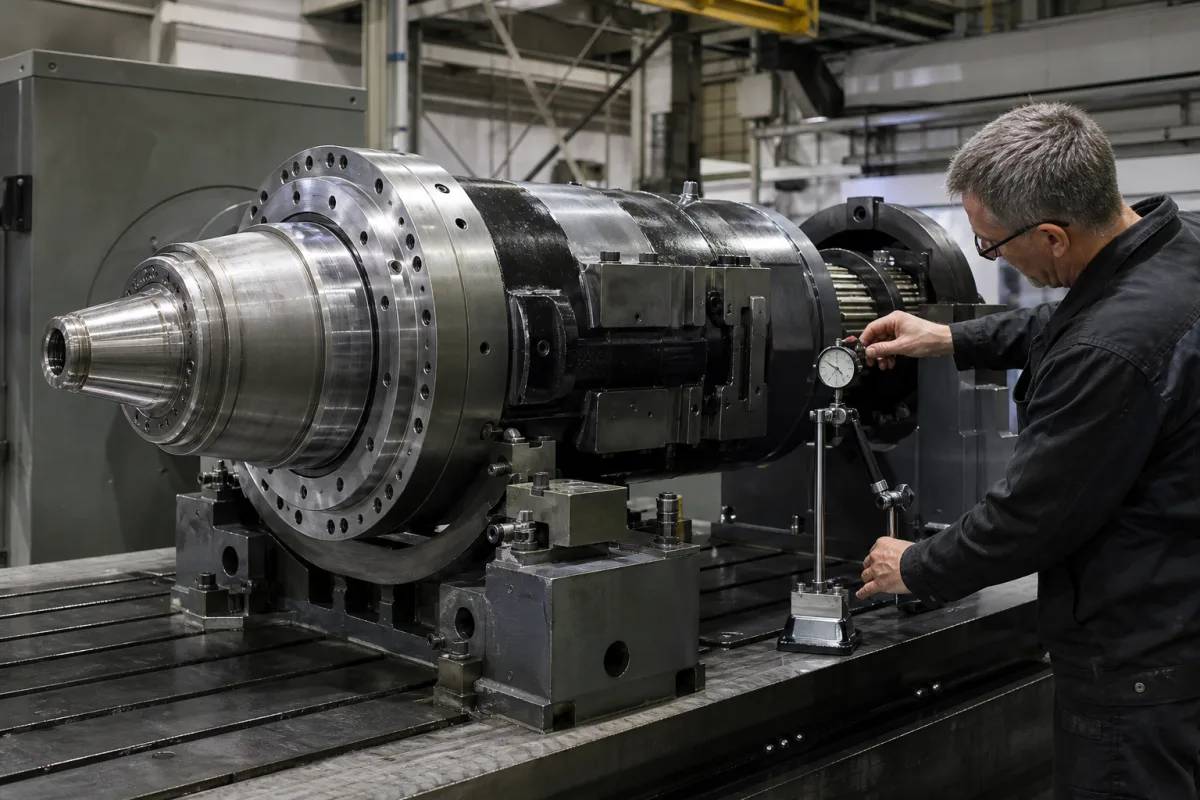
Main spindle unit with external belt or gear drive
Machine-tool main spindles · belt or gear drive, taper and test-bar runout, bearing class and lubrication
A main spindle unit is the precision shaft, bearing set and housing that carries the tool or workpiece in a machine tool, receiving its power from a separate motor through a belt, pulley or gear train. Ask three things first: how the spindle will be driven and at what speed, what runout it is accepted to and where that runout is measured, and which bearing class and lubrication it uses.
Externally driven main spindle units and spindle cartridges (belt-, pulley- or gear-driven) for milling, boring, turning and grinding machines, supplied with the shaft, bearings, housing and tool or workpiece interface. Motorized spindles with a built-in motor for CNC routers, engravers and light machining are covered on the Spindle motor page. Complete machine tools and loose bearings sold alone are outside this page.
CNFX editorial research · Sources checked October 12, 2026 · 6 sources
GMN separates its customer-specific workpiece spindles into two series: the WSE series with an integrated asynchronous or synchronous motor, rated up to S1 350 kW and 1,750 Nm, and the WS series designed for an external drive, where the motor sits outside the spindle and the housing, tool interface and lubrication are set to the customer's specification. [2]
Solpower's BT40 belt-drive spindle is an example of the external-drive type sold as a cartridge: a 120 mm outer diameter housing listed at 10,000 rpm or 12,000 rpm, mounted vertically, with a proximity switch for clamp position and a weight of about 38 kg. [1] Because the motor is outside the spindle, the drive pulley or gear, the belt or gear ratio and the motor are separate items in the quotation.
Luoyang Songju lists belt-driven types among its internal grinding spindles, alongside high-frequency and synchronous-motor types, across a range it states as 6,000 to 120,000 rpm. [5] Editorial note: when a supplier offers both belt-driven and motorized versions, ask which one the quoted speed, power and runout figures refer to.
Give the supplier the machine type, spindle orientation, drive (belt, gear or direct coupling), motor power and speed, ratio, maximum spindle speed, tool or workpiece interface, required runout and where it is measured, bearing class, lubrication and cooling.
02
Read runout at the taper and on a test bar
Solpower publishes three runout figures for its BT40 belt-drive spindle rather than one: 0.002 mm at the taper, 0.003 mm at the root of the test bar, and 0.008 mm on a 300 mm test bar, with the rotor balanced to grade G1 under ISO 1940. [1]
The listed figures rise as the measuring point moves out along the test bar, so a single runout number on a quotation needs its measuring point stated. Editorial calculation: from the root of the test bar to 300 mm out, Solpower's listed runout rises from 0.003 mm to 0.008 mm, an increase of 0.005 mm. [1]
Luoyang Songju states that its grinding spindles use P4/P2 grade bearings and G0.4 balanced rotors to reach sub-micron runout. [5] Editorial note: ask for the runout test record of the spindle actually supplied, with the test-bar length and the speed at which it was measured, and check it again with a dial indicator after the spindle is mounted in the machine.
03
Match the bearing class and lubrication to the speed
GMN manufactures its spindle ball bearings in precision classes P4/ABEC7 and P2/ABEC9, plus its own tighter HG and UP classes. It reports that hybrid bearings, with steel rings and silicon nitride (Si3N4) balls, reach more than twice the life of all-steel bearings and allow speed increases of up to 30%. [3]
Solpower's BT40 cartridge uses angular-contact bearings listed as 7012 x 2 and 7012 x 4 with steel balls, position preload, grease lubrication and a bearing temperature held under +18 °C; it states a spindle cooling demand of 1,000 kcal/h. [1] Editorial calculation: 1,000 kcal/h × 1.163 W per kcal/h ≈ 1.16 kW of heat to be removed by the cooling unit.
GMN describes grease lubrication as maintenance-free for the bearing life and oil-air lubrication as targeted lubrication for very high speeds, with sealing air from the ring gap between shaft and housing keeping grinding residue and liquids out. [4] Luoyang Songju lists P4/P2 precision bearings, which it equates with ABEC-7 and ABEC-9, for bores from 10 mm to 500 mm. [6]
04
Drive type, bearing class, runout and balance records to request with a quote
Ask each supplier whether the spindle is belt-driven, gear-driven or motorized, which bearing class and arrangement it uses, and to send the runout and balance records for the unit quoted.
05
Shaft, bearings, taper and drawbar, drive pulley, housing, lubrication and cooling
Part
Role
Fix in the order
Spindle shaft
Carries the tool or workpiece; runout is measured on it. [1]
Taper, speed, runout positions, bearing class and cooling load for a belt- or gear-driven spindle
Power and torque at the nose of an externally driven spindle come from the motor and drive ratio, so give the motor data along with the cutting requirement.
Field
What it means and published values
Ask the supplier for
Spindle Taper
Tool interface; example BT40 with 700±50 kgf clamping force. [1]
Taper, clamping force, pull stud.
Max Speed (rpm)
Example 10,000 or 12,000 rpm for a 120 mm BT40 belt-drive unit. [1]
Speed limit for the lubrication used.
Power (kW)
Comes from the external motor and drive ratio.
Motor power and ratio.
Torque (N·m)
Motor torque times ratio, less drive losses.
Torque curve at the spindle.
Runout (TIR) (mm)
Example 0.002 mm at taper, 0.008 mm on a 300 mm bar. [1]
Send the drive, accuracy and bearing data together
Paste it into your enquiry below or into an email to a maker, then replace every bracket.
Machine: [type; spindle orientation; tool or workpiece]
Drive: [belt, gear or coupling; motor power; ratio]
Speed: [maximum rpm; working range]
Interface: [taper or spindle nose; clamping force]
Accuracy: [runout at taper; on test bar of stated length; balance grade]
Bearings: [class; arrangement; steel or hybrid; preload]
Lubrication and cooling: [grease or oil-air; heat load; coolant]
Documents: [runout and balance records]
1 company lists this product among what they make. Company figures are quoted from each
company's own website; every card states where the relationship came from.
Luoyang Songju Science and Technology Co., Ltd.
Manufacturing site to be confirmed for the order
Lists external and internal grinding spindles, including belt-driven types, and P4/P2 precision spindle bearings.
Explore company information and manufacturing capabilities, then discuss the scope of your project with a relevant supplier.
Share this page
Compiled and source-reviewed by the CNFX editorial team.
Each manufacturer above links to the page on that company's own website where the product is listed, with the date we checked it. How we source and review
· Page last updated 13 October 2026
Buyer questions
How is a main spindle unit different from a spindle motor?
A main spindle unit with external drive takes its power from a separate motor through a belt, pulley or gear; GMN's WS series is built for external drive while its WSE series has an integrated motor. [2]
What runout does a belt-driven BT40 spindle list?
Solpower lists 0.002 mm at the taper, 0.003 mm at the test-bar root and 0.008 mm on a 300 mm test bar, balanced to G1. [1]
What bearing classes are used in spindles?
GMN builds spindle bearings to P4/ABEC7 and P2/ABEC9; Luoyang Songju lists P4/P2 bearings for 10–500 mm bores. [3][6]
Sources and what still needs a direct check
Sources checked 2026-10-12. GMN and Luoyang Songju are spindle and bearing makers describing their own products; Solpower is a Taiwanese spindle maker publishing a belt-drive spindle data sheet. Figures are for the products named and must be confirmed for the unit you buy.