Industry-Verified Manufacturing Data (2026)

Drainage Tray

Based on aggregated insights from multiple verified factory profiles within the CNFX directory, the standard Drainage Tray used in the Beverage Manufacturing sector typically supports operational capacities ranging from standard industrial configurations to heavy-duty production requirements.

Technical Definition & Core Assembly

A canonical Drainage Tray is characterized by the integration of Tray Body and Drain Outlet Flange. In industrial production environments, manufacturers listed on CNFX commonly emphasize Stainless Steel (AISI 304 or 316) construction to support stable, high-cycle operation across diverse manufacturing scenarios.

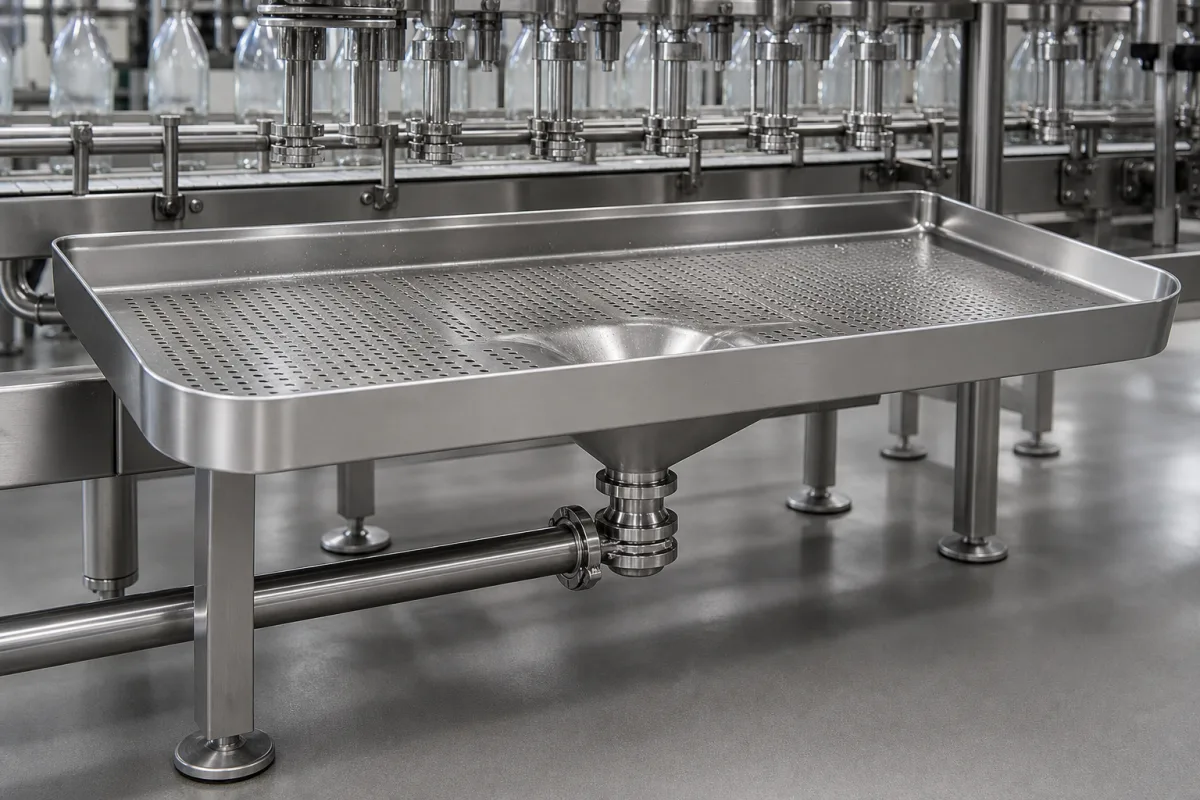
A component designed to collect and channel rinse water and residual liquid away from bottles during the rinsing process.
Product Specifications

Technical details and manufacturing context for Drainage Tray

Definition
The drainage tray is an integral part of a High-Speed Rotary Beverage Bottle Rinsing Machine. Positioned beneath the rotary rinsing heads or bottle carriers, its primary function is to efficiently capture all rinse water, cleaning solutions, and any residual beverage or contaminants washed from the bottles. It ensures a clean and dry working environment by preventing liquid spillage onto the machine frame or floor, directing all wastewater toward the machine's central drainage or recirculation system.
Working Principle
The tray utilizes gravity and its sloped or channeled design. As bottles are rinsed on the rotating platform above, water and liquids fall onto the tray surface. The tray's geometry (often with a central drain or peripheral channels) guides the liquid by gravity flow to designated outlet ports, connected to drainage pipes or a filtration/recovery system.
Common Materials
Stainless Steel (AISI 304 or 316)
Technical Parameters
  • Overall dimensions (Length x Width x Depth) to match the footprint of the rinsing station's rotary section. (mm) Standard Spec
Components / BOM
  • Tray Body
    The main basin that collects the liquid. Typically features a sloped base to direct flow.
    Material: Stainless Steel
  • Drain Outlet Flange
    A reinforced connection point for attaching a drainage hose or pipe.
    Material: Stainless Steel
  • Mounting Brackets
    Hardware used to securely fasten the tray to the rinsing machine's frame.
    Material: Stainless Steel
Engineering Reasoning
0-2.5 L/min flow rate, 0-0.3 bar pressure differential
3.1 L/min flow rate causing hydraulic jump and spillage, 0.45 bar pressure differential causing seal deformation >0.5 mm
Design Rationale: Bernoulli's principle violation at high flow rates causing hydraulic jump; Hooke's law elastic limit exceedance in EPDM seals at ΔP>0.45 bar
Risk Mitigation (FMEA)
Trigger Calcium carbonate scaling accumulation >0.8 mm thickness
Mode: Flow restriction to <0.5 L/min causing inadequate drainage
Strategy: 316L stainless steel construction with electropolished 0.4 μm Ra surface finish
Trigger Polymer chain scission from 254 nm UV-C exposure >15,000 μW·s/cm²
Mode: Polypropylene embrittlement with <2% elongation at break
Strategy: UV-stabilized PP copolymer with 0.5% HALS additive and 2.0 mm minimum wall thickness

Industry Taxonomies & Aliases

Commonly used trade names and technical identifiers for Drainage Tray.

Industrial Ecosystem & Supply Chain DNA

Complementary Systems
Downstream Applications
Specialized Tooling

Application Fit & Sizing Matrix

Operational Limits
pressure: Atmospheric to 0.5 bar (7.25 psi) max
flow rate: Up to 50 L/min (13.2 GPM)
temperature: 0°C to 80°C (32°F to 176°F)
slurry concentration: Up to 5% solids by weight
Media Compatibility
✓ Rinse water (potable/DI) ✓ Mild cleaning solutions (pH 5-9) ✓ Food-grade lubricants
Unsuitable: Highly corrosive chemicals (pH <2 or >12) or abrasive slurries
Sizing Data Required
  • Bottle diameter and spacing (mm)
  • Rinse station flow rate (L/min)
  • Required drainage slope (%)

Reliability & Engineering Risk Analysis

Failure Mode & Root Cause
Corrosion-induced perforation
Cause: Exposure to corrosive fluids, acidic condensate, or chemical spills without proper material selection or protective coatings, leading to localized thinning and eventual leakage.
Structural deformation or collapse
Cause: Overloading beyond design capacity, improper support installation, or impact damage from equipment or tools, compromising tray integrity and drainage function.
Maintenance Indicators
  • Visible fluid pooling or leakage beneath the tray, indicating perforation, seal failure, or blockage.
  • Audible dripping or splashing sounds during normal operation, suggesting improper slope, overflow, or structural misalignment.
Engineering Tips
  • Specify corrosion-resistant materials (e.g., stainless steel, coated carbon steel, or fiberglass) based on fluid compatibility and environmental conditions, and apply protective coatings or liners if needed.
  • Implement regular inspections for debris accumulation, ensure proper slope (minimum 1/8 inch per foot) for drainage, and install guards or barriers to prevent physical damage from adjacent equipment.

Compliance & Manufacturing Standards

Reference Standards
ISO 9001:2015 - Quality management systems ANSI/ASME B16.5 - Pipe flanges and flanged fittings DIN 19534 - Drainage systems for buildings and outside areas
Manufacturing Precision
  • Flatness: +/- 0.5mm per meter
  • Wall thickness: +/- 0.2mm
Quality Inspection
  • Leak test (hydrostatic or pneumatic)
  • Dimensional verification with calibrated gauges

Factories Producing Drainage Tray

Verified manufacturers with capability to produce this product in China

✓ 96% Supplier Capability Match Found

P Procurement Specialist from Australia Feb 04, 2026
★★★★★
"Impressive build quality. Especially the technical reliability is very stable during long-term operation."
Technical Specifications Verified
T Technical Director from Singapore Feb 01, 2026
★★★★★
"As a professional in the Beverage Manufacturing sector, I confirm this Drainage Tray meets all ISO standards."
Technical Specifications Verified
P Project Engineer from Germany Jan 29, 2026
★★★★★
"Standard OEM quality for Beverage Manufacturing applications. The Drainage Tray arrived with full certification."
Technical Specifications Verified
Verification Protocol

“Feedback is collected from verified sourcing managers during RFQ (Request for Quote) and factory evaluation processes on CNFX. These reports represent historical performance data and technical audit summaries from our B2B manufacturing network.”

18 sourcing managers are analyzing this specification now. Last inquiry for Drainage Tray from Brazil (1h ago).

Supply Chain Compatible Machinery & Devices

Automated Beverage Batch Blending System

Automated system for precise multi-ingredient beverage batch preparation.

Explore Specs →
Automated Beverage Container Sterilization System

Automated system for sterilizing beverage containers before filling.

Explore Specs →
Automated Beverage Labeling and Coding System

Integrated system for applying labels and printing codes on beverage containers.

Explore Specs →
Automated Beverage Ingredient Dispensing System

Automated system for precise dispensing of beverage ingredients into production lines.

Explore Specs →

Frequently Asked Questions

What are the benefits of using stainless steel drainage trays in beverage manufacturing?

Stainless steel drainage trays offer corrosion resistance, easy sanitation compliance with food safety standards, durability for high-volume production environments, and longevity in wet conditions common in beverage manufacturing rinsing processes.

How does this drainage tray integrate with existing bottling line equipment?

The drainage tray features standardized mounting brackets for easy installation on most bottling line frames, compatible drain outlet flanges that connect to facility plumbing, and a sloped tray body design that efficiently channels liquids away from production areas.

What maintenance is required for beverage manufacturing drainage trays?

Regular visual inspections for debris accumulation, periodic cleaning with food-grade sanitizers, checking mounting bracket security, and ensuring drain outlets remain clear of obstructions. Stainless steel construction minimizes maintenance compared to other materials.

Can I contact factories directly on CNFX?

CNFX is an open directory, not a transaction platform. Each factory profile provides direct contact information and production details to help you initiate direct inquiries with Chinese suppliers.

Get Quote for Drainage Tray

Request technical pricing, lead times, or customized specifications for Drainage Tray directly from verified manufacturing units.

Your business information is encrypted and only shared with verified Drainage Tray suppliers.

Thank you! Your message has been sent. We'll respond within 1–3 business days.

Need to Manufacture Drainage Tray?

Connect with verified factories specializing in this product category

Add Your Factory Contact Us
Previous Product
Deoxygenation Chamber
Next Product
Drying/Evaporation Tunnel