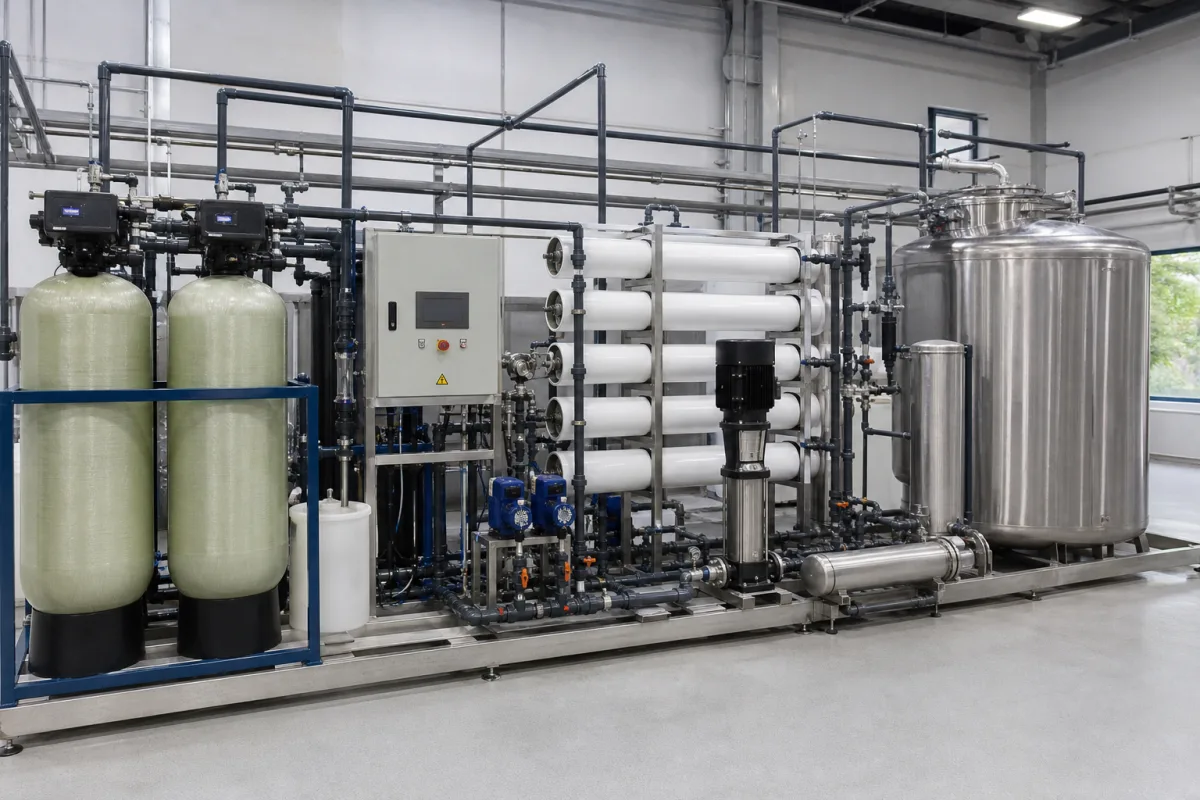
Process water · Pretreatment, membranes and recovery
Pretreatment decides whether reverse-osmosis membranes stay within their limits. The membranes have hard limits on fouling potential, oxidants, temperature, pressure and pH; the filters, softeners and dosing in front of them exist to keep the feed inside those limits. Start from a full analysis of your feed water and the product quality you need, and size the pretreatment as carefully as the membranes.
Packaged process-water systems for beverage, food, boiler feed and general industry: multimedia filtration, softening or antiscalant dosing, dechlorination, cartridge filtration and brackish-water reverse osmosis, with storage and controls. Wastewater treatment and laboratory water purifiers are outside this page.
CNFX editorial research · Sources checked October 12, 2026 · 5 sources
DuPont's FilmTec BW30 brackish-water element datasheet sets a maximum feed silt density index (SDI) of 5 and a free-chlorine tolerance below 0.1 ppm, warning that free chlorine and other oxidants can cause premature membrane failure and that oxidation damage is not covered by warranty; residual chlorine should be removed by pretreatment before the membranes. [1]
The same datasheet lists a maximum operating temperature of 45 °C, maximum operating pressure of 41 bar, continuous pH 2–11 (1–13 for short cleaning), maximum pressure drop of 1.0 bar per element and 3.4 bar per pressure vessel, and a maximum feed flow of 3.6 m³/h for a 4-inch element. [1]
Pretreatment, such as multimedia filters, softeners or antiscalant dosing, carbon or chemical dechlorination and cartridge filters, is chosen from the feed analysis to meet these limits. Ask the supplier to show the expected SDI and residual chlorine at the membrane inlet for your water.
Give the supplier a full feed-water analysis (ions, hardness, silica, iron, manganese, TOC, turbidity or SDI, free chlorine, temperature range and pH), the water source and how it varies by season.
02
Set recovery, permeate quality and concentrate handling
Recovery is the share of feed that becomes permeate; the rest leaves as concentrate. DuPont rates the BW30 at 15% recovery, 2,000 ppm NaCl and 15.5 bar, giving 99.5% stabilized salt rejection (minimum 98%) and permeate flows that may vary by ±20% between elements. [1]
As an editorial calculation only, assuming a design recovery of 75%: producing 10 m³/h of permeate needs about 13.3 m³/h of feed and leaves about 3.3 m³/h of concentrate to discharge or reuse. The achievable recovery depends on scaling species in your water, so ask the supplier for the design recovery, the antiscalant basis and the projected permeate quality.
Ask for a membrane projection for your feed at the lowest and highest water temperature, since datasheet ratings are given at 25 °C test conditions. [1]
03
Start up and operate without damaging the membranes
DuPont stresses that proper start-up prepares the membranes and prevents damage from overfeeding or hydraulic shock: pretreatment, element loading, instrument calibration and checks come first, then feed pressure should rise gradually over 30–60 seconds and cross-flow reach its set point over 15–20 seconds. [1]
The datasheet also advises keeping elements moist after first wetting and immersing them in a preservative solution during long shutdowns to prevent biological growth, and makes the customer responsible for incompatible chemicals and lubricants. Ask the supplier for the start-up, cleaning (CIP) and shutdown procedures for the system offered. [1]
04
RO plants inside bottled-water, beverage and edible-oil lines on the listed pages
Some of these systems are sold as one section of a beverage, bottled-water or edible-oil production line rather than as a stand-alone plant. [2][3][4]
CN Food Machines lists reverse-osmosis purification within bottled-water lines that also include filling and CIP; Borun lists pure-water and reverse-osmosis treatment plants; MIC lists drinking and commercial water treatment equipment. Confirm which parts are made in-house and which membranes and pumps are used. [2][3][5]
05
Multimedia filter, softening, dechlorination, cartridge filter, RO and storage
The BW30 limits fix three of the stages: multimedia filtration to an SDI of 5 or less, dechlorination below 0.1 ppm free chlorine, and the RO stage within 41 bar and 45 °C. [1]
Removes free chlorine below the membrane limit. [1]
Activated carbon or chemical dosing, and monitoring.
Cartridge filter
Protects the high-pressure pump and membranes.
Rating in µm and housing.
High-pressure pump and RO
Separate permeate from concentrate within pressure and temperature limits. [1]
Element type, array, pump and controls.
Storage and distribution
Holds permeate for the process.
Tank material and post-treatment.
06
Flow, pressure, temperature, cartridge rating, power and footprint for an RO water system
Pressure and temperature ceilings come from the BW30 datasheet; flow, cartridge rating, power and footprint depend on your feed analysis and must come from the supplier's membrane projection. [1]
12 companies list this product among what they make. Company figures are quoted from each
company's own website; every card states where the relationship came from.
CN Food Machines
Manufacturing site to be confirmed for the order
Lists reverse-osmosis purification and water treatment equipment within bottled-water production lines.
Explore company information and manufacturing capabilities, then discuss the scope of your project with a relevant supplier.
Share this page
Compiled and source-reviewed by the CNFX editorial team.
Each manufacturer above links to the page on that company's own website where the product is listed, with the date we checked it. How we source and review
· Page last updated 13 October 2026
Buyer questions
Why does a reverse-osmosis system need dechlorination?
DuPont's BW30 datasheet gives a free-chlorine tolerance below 0.1 ppm and warns oxidants can cause premature membrane failure not covered by warranty, so residual chlorine should be removed first. [1]
What SDI do RO membranes need?
The BW30 datasheet sets a maximum feed silt density index of 5. [1]
How fast should an RO system be started?
DuPont recommends raising feed pressure gradually over 30–60 seconds and reaching cross-flow over 15–20 seconds, after pretreatment and checks are complete. [1]
Sources and what still needs a direct check
Sources checked 2026-10-12. DuPont's FilmTec BW30 datasheet gives operating limits for one brackish-water element; other membranes have their own limits. Supplier pages describe their own offers. DuPont's full technical manual and design guidelines were not read for this page.