Editorial Technical Reference

Outlet Conveyor

This page explains how Outlet Conveyor is classified within Beverage Manufacturing. Technical values and manufacturer relationships are research references; confirm the current specification and supplier evidence for each order.

Technical Definition & Core Assembly

Conveyor system that transports oriented bottles from the unscrambler to downstream packaging equipment
Representative product image. Confirm appearance and specifications with the manufacturer.

Product Specifications

Technical details and manufacturing context for Outlet Conveyor

Definition
The outlet conveyor is a critical component of bottle unscrambling systems that receives properly oriented bottles from the unscrambling mechanism and transports them in an organized, controlled manner to subsequent packaging stations such as filling, capping, or labeling machines. It ensures continuous, stable bottle flow while maintaining proper spacing and orientation. The conveyor is typically constructed with a stainless steel frame (SS304) and a food-grade polyurethane belt, both chosen for corrosion resistance and compliance with food safety requirements. It is designed to handle bottles with diameters ranging from 50 to 120 mm and heights from 150 to 350 mm, with adjustable guide rails to accommodate different bottle sizes. The conveyor operates at speeds between 0.5 and 2.0 m/s, with higher speeds potentially causing bottle tipping, so speed must be matched to bottle stability. The load capacity ranges from 50 to 200 kg/m, and the motor power is typically 0.75 to 3.0 kW, depending on conveyor length and load. The system operates on a three-phase power supply of 380–480 V AC (IEC 60038) and is available with ingress protection ratings from IP54 to IP65, with IP65 recommended for washdown environments. The operating temperature range is 0 to 40 °C, as lower temperatures may affect belt flexibility. Conveyor width ranges from 200 to 600 mm, and length from 2000 to 10000 mm, with modular sections for easy extension. The total weight varies from 500 to 2000 kg depending on configuration. All specifications are reference ranges and must be verified with the manufacturer for specific models and applications.
Working Principle
The outlet conveyor typically operates using a motor-driven belt or chain system that moves at a controlled speed synchronized with the unscrambler output. Bottles are transferred from the unscrambler discharge point onto the conveyor surface, where they are transported along a predetermined path while maintaining their upright orientation through guide rails or containment systems. The conveyor speed is adjustable to match the production rate, and sensors may be integrated to monitor bottle flow and detect jams. The system is designed to ensure smooth transfer and consistent spacing, preventing bottlenecks and maintaining efficiency in the packaging line.
Common Materials
Stainless steel, Food-grade conveyor belt material, Anodized aluminum
Technical Parameters
ParameterTypical rangeNotes & selection driver
Conveyor Speed0.5–2.0 m/sHigher speeds may cause bottle tipping
Bottle Diameter Range50–120 mmOutside range requires change of guide rails
Bottle Height Range150–350 mmAdjustable height guides
Load Capacity50–200 kg/mMaximum distributed load on conveyor
Motor Power0.75–3.0 kWDepends on conveyor length and load
Operating Voltage380–480 V ACThree-phase, 50/60 HzIEC 60038
Operating Temperature0–40 °CBelow 0°C may affect belt flexibility
Ingress ProtectionIP54–IP65IP65 for washdown environmentsIEC 60529
Belt MaterialPUFood-grade polyurethane, FDA compliant
Frame MaterialSS304Stainless steel for corrosion resistanceASTM A240
Conveyor Width200–600 mmCustom widths available
Conveyor Length2000–10000 mmModular sections for easy extension
Weight500–2000 kgDepends on length and configuration

Ranges are indicative industry figures for RFQ preparation, not a supplier commitment. Confirm every value and standard with the legal manufacturer before ordering.

Components / BOM
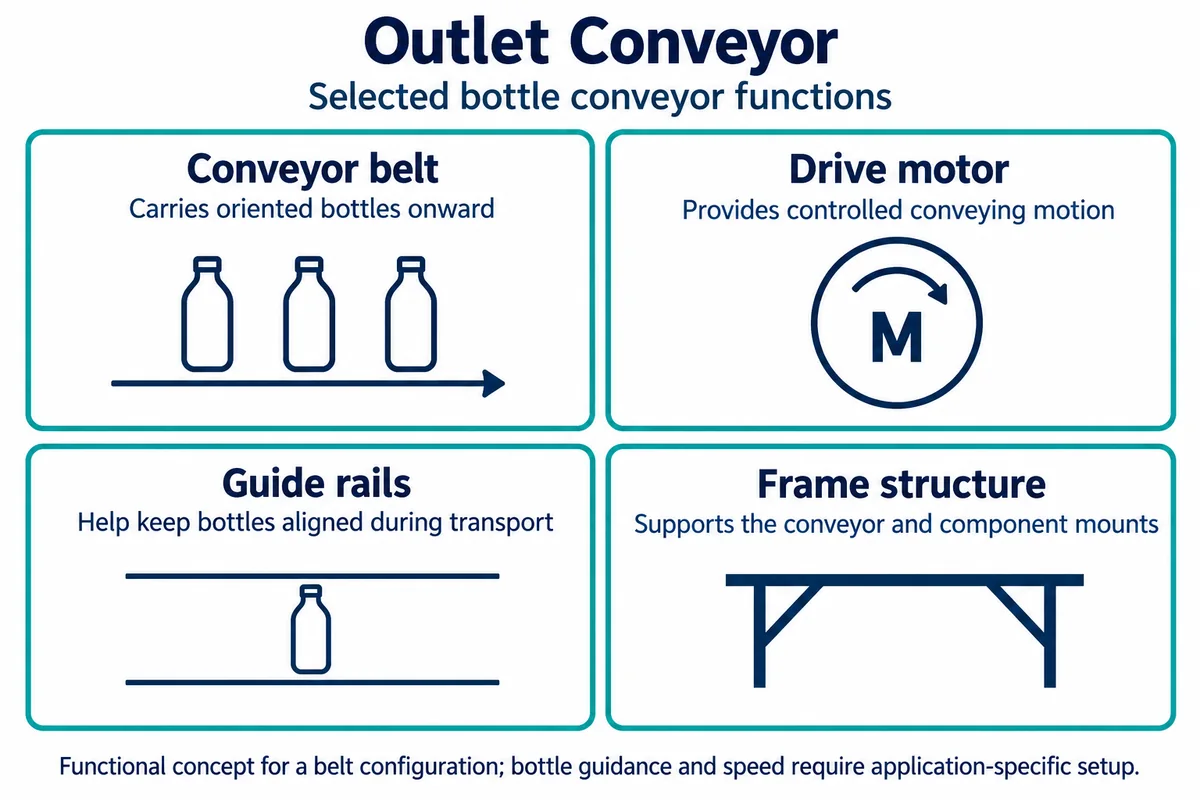
  • Conveyor Belt
    Surface that transports bottles while providing friction and stability
    Material: Food-grade PVC or polyurethane
  • Drive Motor
    Provides power to move the conveyor at controlled speeds
    Material: Stainless steel housing with copper windings
  • Guide Rails Part
    Maintain bottle orientation and prevent falling during transport
    Material: Stainless steel or food-grade plastic
  • Frame Structure
    Provides structural support and mounting points for all components
    Material: Stainless steel or powder-coated carbon steel
  • Sensors Optional
    Monitor bottle flow and detect jams on the conveyor.

Industry Taxonomies & Aliases

Commonly used trade names and technical identifiers for Outlet Conveyor.

Applied To / Applications

This component is essential for the following industrial systems and equipment:

Industrial Ecosystem & Supply Chain Structure

Complementary Systems
Downstream Applications
Specialized Tooling

Application Fit & Sizing Matrix

Operational Limits
pressure: Not applicable - mechanical conveying system
other spec: Bottle throughput: 50-1000 bottles per minute, Bottle size range: 50ml to 2L containers, Maximum incline: 15 degrees
temperature: Ambient to 50°C (122°F) - typical for bottling lines
Media Compatibility
✓ PET plastic bottles ✓ Glass bottles ✓ Aluminum cans
Unsuitable: Heavy industrial parts or abrasive materials (e.g., metal components, stoneware)
Sizing Data Required
  • Bottle dimensions (height, diameter, weight)
  • Required throughput (bottles per minute)
  • Available floor space and conveyor length

Reliability & Engineering Risk Analysis

Failure Mode & Root Cause
Bearing failure
Cause: Inadequate lubrication leading to overheating and wear, or contamination from dust/debris causing abrasive damage.
Belt misalignment or tracking issues
Cause: Improper tensioning, worn or damaged pulleys/rollers, or structural misalignment of the conveyor frame.
Maintenance Indicators
  • Unusual grinding, squealing, or knocking noises from drive components or rollers.
  • Visible belt slippage, excessive vibration, or irregular movement during operation.
Engineering Tips
  • Implement a proactive lubrication schedule for all bearings and moving parts, using the correct lubricant type and quantity as per manufacturer specifications.
  • Regularly inspect and adjust belt tension and tracking, and ensure all rollers and pulleys are clean, aligned, and free from damage to prevent premature wear.

Indicative industry ranges for design and RFQ preparation. Confirm the exact figures and applicable standard with the manufacturer before specifying.

Compliance & Manufacturing Standards

Applicable Standards
ANSI/ASME B20.1 - Safety standards for conveyors and related equipment DIN 15201 - Continuous mechanical handling equipment; belt conveyors for bulk materials

Quoted from the published standard.

Manufacturing Precision
  • Belt alignment: +/- 3mm over 10m length
  • Roller concentricity: 0.05mm TIR (Total Indicator Runout)
Quality Inspection
  • Non-destructive testing (NDT) - Magnetic particle inspection for welds
  • Load testing - 125% rated capacity for 4 hours

Manufacturers of Outlet Conveyor

Manufacturer profiles associated with Outlet Conveyor.

Sourcing Outlet Conveyor from China?
Tell us your specification and target quantity — we will match it against manufacturer records and come back with the factories that fit.
Request manufacturers We manufacture this

Manufacturer listings support early research and capability understanding. They are not certification, ranking, or transaction guarantees.

Technical documentation
Request current drawings, revision history, and a signed specification sheet.
Manufacturing capability
Verify equipment lists, process limits, capacity, and representative production evidence.
Inspection readiness
Confirm test methods, calibrated equipment, sampling plans, and traceable reports.
Supplier transparency
Check the legal entity, factory address, ownership, certifications, and direct contacts.

CNFX does not score or rank suppliers. Buyers must verify all claims and documents with the legal manufacturer before ordering.

Supply Chain Compatible Machinery & Devices

Automated Beverage Container Pressure Testing System

Automated system for testing beverage container pressure resistance and seal integrity.

Explore Specs →
Automated Beverage Container Leak Detection System

The Automated Beverage Container Leak Detection System is an industrial device designed for integration into bottling or canning lines.

Explore Specs →
Automated Beverage Container Depalletizing Machine

Industrial machine that automatically removes beverage containers from pallets for production line feeding

Explore Specs →
Regeneration Section

A dedicated section within an industrial system designed to restore or renew the functional properties of materials, media, or components through controlled processes.

Explore Specs →

Frequently Asked Questions

What is the typical speed range of the outlet conveyor?

The conveyor speed is typically 0.5 to 2.0 m/s. Higher speeds may cause bottle tipping, so the speed should be adjusted based on bottle stability and production requirements.

What bottle sizes can the outlet conveyor handle?

The conveyor can handle bottles with diameters from 50 to 120 mm and heights from 150 to 350 mm. Guide rails are adjustable to accommodate different sizes within these ranges.

What materials are used in the construction?

The frame is made of stainless steel (SS304) for corrosion resistance, and the belt is food-grade polyurethane (PU) that is FDA compliant. These materials are suitable for food and beverage applications.

What are the electrical requirements?

The conveyor operates on a three-phase power supply of 380–480 V AC, 50/60 Hz, per IEC 60038. The motor power ranges from 0.75 to 3.0 kW, depending on conveyor length and load.

Data Basis

Editorial classification, named public sources where available, and source-reviewed manufacturer records.

Preliminary Technical Classification
This page supports structured research, RFQ preparation, and supplier evaluation. It does not replace buyer-led supplier qualification, standards review, or technical approval.
Buyer enquiry

Request manufacturing insight for Outlet Conveyor

Ask for use case, specification boundaries, supplier type, and RFQ preparation information for this product.

Where it goes
Straight to the CNFX editorial desk, and to the manufacturer if this product is linked to a claimed profile. Nothing is broadcast to a supplier list.
Your details stay here
We do not sell or rent enquiry data, and we do not add you to a mailing list. Used only to answer this request.
No commission, no middleman
CNFX is a directory. We take no cut of any order and never negotiate on a supplier's behalf.
What we don't claim
A listing is not an endorsement. Qualify every supplier and verify every figure yourself before ordering.

Your business information is used only to process this request.

Thank you! Your message has been sent. We'll respond within 1–3 business days.
Sorry, we couldn't send your message. Please try again, or email us at contact@cnfx.com.

Need to Manufacture Outlet Conveyor?

Compare manufacturer profiles with relevant product and process capability.

Previous Product
Vacuum Gripper End-Effector
Last Product
Get QuotesChat