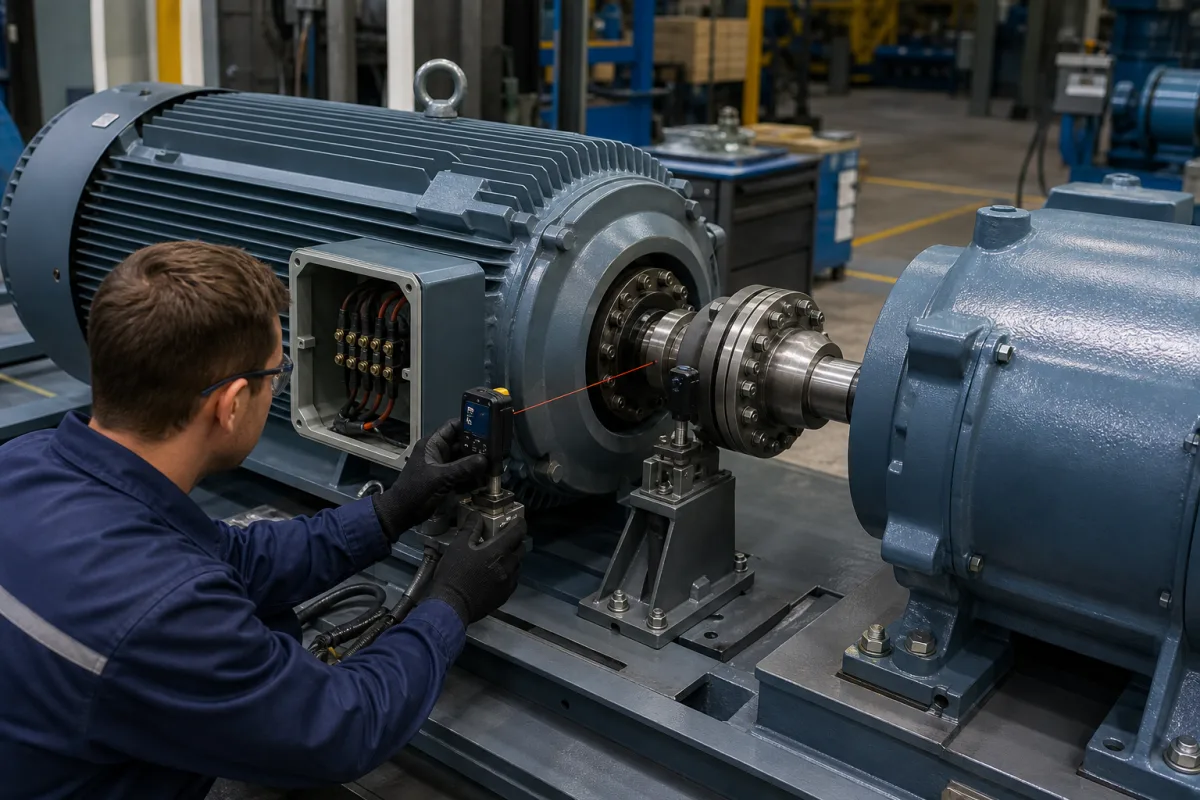
Blender drive motor (geared motor drive for powder blenders)
Blender drive motors · Geared motor drives for powder bin and tumble blenders: low output speed, torque and service factor, coupling alignment
A blender drive motor is the electric motor, together with its gear reducer and coupling, that turns the bin, drum or shell of a powder blender at a few revolutions per minute. Three figures decide whether it will turn a full bin for years: the output speed range and torque at maximum load, the service factor the reducer is sized with for your daily running hours, and the alignment tolerance the motor, coupling and reducer are set to.
Electric motors with gear reducers, couplings and speed control that drive pharmaceutical bin, post, V and double-cone blenders and similar low-speed powder mixers. This differs from choosing a general-purpose motor by efficiency class and load: AC induction and permanent-magnet motors for pumps, fans, conveyors and machines are covered on the Electric motor page. Servo motors, e-bike and AGV wheel motors, direct-drive torque motors and the blenders themselves are outside this page.
CNFX editorial research · Sources checked October 12, 2026 · 3 sources
Set output speed and torque from the blender's load
Canaan's specification table for its HTD post bin blenders shows how drive size follows bin size: bins of 100 L to 2,000 L with maximum net loads of 50 kg to 1,000 kg, mixing motors of 1.5 kW to 11 kW, and working speeds of 3–20 r/min for the smaller models, 3–15 r/min for 500–800 L and 3–10 r/min for 1,000 L and above. The HTD1000 lists a 1,000 L bin, 500 kg net load, 3–10 r/min, a 4 kW mixing motor and a separate 3 kW lifting motor. [1]
Canaan describes the bin as held at 30° to the rotary axis, mixing for a set time and speed, then turning to vertical and lowering when the time is up, so the drive has to start, run and stop the loaded bin on every batch. [1]
Editorial calculation: assuming a motor speed of 1,450 rpm at 50 Hz (an assumed nameplate value), an overall ratio of 1,450 ÷ 10 = 145:1 gives the HTD1000's top speed of 10 r/min. On the same ratio, 3 r/min needs about 435 rpm at the motor, roughly 15 Hz on a variable-frequency drive if speed is taken as proportional to frequency. If the full 4 kW reached the bin at 10 r/min, the shaft torque would be 9,550 × 4 ÷ 10 ≈ 3,820 N·m before gear losses. [1][2]
Give the supplier the blender type and model, bin volume and maximum loaded mass, speed range, run time per batch and batches per day, start–stop and inching needs, supply voltage and frequency, the hazardous-area classification of the room, and the cleaning method.
02
Size the gear reducer with a service factor for the duty
AutomationDirect's IronHorse gearbox manual sets out a selection order: find the load torque and speed, the overall ratio of motor speed to load speed, the gearbox and external ratios, the service factor and overhung-load factor, then pick a gearbox whose thermal and mechanical ratings exceed the real and design torque, and finally a compatible motor. Its worked example divides 1,750 rpm motor speed by 20 rpm load speed for an overall ratio of 87.5. [2]
The AGMA service factor table reproduced in the manual gives, for agitators handling liquids and solids, 1.00 for up to 3 hours a day, 1.25 for 3–10 hours and 1.50 for over 10 hours; concrete mixers are listed at 1.25, 1.25 and 1.50. Tumble blenders for powders are not listed, so ask the reducer supplier which class they use. [2]
Editorial calculation: taking the 3,820 N·m example above and a factor of 1.25 for 3–10 hours a day, the reducer's design torque would be 3,820 × 1.25 ≈ 4,775 N·m. The factor is an assumed classification, not a published rating for blenders. [2][1]
03
Align motor, coupling and reducer to a stated tolerance
Pruftechnik's practical guide to shaft alignment gives suggested tolerances for short flexible couplings, to be used where no in-house or machine-maker tolerance exists. At 1500 RPM it lists offset of 0.09 mm acceptable and 0.06 mm excellent, and angularity of 0.07 mm and 0.05 mm gap difference per 100 mm of coupling diameter; at 750 RPM the offsets are 0.19 mm and 0.09 mm. It gives a soft-foot limit of 0.06 mm at any speed and states that rigid couplings have no tolerance for misalignment. [3]
The guide notes that tolerable misalignment depends on speed, power rating, coupling type, spacer length, the coupled equipment and the service life expected, and that its acceptable limits were derived from an allowable sliding velocity of 0.5 inch/s in lubricated steel couplings. [3]
Editorial calculation: for a 200 mm flexible coupling at 1500 RPM, the angularity limits become 0.07 × 2 = 0.14 mm acceptable and 0.05 × 2 = 0.10 mm excellent gap difference across the coupling face. [3]
04
Split mixing and lifting drives; account for belt stages
Canaan's HTD blenders use one motor for mixing and another for lifting the bin, each with its own rating. [1] The IronHorse manual covers reductions made partly outside the gearbox, such as V-belt pulleys, which add an overhung-load factor (1.5 for a V-belt in its example). [2]
05
Rate each link of the blender drive train
A loaded bin is only as well driven as the weakest link between motor and bin shaft, so each item below needs its own rating in the order.
Nameplate, enclosure and room data for the blender drive
Canaan publishes motor power and bin speed for its blenders; insulation, IP code, efficiency class and noise are not on its table and have to come from the motor and reducer makers for your room.
1 company lists this product among what they make. Company figures are quoted from each
company's own website; every card states where the relationship came from.
Jiangsu Mengyang Motor Manufacture Co. Ltd.
Manufacturing site to be confirmed for the order
Lists AC asynchronous motors, asynchronous induction gear motors and NEMA and IEC AC motors.
Explore company information and manufacturing capabilities, then discuss the scope of your project with a relevant supplier.
Share this page
Compiled and source-reviewed by the CNFX editorial team.
Each manufacturer above links to the page on that company's own website where the product is listed, with the date we checked it. How we source and review
· Page last updated 13 October 2026
Buyer questions
How fast does a bin blender drive turn?
Canaan's HTD post bin blenders list 3–20 r/min for small bins and 3–10 r/min from 1,000 L up. [1]
What service factor should the gear reducer have?
The AGMA table in AutomationDirect's manual gives 1.00, 1.25 or 1.50 for agitators with liquids and solids at up to 3, 3–10 and over 10 hours a day; blenders are not listed, so confirm the class with the supplier. [2]
How closely should motor and reducer be aligned?
Pruftechnik suggests 0.09 mm acceptable and 0.06 mm excellent offset for short flexible couplings at 1500 RPM, unless the machine maker sets a tolerance. [3]
Sources and what still needs a direct check
Sources checked 2026-10-12. Canaan is a blender maker and its figures are for its HTD models. The AGMA service factor table is reproduced in AutomationDirect's IronHorse gearbox manual. Pruftechnik's alignment tolerances are its own suggested values.