Industry-Verified Manufacturing Data (2026)

Product Screening System

Based on aggregated insights from multiple verified factory profiles within the CNFX directory, the standard Product Screening System used in the Chemical Manufacturing sector typically supports operational capacities ranging from standard industrial configurations to heavy-duty production requirements.

Technical Definition & Core Assembly

A canonical Product Screening System is characterized by the integration of Vibrating Screen Deck and Vibration Motor/Exciter. In industrial production environments, manufacturers listed on CNFX commonly emphasize Stainless Steel (e.g., 304, 316) construction to support stable, high-cycle operation across diverse manufacturing scenarios.

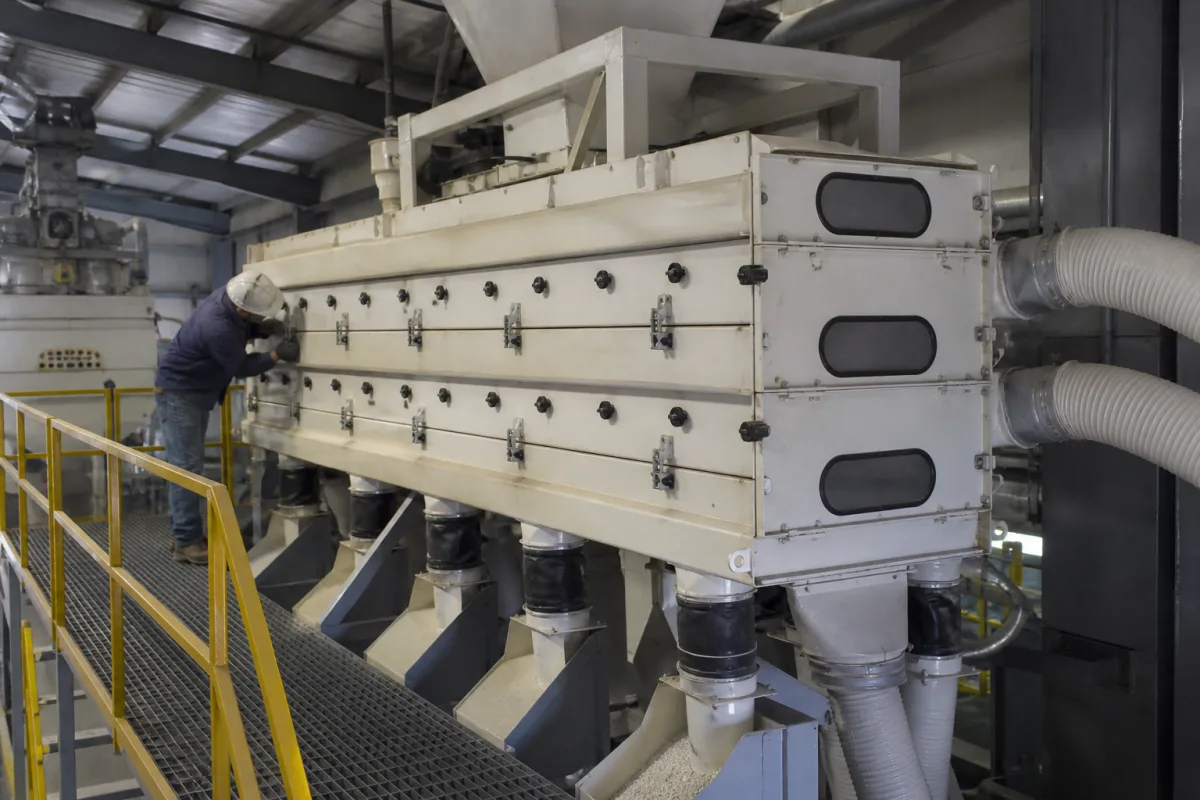
A mechanical system that separates urea granules by size within the granulation and prilling process.

Product Specifications

Technical details and manufacturing context for Product Screening System

Definition
The Product Screening System is a critical component of the Modular Urea Granulation and Prilling System, responsible for classifying the produced urea granules into specified size fractions. It ensures that only granules meeting the target size distribution proceed to packaging or further processing, while oversized and undersized particles are recycled or removed, maintaining product quality and process efficiency.
Working Principle
The system typically employs vibrating screens or rotary sieves. Urea granules from the granulator or prilling tower are fed onto the screen surface. Mechanical vibration or rotation causes the granules to move across the screen. Particles smaller than the screen apertures pass through (undersize), while those larger than the apertures are retained (oversize). Correctly sized granules are collected as the on-spec product stream.
Common Materials
Stainless Steel (e.g., 304, 316), Polyurethane Screen Mesh, Carbon Steel (for structural frames)
Technical Parameters
  • Screen aperture size defining the target granule size cut-point. (mm) Standard Spec
Components / BOM
  • Vibrating Screen Deck
    The primary screening surface where size separation occurs via vibration.
    Material: Stainless steel frame with polyurethane or wire mesh panels
  • Vibration Motor/Exciter
    Generates the oscillating or gyratory motion necessary for material movement and separation on the screen deck.
    Material: Cast iron housing, copper windings
  • Feed Hopper/Chute
    Channels the incoming stream of urea granules evenly onto the screen surface.
    Material: Stainless steel
  • Product Collection Hoppers
    Collects the separated streams: on-spec product, oversize, and undersize.
    Material: Stainless steel
  • Dust Enclosure/Seals
    Contains dust and prevents product loss or contamination during the screening process.
    Material: Rubber, polyurethane, or fabric
Engineering Reasoning
0.5-3.0 mm granule diameter separation range at 15-25 rpm rotational speed
Screen mesh deformation exceeding 0.15 mm permanent deflection at 35 rpm rotational speed
Design Rationale: Resonance-induced fatigue failure at 28-32 Hz vibration frequency matching screen natural frequency
Risk Mitigation (FMEA)
Trigger Urea granule moisture content exceeding 0.8% by mass
Mode: Screen mesh blinding with adhesive urea buildup
Strategy: Integrated infrared moisture sensor with automated bypass valve at 0.75% threshold
Trigger Bearing lubrication degradation below ISO VG 32 viscosity at 65°C
Mode: Rotational imbalance causing 0.5 mm radial runout
Strategy: Magnetic particle clutch with 0.1 mm radial tolerance limit switches

Industry Taxonomies & Aliases

Commonly used trade names and technical identifiers for Product Screening System.

Industrial Ecosystem & Supply Chain DNA

Complementary Systems
Downstream Applications
Specialized Tooling

Application Fit & Sizing Matrix

Operational Limits
pressure: Atmospheric to 0.5 bar gauge
flow rate: 5-50 m³/h per screening unit
temperature: Ambient to 80°C (176°F)
slurry concentration: Up to 70% solids by weight
Media Compatibility
✓ Urea granules (prilled or granular) ✓ Ammonium nitrate granules ✓ Compound fertilizer blends
Unsuitable: Highly corrosive or abrasive slurries (e.g., phosphoric acid-based)
Sizing Data Required
  • Required throughput (tons/hour)
  • Target particle size distribution (feed and product specs)
  • Available footprint and layout constraints

Reliability & Engineering Risk Analysis

Failure Mode & Root Cause
Screen blinding/plugging
Cause: Material buildup on screen mesh due to sticky or fine particles, moisture, or improper material characteristics, reducing screening efficiency and throughput.
Structural fatigue/frame cracking
Cause: Cyclic loading from vibration mechanisms, material impact forces, or resonance issues leading to stress concentrations at weld joints or frame connections.
Maintenance Indicators
  • Unusual vibration patterns or audible knocking sounds indicating imbalance, bearing failure, or loose components
  • Visible material spillage or bypass around screen edges suggesting seal failure, screen damage, or excessive feed rates
Engineering Tips
  • Implement regular screen mesh inspection and cleaning protocols using appropriate methods (air blowers, brushes, ultrasonic) based on material characteristics
  • Establish vibration analysis monitoring to detect early imbalance, bearing wear, or structural issues before catastrophic failure occurs

Compliance & Manufacturing Standards

Reference Standards
ISO 9001:2015 Quality Management Systems ANSI/ASQ Z1.4 Sampling Procedures and Tables for Inspection by Attributes CE Marking (EU Machinery Directive 2006/42/EC)
Manufacturing Precision
  • Alignment: +/-0.05mm
  • Surface Finish: Ra 1.6μm
Quality Inspection
  • Dimensional Verification with CMM
  • Functional Performance Test

Factories Producing Product Screening System

Verified manufacturers with capability to produce this product in China

✓ 95% Supplier Capability Match Found

P Procurement Specialist from Brazil Feb 04, 2026
★★★★★
"Impressive build quality. Especially the technical reliability is very stable during long-term operation."
Technical Specifications Verified
T Technical Director from Canada Feb 01, 2026
★★★★★
"As a professional in the Chemical Manufacturing sector, I confirm this Product Screening System meets all ISO standards."
Technical Specifications Verified
P Project Engineer from United States Jan 29, 2026
★★★★★
"Standard OEM quality for Chemical Manufacturing applications. The Product Screening System arrived with full certification."
Technical Specifications Verified
Verification Protocol

“Feedback is collected from verified sourcing managers during RFQ (Request for Quote) and factory evaluation processes on CNFX. These reports represent historical performance data and technical audit summaries from our B2B manufacturing network.”

18 sourcing managers are analyzing this specification now. Last inquiry for Product Screening System from Brazil (1h ago).

Supply Chain Compatible Machinery & Devices

Modular Distillation Column System

Pre-engineered modular system for continuous separation of chemical mixtures via distillation.

Explore Specs →
Automated Batch Crystallization System

Automated system for controlled crystallization of chemical compounds in batch processes.

Explore Specs →
Automated pH Monitoring and Dosing System

Automated system for continuous pH monitoring and chemical dosing in process streams.

Explore Specs →
Automated Powder Dispensing and Blending System

Automated system for precise dispensing and homogeneous blending of powdered chemicals.

Explore Specs →

Frequently Asked Questions

What materials are used in the construction of this urea screening system?

The system features stainless steel (304/316 grades) for corrosion resistance, polyurethane screen mesh for durability, and carbon steel structural frames for strength in chemical manufacturing environments.

How does the vibrating screen deck improve urea granule separation?

The vibrating screen deck uses controlled vibration from the motor/exciter to efficiently separate urea granules by size, ensuring consistent product quality in granulation and prilling processes while minimizing dust emissions.

What maintenance is required for this screening system in chemical plants?

Regular inspection of polyurethane screen mesh for wear, checking vibration motor operation, and maintaining dust enclosure seals are key maintenance tasks to ensure optimal performance and longevity in urea production facilities.

Can I contact factories directly on CNFX?

CNFX is an open directory, not a transaction platform. Each factory profile provides direct contact information and production details to help you initiate direct inquiries with Chinese suppliers.

Get Quote for Product Screening System

Request technical pricing, lead times, or customized specifications for Product Screening System directly from verified manufacturing units.

Your business information is encrypted and only shared with verified Product Screening System suppliers.

Thank you! Your message has been sent. We'll respond within 1–3 business days.

Need to Manufacture Product Screening System?

Connect with verified factories specializing in this product category

Add Your Factory Contact Us
Previous Product
Product Collection Tank
Next Product
Protection Sheath