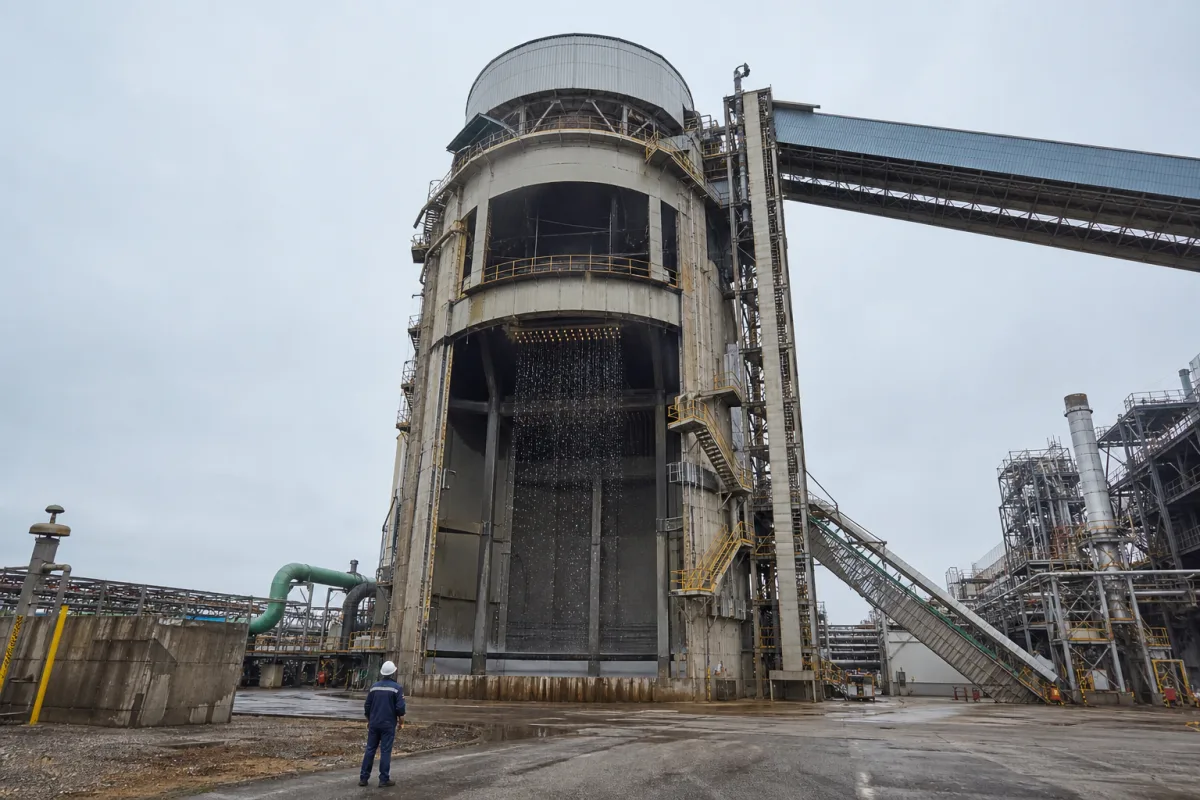
Prilling tower (prill tower for urea and ammonium nitrate)
Prill towers for urea and ammonium nitrate · Product and grade, melt concentration, fluidized or non-fluidized bed, cooling airflow, spray device, cooling and screening, dust and ammonia control
A prilling tower turns a concentrated melt — urea or ammonium nitrate — into small spherical solids by spraying it from the top of a tall tower so the droplets cool and freeze as they fall through rising air. Settle three things before specifying one: the product, grade and melt it will handle, the airflow, spray device and bed or cooling arrangement that set prill quality, and the scrubbing needed for the dust and ammonia the tower air carries out.
Prill towers and their spray heads, air systems and bottom beds for urea and ammonium nitrate solids. Drum and pan granulators, rotary drum coolers and dryers, water cooling towers and the upstream synthesis and evaporation units are outside this page except where compared.
CNFX editorial research · Sources checked October 12, 2026 · 4 sources
EPA's AP-42 section on urea describes prilling as spraying molten urea from the top of a prill tower so the droplets fall through a counter-current air flow, cool and solidify into nearly spherical particles. It names two tower types — fluidized bed and non-fluidized bed — and notes that a non-fluidized-bed tower may need a separate solids cooling step to make agricultural-grade prills. [1] Aqueous urea solution begins to decompose to biuret and ammonia at 60 °C, and the concentration method is chosen by the biuret level allowed in the product. [1]
The AP-42 ammonium nitrate section describes a melt of about 95–99.8% ammonium nitrate at roughly 149 °C sprayed into the top of the tower; a 95–97.5% melt gives low-density prills near 1.29 specific gravity, porous enough to absorb oil for blasting agents, and a 99.5–99.8% melt gives high-density prills near 1.65. Product leaves solids formation at about 66–124 °C and is cooled in rotary drums or fluidized beds; low-density prills need drying first; cooled prills are screened, with offsize dissolved and recycled. [2]
Both sections compare prilling with granulation: granules are larger or stronger in crushing strength and abrasion resistance and need less air, while granulators cannot make low-density ammonium nitrate or small feed-grade urea economically. [1][2]
Give the supplier the product (urea or ammonium nitrate) and grade, melt concentration and temperature, design capacity, target prill size and distribution, density and strength, additives or coatings, tower type (fluidized or non-fluidized bed), site climate (temperature and humidity range), cooling and screening downstream, emission limits for particulate and ammonia, and materials.
02
Set cooling airflow, spray device and emission control
AP-42 lists the factors that change prill tower emissions: product grade, air flow rate, tower bed type and ambient temperature and humidity. Colder air forms smaller particles that control devices remove less efficiently, and high humidity forces higher airflow, which raises emissions. [1] For ammonium nitrate, emissions come from microprills, attrition of prills against the tower and one another, and crystal-state transitions; tower air velocity sets how much microprill mass is carried out, partly plugged spray orifices raise fines, and spinning buckets and vibrated spray plates help reduce microprill formation. [2]
Its urea table gives uncontrolled particulate of 1.9 kg/Mg for non-fluidized-bed agricultural-grade prilling (0.032 kg/Mg controlled with a downcomer and wetted-fibre filter scrubber at 98.3% efficiency) and 3.1 kg/Mg for fluidized-bed agricultural grade (0.39 kg/Mg with an entrainment scrubber), with uncontrolled ammonia of 0.43 and 1.46 kg/Mg. [1] For ammonium nitrate it gives 1.59 kg/Mg particulate from high-density and 0.46 kg/Mg from low-density prill towers, with wet-scrubber efficiencies of 62% and 43%, and uncontrolled ammonia of 28.6 and 0.13 kg/Mg. [2] Urea emission sources are controlled with wet scrubbers whose liquor is recycled to the concentration step. [1]
Editorial calculation: at 1,000 Mg/day of non-fluidized-bed agricultural-grade urea prills, 1.9 kg/Mg is about 1,900 kg/day of particulate leaving the tower uncontrolled and 0.032 kg/Mg about 32 kg/day after the scrubber. For high-density ammonium nitrate, 1.59 × (1 − 0.62) ≈ 0.60 kg/Mg remains after a 62% scrubber. [1][2]
A Chinese utility model patent, CN218945003U (filed 17 November 2022 by Shanghai Jingye Environmental Protection and Energy Technology), gives the retrofit context for natural-draft towers. Its background states that natural-ventilation urea and urea-based compound fertilizer prilling towers emitted about 150–350 mg/Nm³ of dust and 80–150 mg/Nm³ of ammonia, and that towers have since been upgraded either by wet scrubbing or by dry dust removal. It describes a dry system of bag filters with a suction fan on top of a ventilation room at the tower head, notes that adding this load to an existing tower can force a thicker shell, and claims a layout with staggered top ventilation holes, no adjustable shutters, and a spray (granulation) room that narrows towards the bottom so air reaches all the droplets instead of bypassing between the room and the tower wall. [3]
Editorial note: if an existing natural-draft tower is to be fitted with dust removal, ask the supplier for a structural check of the tower head and shell under the added filter and fan load, and for guaranteed dust and ammonia in mg/Nm³ at the stack. [3]
An industrial-scale study of a two-stage vacuum ammonium nitrate process (Yildiz Technical University with Toros Agri's research centre) lists the conditions feeding the tower: second-stage evaporation at 3 kg/cm² and 175 °C, dilution with calcium carbonate filler and prilling at 1 kg/cm² and 175 °C, with the prills then held in a rotating drum coated with anticaking agent. Its prilling bucket rotates at 150–300 rpm, bucket speed affects particle size, and a conical bucket gives the 2 mm average prill size the author calls the EFMA standard value. CO₂ from calcium carbonate filler foamed the melt and cracked or deformed prill surfaces, which the plant countered by adding sulfuric acid and then silicic acid (1 mL per 5.6 mL sulfuric acid) at dilution; with a calcium lignosulfonate coating, no caking or degradation was observed over two years of storage. [4]
03
References and stack guarantees to ask each tower supplier for
Ask each supplier for references on the same product and grade, the guaranteed prill size distribution and strength, airflow and fan power, spray-device design, and the guaranteed particulate and ammonia at the stack. [1][2]
04
Spray bucket, shell, fans, bottom cooler and scrubber
AP-42, the background of CN218945003U and the Yildiz Technical University plant study supply the airflow, temperature, prill-size, bucket and stack rows; tower height, diameter, capacity, materials and weight have no published value here.
Field
What it means and published values
Ask the supplier for
Tower Height
Fall distance for solidifying.
m.
Tower Diameter
Air and droplet path.
m.
Production Capacity
Design throughput.
t/d; turndown.
Prill Size
Product size. One ammonium nitrate plant targets a 2 mm average from a conical bucket at 150–300 rpm. [4]
Explore company information and manufacturing capabilities, then discuss the scope of your project with a relevant supplier.
Share this page
Compiled and source-reviewed by the CNFX editorial team.
Each manufacturer above links to the page on that company's own website where the product is listed, with the date we checked it. How we source and review
· Page last updated 13 October 2026
Buyer questions
How does a prilling tower work?
EPA AP-42 describes molten urea sprayed from the top of the tower, cooling and solidifying into near-spherical prills in counter-current air. [1]
What sets ammonium nitrate prill density?
Melt concentration: 95–97.5% gives low-density prills near 1.29 specific gravity, 99.5–99.8% high-density near 1.65. [2]
How much dust does a urea prill tower emit?
AP-42 lists 1.9 kg/Mg uncontrolled for non-fluidized agricultural grade and 3.1 kg/Mg for fluidized bed. [1]
Why do prill tower emissions rise in cold or humid weather?
Cold air forms smaller particles that are harder to capture, and high humidity needs more airflow. [1]
How much dust did natural-draft urea prill towers emit?
A 2022 Chinese patent's background puts them at about 150–350 mg/Nm³ of dust and 80–150 mg/Nm³ of ammonia before wet or dry dust-removal upgrades. [3]
How fast does a prilling bucket rotate?
In an industrial ammonium nitrate plant described in Heliyon (2020), the prilling bucket rotates at 150–300 rpm with melt at 175 °C, and a conical bucket gives a 2 mm average prill size. [4]
Sources and what still needs a direct check
Sources checked 2026-10-12. EPA's AP-42 sections 8.2 (urea) and 8.3 (ammonium nitrate) describe prilling, the factors that affect prill tower emissions and the emission factors cited here; a Chinese utility model and a Yildiz Technical University plant study add tower and spray-bucket details. Design values for your order must come from the process licensor and supplier.