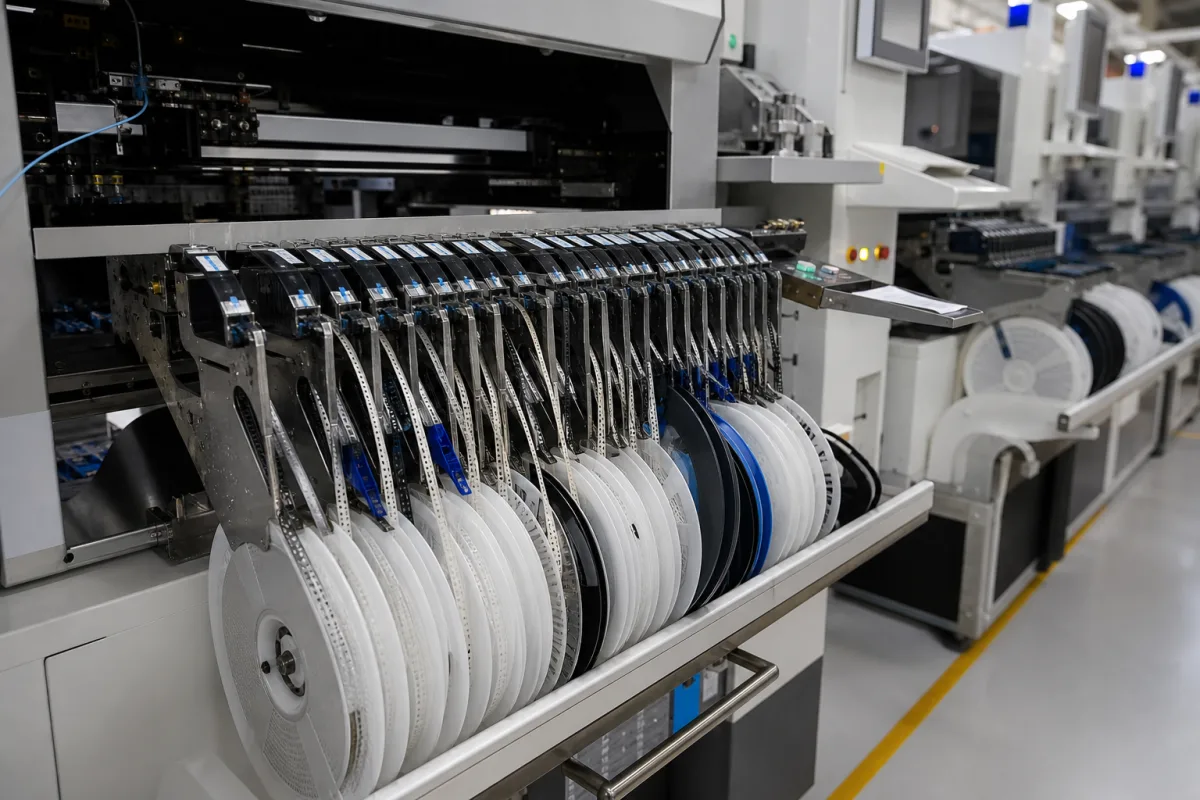
Tape feeders that present surface-mount components to pick-and-place machines · Carrier tape widths and pitches, sprocket indexing, cover tape peeling before the pick position, vibration of open pockets, multi-pitch feeders, and non-splicing loading
A component feeder for surface-mount assembly holds a reel of components packed in carrier tape and advances the tape one pocket at a time, peeling back the cover tape so the pick-and-place head can lift each part from the pick position. Feeders must match the machine, the tape width and the pocket pitch. Ask three things first: which placement machine and feeder interface they must fit, which tape widths and pitches they must run, and how reliably they index and present parts and how reels are changed.
Tape (reel) feeders for SMT pick-and-place machines, including mechanical, pneumatic and electric feeders and non-splicing types. Stick, tray and bulk feeders, the pick-and-place machine itself (see surface mount technology SMT pick-and-place machine), placement heads and component packaging are outside this page except where compared.
CNFX editorial research · Sources checked October 12, 2026 · 4 sources
US patent 5,725,140 (Tape feeder for a surface mount placement system, 1998) explains that parts for placement are packaged in carrier tape with a sequence of pockets, each holding a part, with a cover tape attached to the top surface to retain them and the tape wound on a reel; at the machine the reel is loaded into a tape feeder that unreels the tape, advances it past a point where the cover tape is removed and then past a pick location where a vacuum quill picks each part. Carrier tape is standardised in width (8, 12, 16, 24, 32, 44 and 56 mm) and pitch, the pocket-to-pocket spacing, which varies with pocket size and width: 8 mm tape may have a 2 mm or 4 mm pitch. For a feeder, pitch and stroke length mean the same thing. [1]
It notes that a tape feeder handles a single tape width with its possible pitches. [1]
Editorial calculation: a feeder set to a 4 mm pitch on 8 mm tape must advance 4 mm per pick, so 1,000 picks consume 4 m of tape; a 2 mm pitch halves that. Check reel lengths against your run sizes. [1]
Give the supplier the pick-and-place machine make and model and its feeder bank interface, tape widths and pitches to be run, paper or embossed tape, component sizes (smallest and largest), reel diameters, number of feeders, indexing method (mechanical, pneumatic, electric), splicing or non-splicing loading, feeder ID and verification needs, and calibration and maintenance tools.
02
Check indexing reliability, peeling and reel changes
US 5,725,140 reports that in earlier feeders the tape was advanced by positively stopped means that engaged the tape unreliably and needed realignment, the cover tape was removed some pockets ahead of the pick location so at least one pocket could be fully open, and interlocked linkages repeatedly struck by the machine's actuator could vibrate the tape and dislodge a part from an exposed pocket. Its aim is reliable advancement and reduced vibration of the open pocket at the pick location. [1]
US patent 9,839,170 B2 (Feeder) describes non-splicing feeders that supply components from carrier tape without splicing a new tape onto the old one: a sprocket engages the tape's holes, formed at a regular pitch, to index it, and when a tape runs out the operator inserts a new one at the insertion gate. It notes that a new tape grabbed suddenly by the insertion sprocket can jerk the operator's hold, and uses an upstream sprocket with engaging protrusions on only part of its circumference so the tape is taken in safely. [2]
Editorial note: ask the supplier for its mis-pick and part-loss data at your component sizes and speeds, and how reel changes are made without stopping the line.
Yamaha Motor's Auto Loading Feeder specification shows the limits of one production auto-loading feeder: 8 mm wide tape up to 1 mm thick, paper carrier tape (embossed tape listed as under development) and no pressure-sensitive adhesive cover tape; feed pitch of 2 mm or 4 mm; reels up to 14.4 mm wide and 382 mm in diameter (13.6 mm and 178 mm with the preset holder); a minimum loadable tape length of 400 mm; parts from 0603 to 3216 mm in four feeder types — 2S (0603/1005), M (1608), L (2012) and LL (3216); a tape loading time of about 5 s from feed start to pick-up ready; an occupied width of 12 mm per 8 mm-converted slot; external dimensions of 549 × 11.5 × 278 mm; a weight of about 1.50 kg; and compatibility with its YS, YSM and YRM mounters fitted with a tape cutter. [4]
Editorial calculation: at the 4 mm pitch, the 400 mm minimum tape length is 100 pockets, and at 2 mm it is 200, so a part reel with fewer remaining pockets than that cannot be auto-loaded. Because each feeder takes a 12 mm slot rather than 8 mm, a bank with room for 24 feeders of 8 mm width takes 24 × 8 ÷ 12 = 16 of these units; check the slot count on your machine before ordering. [4]
03
Check tape dimensions on the component maker's drawing
Component makers publish carrier-tape drawings that the feeder must match. Vishay's tape drawing for its PowerPAK 8 × 8 package (document 65517) shows 16 mm wide tape with pockets on a 12 mm pitch, sprocket holes of 1.5 mm (+0.1/−0 mm) diameter on a 4 mm pitch, 1.75 mm from the tape edge, with camber in compliance with EIA 481 and a cumulative tolerance of ±0.2 mm over 10 sprocket-hole pitches. [3]
Notes on the drawing state that pocket position is measured as the true position of the pocket, not of the pocket hole, and give default tolerances of ±0.2 mm (one decimal) and ±0.1 mm (two decimals). A feeder for this part needs a 16 mm width setting and a 12 mm index, three sprocket pitches per pocket. [3][1]
Editorial calculation: 12 mm pocket pitch ÷ 4 mm sprocket pitch = 3 sprocket holes per index; 3,000 parts × 12 mm ≈ 36 m of loaded tape per reel.
Tape dimension (Vishay PowerPAK 8×8 drawing)
Value
Tape width
16 ± 0.3 mm
Pocket pitch
12 mm
Sprocket hole pitch
4 mm (10 pitches ±0.2 mm cumulative)
Sprocket hole diameter
1.5 mm +0.1/−0
Sprocket hole to tape edge
1.75 ± 0.1 mm
Pocket centre line to sprocket line
7.5 ± 0.1 mm
Pocket A0 × B0 × K0
8.4 × 8.4 × 1.4 mm
Quantity per reel
3,000
Tape material
PS and carbon, surface resistivity 10⁵ to below 10¹² Ω/sq
List the tape widths and pocket pitches of your parts from the component makers' tape drawings, and ask the feeder supplier which widths and pitches each feeder model indexes.
What each feeder model must state: widths, pitches, slot and index time
Width, pitch, weight and slot rows draw on the tape-feeder patent, Yamaha's auto-loading feeder and Vishay's tape drawing; feeding speed and positioning accuracy have no published figure here and must come from the feeder supplier.
Explore company information and manufacturing capabilities, then discuss the scope of your project with a relevant supplier.
Share this page
Compiled and source-reviewed by the CNFX editorial team.
Each manufacturer above links to the page on that company's own website where the product is listed, with the date we checked it. How we source and review
· Page last updated 13 October 2026
Buyer questions
What tape widths do SMT feeders handle?
Standard carrier tape widths are 8, 12, 16, 24, 32, 44 and 56 mm; a feeder handles one width with its pitches (US 5,725,140). [1]
Why do feeders drop or mispick parts?
Unreliable tape advance and vibration of an open pocket at the pick location can dislodge parts (US 5,725,140). [1]
What is a non-splicing feeder?
One that accepts a new carrier tape at an insertion gate without splicing it to the old tape (US 9,839,170). [2]
What sprocket pitch does SMT carrier tape use?
Vishay's tape drawing for a PowerPAK 8×8 part shows 1.5 mm sprocket holes on a 4 mm pitch, 1.75 mm from the edge, with ±0.2 mm cumulative tolerance over 10 pitches. [3]
Which parts and tapes can an auto-loading feeder take?
Yamaha lists its Auto Loading Feeder for 8 mm paper tape at 2 or 4 mm pitch, parts from 0603 to 3216 mm, reels up to 382 mm diameter and about 5 s loading time. [4]
Sources and what still needs a direct check
Sources checked 2026-10-12. Two sources are US patents (Amistar and Fuji) describing feeders in their own terms, Vishay's drawing gives one component's tape dimensions, and Yamaha Motor's Auto Loading Feeder specification gives one maker's feeder limits; tape dimensions are set by the EIA-481 standard, which is not reproduced here.