Industry-Verified Manufacturing Data (2026)

Tape Advance Mechanism

Based on aggregated insights from multiple verified factory profiles within the CNFX directory, the standard Tape Advance Mechanism used in the Computer, Electronic and Optical Product Manufacturing sector typically supports operational capacities ranging from standard industrial configurations to heavy-duty production requirements.

Technical Definition & Core Assembly

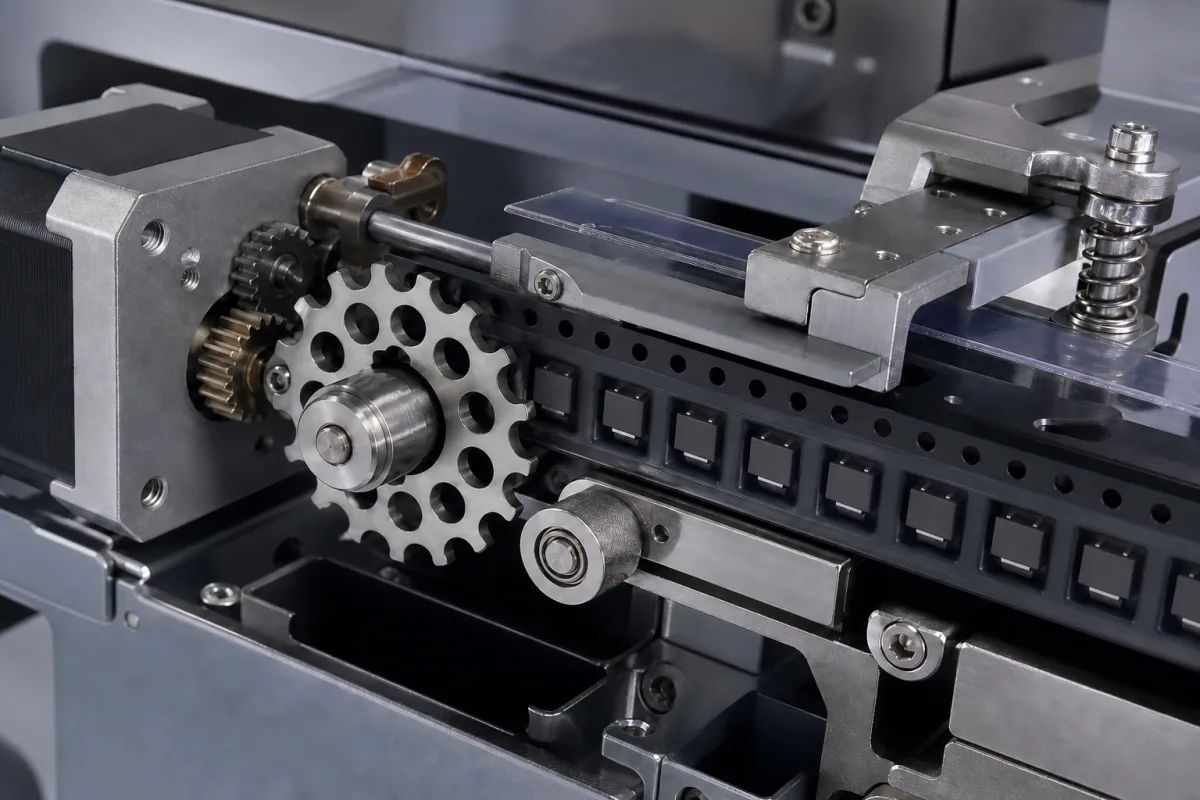
A canonical Tape Advance Mechanism is characterized by the integration of Drive Sprocket and Stepper/Servo Motor. In industrial production environments, manufacturers listed on CNFX commonly emphasize Stainless Steel construction to support stable, high-cycle operation across diverse manufacturing scenarios.

A mechanical system within a component feeder that precisely advances tape carrying electronic components to the pick-up position.
Product Specifications

Technical details and manufacturing context for Tape Advance Mechanism

Definition
The Tape Advance Mechanism is a critical sub-assembly of a Component Feeder used in automated assembly lines, particularly in surface-mount technology (SMT) equipment. It controls the incremental movement of carrier tape containing electronic components (such as resistors, capacitors, or integrated circuits) from the supply reel to the precise location where a pick-and-place machine can extract the component for placement onto a printed circuit board (PCB).
Working Principle
The mechanism typically uses a sprocket or drive wheel that engages with perforations (sprocket holes) along the edge of the carrier tape. A stepper or servo motor provides controlled rotational motion to the sprocket, advancing the tape by one pocket (component cavity) per cycle. An indexing sensor (often optical) detects the position of the tape to ensure accurate alignment of each component pocket with the feeder's pick-up point before the advance cycle is initiated.
Common Materials
Stainless Steel, Aluminum Alloy, Engineering Plastic (e.g., POM)
Technical Parameters
  • Pitch (center-to-center distance between component pockets on the tape), typically 2mm, 4mm, 8mm, 12mm, 16mm, 24mm, or 32mm. (mm) Customizable
Components / BOM
  • Drive Sprocket
    Engages with the sprocket holes on the carrier tape to pull it forward.
    Material: Stainless Steel
  • Stepper/Servo Motor
    Provides the controlled rotational force to drive the sprocket.
    Material: Various (Motor Housing: Aluminum, Internal: Copper Windings, Magnets)
  • Indexing Sensor
    Optical or mechanical sensor that detects tape position to ensure accurate indexing.
    Material: Engineering Plastic, Glass (for lens)
  • Tape Guide Rails
    Channels that constrain the carrier tape laterally to maintain alignment during advance.
    Material: Stainless Steel or Aluminum Alloy
Engineering Reasoning
0.5-2.0 N·m torque, 0.1-1.0 mm/s advance rate, 0.01 mm positioning accuracy
Torque exceeding 2.5 N·m causes gear tooth shear at 350 MPa yield strength, advance rate below 0.05 mm/s causes tape slippage exceeding 0.5 mm cumulative error
Design Rationale: Gear tooth fatigue failure due to cyclic loading at 10^6 cycles (Miner's rule), tape adhesion degradation following Arrhenius equation with activation energy 80 kJ/mol at 60°C
Risk Mitigation (FMEA)
Trigger Stepper motor phase loss due to driver IC thermal shutdown at 150°C junction temperature
Mode: Intermittent tape advance causing 0.3-0.8 mm positional drift per cycle
Strategy: Motor driver heatsink design maintaining junction temperature below 125°C with 15°C thermal margin
Trigger Tape spool bearing lubrication depletion after 500,000 cycles at 2 Hz operation
Mode: Increasing friction torque from 0.8 N·m to 2.2 N·m over 1000 cycles
Strategy: Sealed-for-life bearings with PTFE lubricant rated for 10^7 cycles at 3 Hz maximum

Industry Taxonomies & Aliases

Commonly used trade names and technical identifiers for Tape Advance Mechanism.

Applied To / Applications

This component is essential for the following industrial systems and equipment:

Industrial Ecosystem & Supply Chain DNA

Complementary Systems
Downstream Applications
Specialized Tooling

Application Fit & Sizing Matrix

Operational Limits
pressure: Atmospheric only (no pressure differentials)
other spec: Tape width: 8-32mm, Component pitch: 4-24mm, Max tape speed: 0.5m/s, Positioning accuracy: ±0.1mm
temperature: 15°C to 35°C (operational), 0°C to 50°C (storage)
Media Compatibility
✓ Embossed carrier tape with ESD-safe materials ✓ Paper/polyester composite carrier tapes ✓ Clear cover tape with standard adhesive
Unsuitable: Corrosive chemical environments or conductive dust contamination
Sizing Data Required
  • Component pitch (mm)
  • Maximum tape advance rate (components/hour)
  • Required positioning accuracy (±mm)

Reliability & Engineering Risk Analysis

Failure Mode & Root Cause
Misalignment-induced wear
Cause: Improper installation or gradual component drift causing uneven tape tension, leading to accelerated wear on rollers, guides, and drive components.
Motor/Drive system failure
Cause: Overheating due to excessive load, dust/debris ingress, or electrical issues (e.g., voltage spikes, worn brushes in DC motors) leading to torque loss or complete stoppage.
Maintenance Indicators
  • Audible squealing, grinding, or irregular clicking noises during operation
  • Visible tape slippage, uneven winding, or inconsistent advance speed
Engineering Tips
  • Implement regular laser alignment checks and tension calibration using a tension gauge to ensure optimal roller and guide positioning
  • Establish preventive maintenance schedule for cleaning air vents/filters, inspecting electrical connections, and lubricating bearings with manufacturer-specified lubricants

Compliance & Manufacturing Standards

Reference Standards
ISO 9001:2015 - Quality management systems ANSI/ASME B46.1-2019 - Surface Texture DIN 55350-12:2009 - Quality management and quality assurance
Manufacturing Precision
  • Shaft alignment: +/-0.05mm
  • Roller concentricity: 0.03mm TIR
Quality Inspection
  • Dimensional verification with CMM
  • Functional endurance testing under load

Factories Producing Tape Advance Mechanism

Verified manufacturers with capability to produce this product in China

✓ 92% Supplier Capability Match Found

P Project Engineer from United States Feb 14, 2026
★★★★★
"The Tape Advance Mechanism we sourced perfectly fits our Computer, Electronic and Optical Product Manufacturing production line requirements."
Technical Specifications Verified
S Sourcing Manager from United Arab Emirates Feb 11, 2026
★★★★★
"Found 55+ suppliers for Tape Advance Mechanism on CNFX, but this spec remains the most cost-effective."
Technical Specifications Verified
P Procurement Specialist from Australia Feb 08, 2026
★★★★★
"The technical documentation for this Tape Advance Mechanism is very thorough, especially regarding technical reliability."
Technical Specifications Verified
Verification Protocol

“Feedback is collected from verified sourcing managers during RFQ (Request for Quote) and factory evaluation processes on CNFX. These reports represent historical performance data and technical audit summaries from our B2B manufacturing network.”

8 sourcing managers are analyzing this specification now. Last inquiry for Tape Advance Mechanism from Brazil (46m ago).

Supply Chain Compatible Machinery & Devices

Industrial IoT Gateway

Edge computing device connecting industrial equipment to cloud platforms.

Explore Specs →
Modular Industrial Edge Computing Device

Rugged computing platform for industrial data processing at the network edge

Explore Specs →
Industrial Smart Camera Module

Embedded vision system for industrial automation and quality inspection.

Explore Specs →
Industrial Wireless Power Transfer Module

Wireless power transfer module for industrial equipment applications

Explore Specs →

Frequently Asked Questions

What materials are used in the tape advance mechanism for durability?

Our mechanism uses stainless steel for critical wear components, aluminum alloy for lightweight structural parts, and engineering plastics like POM for smooth tape guidance, ensuring long-term reliability in manufacturing environments.

How does the indexing sensor improve tape positioning accuracy?

The indexing sensor detects sprocket holes in the carrier tape, providing feedback to the stepper/servo motor for closed-loop control. This ensures ±0.1mm positioning accuracy for consistent component pick-up in automated assembly lines.

Can this mechanism handle different tape widths for various electronic components?

Yes, the adjustable tape guide rails accommodate standard tape widths from 8mm to 56mm. The drive sprocket is designed to engage with common tape pitch specifications used in SMT and through-hole component packaging.

Can I contact factories directly on CNFX?

CNFX is an open directory, not a transaction platform. Each factory profile provides direct contact information and production details to help you initiate direct inquiries with Chinese suppliers.

Get Quote for Tape Advance Mechanism

Request technical pricing, lead times, or customized specifications for Tape Advance Mechanism directly from verified manufacturing units.

Your business information is encrypted and only shared with verified Tape Advance Mechanism suppliers.

Thank you! Your message has been sent. We'll respond within 1–3 business days.

Need to Manufacture Tape Advance Mechanism?

Connect with verified factories specializing in this product category

Add Your Factory Contact Us
Previous Product
Tamper-Detection Mesh
Next Product
Telemetry Interface