Editorial Technical Reference

Control Panel Interface

This page explains how Control Panel Interface is classified within Computer, Electronic and Optical Product Manufacturing. Technical values and manufacturer relationships are research references; confirm the current specification and supplier evidence for each order.

Technical Definition & Core Assembly

The user-facing software component of a graphical user interface module that provides operators with interactive controls and visual feedback for system monitoring and command input.
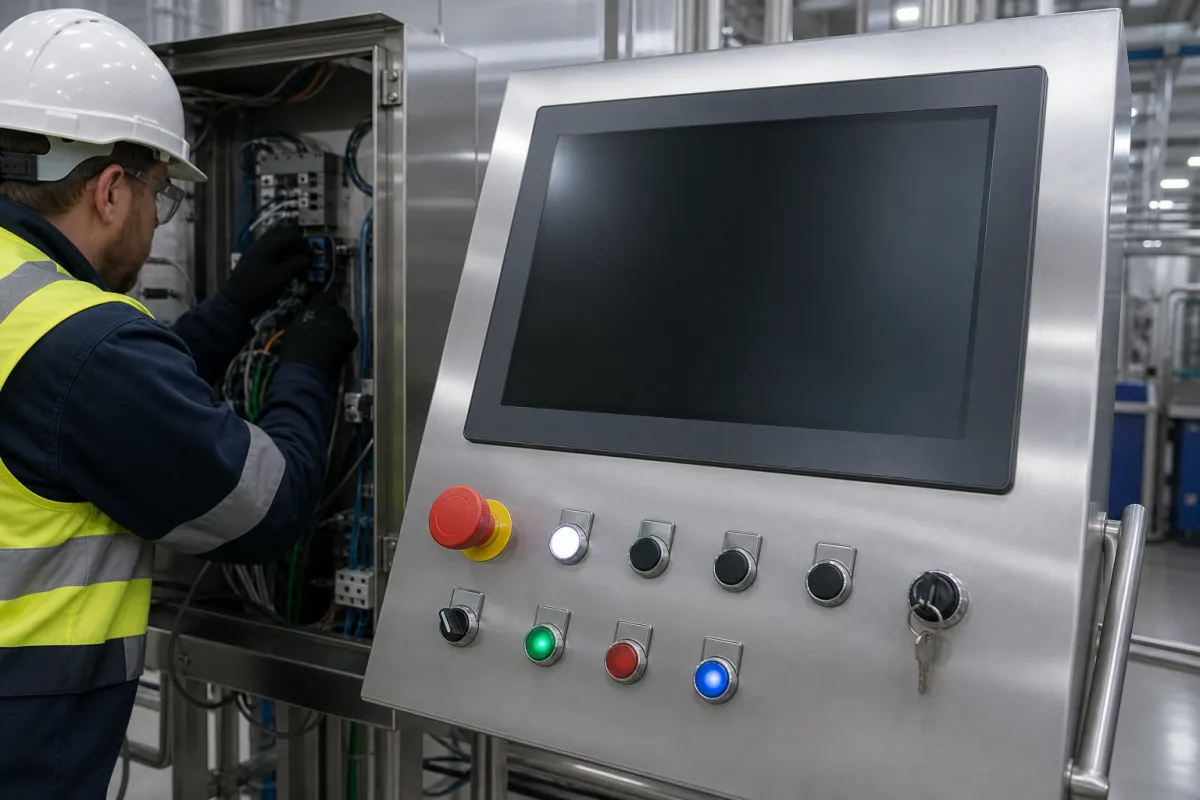
Control Panel Interface in a manufacturing environment
Representative product image. Confirm appearance and specifications with the manufacturer.

Product Specifications

Technical details and manufacturing context for Control Panel Interface

Definition
A control panel interface is the interactive software component within a graphical user interface module that serves as the primary human-machine interface for industrial systems. It displays real-time operational data, system status indicators, and provides input controls (buttons, sliders, menus) that allow operators to monitor processes, adjust parameters, initiate commands, and respond to alerts. This interface translates complex system operations into intuitive visual representations and actionable controls, enabling efficient supervision and management of industrial equipment and processes. The interface is typically housed in an enclosure with a display panel, touch overlay, and embedded processor, and runs on firmware or software that manages communication with the control system. It supports various communication interfaces such as RS-232, RS-485, and Ethernet, and may include memory for data logging. The operating temperature range is -10 to 55 °C, storage temperature -20 to 70 °C, and relative humidity 10 to 90% non-condensing. Ingress protection ratings range from IP54 to IP65, supply voltage is 24 V DC ±10%, power consumption 5 to 15 W, display resolution from 800×480 to 1920×1080 pixels, and touch screen types from resistive to capacitive. Memory ranges from 128 to 512 MB, weight from 0.5 to 3.0 kg, and dimensions from 150×100×30 to 400×300×80 mm. These values are reference ranges; actual specifications must be confirmed with the manufacturer for the specific model and application. Standards such as IEC 60068-2-1, IEC 60068-2-2, IEC 60068-2-78, IEC 60529, IEC 61131-2, and IEC 61158 are referenced for testing and verification, but do not imply certification or compliance of any specific product.
Working Principle
The control panel interface operates by receiving data signals from connected sensors and system components, processing this information through embedded software algorithms, and rendering it visually on a display screen. It accepts user input through touch, mouse, or keyboard interactions, converts these inputs into command signals, and transmits them to the control system. The interface continuously updates display elements based on real-time feedback from the system, maintaining synchronization between the operator's view and actual system state. This ensures that operators can monitor processes, adjust parameters, and respond to alerts effectively.
Common Materials
LCD/TFT display panel, Touch-sensitive overlay, Embedded processor, Interface software/firmware
Technical Parameters
ParameterTypical rangeNotes & selection driver
Operating Temperature-10–55 °COutside this range, display response may degrade.
Storage Temperature-20–70 °CProlonged exposure beyond limits may damage components.
Relative Humidity10–90 % RHNon-condensing; condensation may cause short circuits.IEC 60068-2-78
Ingress ProtectionIP54–IP65Higher rating required for dusty or wet environments.IEC 60529
Supply Voltage24 ±10% V DCOutside range may cause malfunction or damage.IEC 61131-2
Power Consumption5–15 WDepends on display size and backlight brightness.
Display Resolution800×480–1920×1080 pixelsHigher resolution for detailed graphics.
Touch Screen TypeResistive–CapacitiveCapacitive for multi-touch and better clarity.
Communication InterfaceRS-232, RS-485, EthernetMultiple protocols supported.IEC 61158
Memory128–512 MBFlash memory for data logging.
Weight0.5–3.0 kgDepends on screen size and enclosure.
Dimensions (W×H×D)150×100×30–400×300×80 mmPanel cutout size varies by model.

Ranges are indicative industry figures for RFQ preparation, not a supplier commitment. Confirm every value and standard with the legal manufacturer before ordering.

Components / BOM
  • Display Module
    Visual output of system data, status indicators, and control elements
    Material: LCD/TFT panel with protective glass
  • Touch Sensor Layer Part
    Detects and interprets user touch inputs for control interaction
    Material: Capacitive or resistive touch film
  • Processing Unit
    Executes interface software, processes data, and manages communication
    Material: Embedded microprocessor with memory
  • Interface Controller
    Manages communication between the interface and external control systems
    Material: Communication protocol chips and circuitry
  • Enclosure/Bezel Part
    Protects internal components and provides mounting structure
    Material: Industrial-grade plastic or metal

Application & selection

Application Fit & Sizing Matrix

Operational Limits
pressure: N/A (software component)
other spec: Display resolution: 1920x1080 minimum, Refresh rate: 60Hz, Input latency: <50ms
temperature: 0°C to 50°C (operating), -20°C to 70°C (storage)
Media Compatibility
✓ Clean industrial air environments ✓ Control rooms with filtered air ✓ Enclosed operator cabins
Unsuitable: Wet or high-humidity environments without proper IP-rated enclosures
Sizing Data Required
  • Required screen resolution and size
  • Number of simultaneous control interfaces needed
  • Integration protocol requirements (e.g., OPC UA, Modbus, Ethernet/IP)

Risk, maintenance & compliance

Reliability & Engineering Risk Analysis

Failure Mode & Root Cause
Electrical Contact Degradation
Cause: Oxidation or contamination of relay contacts, switches, or terminal connections due to environmental exposure (moisture, dust, corrosive atmospheres) leading to increased resistance, arcing, and eventual failure.
Display/Interface Malfunction
Cause: LCD/LED screen failure or touchscreen unresponsiveness caused by prolonged exposure to UV light, temperature extremes, mechanical stress, or internal component aging (backlight, drivers).
Maintenance Indicators
  • Intermittent or erratic operation (e.g., controls responding unpredictably, display flickering)
  • Unusual audible indicators (e.g., buzzing from relays, arcing sounds, or alarms from integrated diagnostics)
Engineering Tips
  • Implement environmental controls: Maintain clean, dry, and temperature-stable conditions; use sealed enclosures or NEMA-rated panels to prevent contamination and condensation.
  • Adhere to scheduled preventive maintenance: Regularly inspect and clean internal components, verify tight electrical connections, and update firmware/software to address known issues.

Indicative industry ranges for design and RFQ preparation. Confirm the exact figures and applicable standard with the manufacturer before specifying.

Compliance & Manufacturing Standards

Applicable Standards
ISO 13849-1: Safety of machinery - Safety-related parts of control systems ANSI/UL 508A: Standard for Industrial Control Panels CE Marking (EN 60204-1: Safety of machinery - Electrical equipment of machines)

Quoted from the published standard.

Manufacturing Precision
  • Panel cutout dimensions: +/-0.5mm
  • Component mounting hole alignment: +/-0.2mm
Quality Inspection
  • Dielectric withstand test (hipot test)
  • Functional safety verification test
Technical documentation
Request current drawings, revision history, and a signed specification sheet.
Manufacturing capability
Verify equipment lists, process limits, capacity, and representative production evidence.
Inspection readiness
Confirm test methods, calibrated equipment, sampling plans, and traceable reports.
Supplier transparency
Check the legal entity, factory address, ownership, certifications, and direct contacts.

Compare the published product scope and source details, then include your specifications and quantity in an enquiry.

Manufacturers of Control Panel Interface

Manufacturer profiles associated with Control Panel Interface.

Sourcing Control Panel Interface from China?
Tell us your specification and target quantity — we will match it against manufacturer records and come back with the factories that fit.
Request manufacturers We manufacture this

Explore company information and manufacturing capabilities, then discuss the scope of your project with a relevant supplier.

Buyer enquiry

Request manufacturing insight for Control Panel Interface

Ask for use case, specification boundaries, supplier type, and RFQ preparation information for this product.

Where it goes
Straight to the CNFX editorial desk, and to the manufacturer if this product is linked to a claimed profile. Nothing is broadcast to a supplier list.
Your details stay here
We do not sell or rent enquiry data, and we do not add you to a mailing list. Used only to answer this request.
No commission, no middleman
CNFX is a directory. We take no cut of any order and never negotiate on a supplier's behalf.
What to include
Share your product specifications, quantity, destination and target delivery date.

Your business information is used only to process this request.

Thank you! Your message has been sent. We'll respond within 1–3 business days.
Sorry, we couldn't send your message. Please try again, or email us at [email protected].

Frequently Asked Questions

What is a control panel interface?

A control panel interface is the interactive software component within a graphical user interface module that provides operators with visual feedback and controls for monitoring and commanding industrial systems.

What are the typical operating temperature ranges?

The listed operating temperature range is -10 to 55 °C and the listed storage temperature range is -20 to 70 °C; both must be confirmed with the manufacturer for the specific interface. IEC 60068-2-1 and IEC 60068-2-2 are cold and dry-heat test methods and do not establish these ranges.

What communication interfaces are supported?

Common interfaces include RS-232, RS-485, and Ethernet, referencing IEC 61158. Actual support depends on the model.

What standards are referenced for verification?

Standards such as IEC 60068-2-1, IEC 60068-2-2, IEC 60068-2-78, IEC 60529, IEC 61131-2, and IEC 61158 are used for testing and verification. They do not guarantee certification.

Related equipment

Applied To / Applications

This component is essential for the following industrial systems and equipment:

Data Basis

Editorial classification, named public sources where available, and source-reviewed manufacturer records.

Preliminary Technical Classification
This page supports structured research, RFQ preparation, and supplier evaluation. It does not replace buyer-led supplier qualification, standards review, or technical approval.

Need to Manufacture Control Panel Interface?

Compare manufacturer profiles with relevant product and process capability.

Previous Product
XY Positioning Stage
Last Product
Get QuotesChat