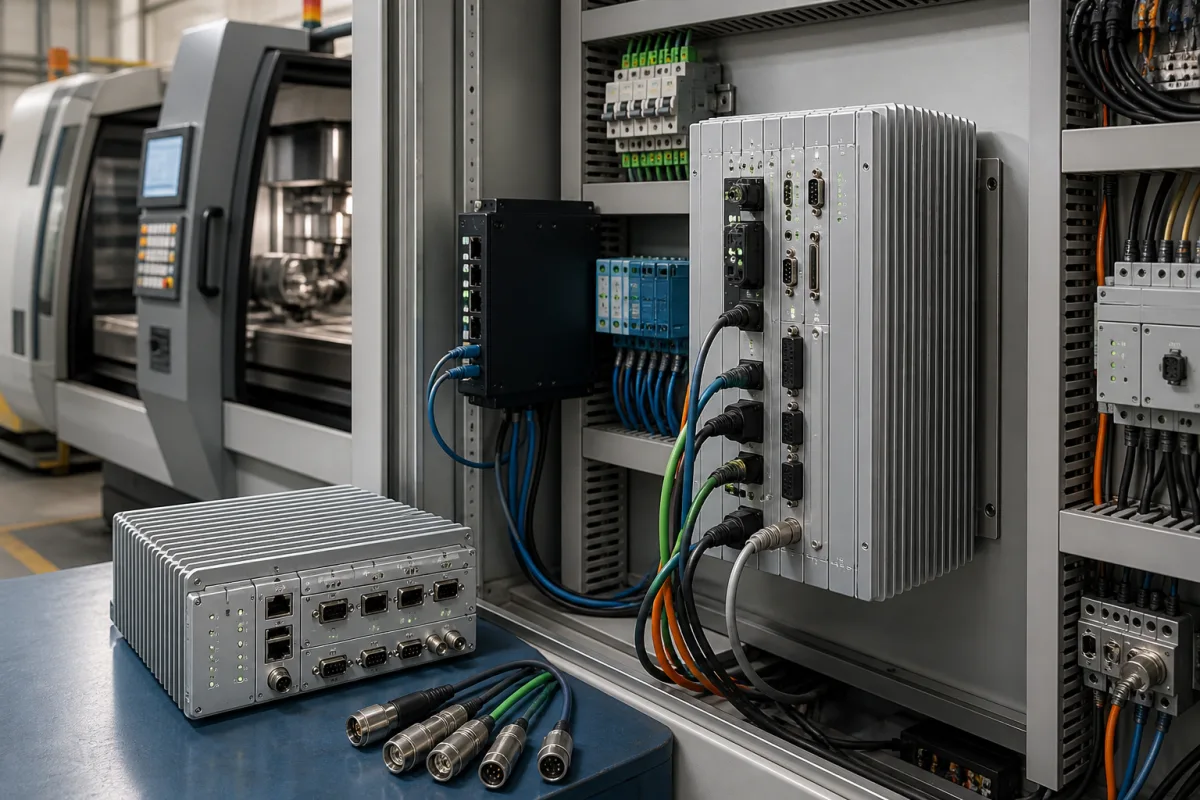
Machine-tool data processing unit: the cabinet box that reads the CNC and serves MTConnect or OPC UA data
The small fanless computer bolted into a CNC machine's cabinet to collect its data · MTConnect adapter and agent, OPC UA for Machine Tools variables, and how NIST wired and fenced off its own shop floor
On a machine tool, the 'processing unit' that plant IT asks for can be a small fanless computer in or beside the electrical cabinet, as in the picture: Ethernet and serial lines from the CNC go in, and a standard data stream comes out for monitoring, MES or analytics software. What it must do is set by three things: which interface the controller can speak (an MTConnect adapter, an OPC UA server, or neither), which signals the plant wants and how fast they change, and how the box is networked without exposing an old controller to the plant network.
Edge data-collection units for CNC machine tools: the computer that hosts the controller adapter, an MTConnect agent or an OPC UA for Machine Tools server, and its network connection to MES and monitoring software. Automatic assembly cells such as O-ring fitting machines are covered on the Automatic O-ring assembly page. The hardware ruggedness of box PCs (cooling, temperature range, shock, power input) is covered on the Industrial computer page, real-time soft-PLC control computers on the Control computer for real-time machine control page, and plain serial-to-Ethernet converters on the Serial device server page.
CNFX editorial research · Sources checked October 12, 2026 · 3 sources
Adapter in, agent out: SHDR lines from the CNC, HTTP documents on port 5000 and a 131,072-slot buffer
MTConnect splits the job in two. An adapter talks to the controller's own interface; an agent turns what the adapter sends into standard documents that any client can request. Both can run on the same cabinet box.
NIST describes the adapter as an optional piece of software or hardware that interfaces with the equipment's programming interface, and the agent as a special-purpose HTTP server that publishes MTConnect response documents. Clients make four requests: probe (the device model), current (the latest values), sample (a specified number of entries) and asset. NIST notes that the agent reports only changes in data items, and that the availability of data is the only data item a device must report to comply with the standard. [3]
The MTConnect Institute's C++ reference agent shows the default settings such a box starts with: it listens for HTTP on port 5000, takes an adapter on port 7878 in its minimal example, and keeps samples, events and conditions in a circular buffer of 2^17 = 131,072 slots, with up to 1,024 assets in memory. Its README describes SHDR as a timestamped pipe-delimited text stream over plain TCP, created for CNC controls and legacy equipment that cannot support MQTT or HTTP, and lists it as the adapter input for CNC and legacy equipment, with MQTT for IoT sensors and PLC networks. [1]
Editorial calculation: the buffer is counted in observations, not time. Assuming a machine whose adapter sends 50 changed values per second, 131,072 slots cover 131,072 ÷ 50 ≈ 2,621 s, about 44 minutes; a client that is offline longer than that loses the gap unless the buffer is enlarged or data is archived elsewhere. At 5 changes per second the same buffer covers about 7.3 hours.
Device model, latest values, a run of entries, asset documents [3]
Which requests your MES or dashboard uses
For a quotation, give the controller make, model and software version, whether the builder supplies an MTConnect adapter or an OPC UA server, the data items wanted, the expected change rate, and how long data must survive a network outage.
02
Legacy machine signals and the OPC 40501-1 variables that replace them: production state, feed override, alarm severity 667
Where the controller or the box runs an OPC UA server instead, OPC 40501-1 (OPC UA for Machine Tools, Part 1, release 1.02.0 of 1 November 2024) gives the machine one information model for monitoring and job overview, aimed at MES, SCADA, ERP and analytics clients. [2]
The specification's informative Annex B maps the signals machine builders used to wire for leading customers onto its variables. A data processing unit that has to feed an existing dashboard can use this mapping to derive the old signals from the new model, or the other way round. [2]
Legacy signal
OPC 40501-1 source
Comment from the specification
Production
v1.00: channel mode, active program state, feed override and channel modifiers; from v1.01: machine item state Executing and operation mode Processing [2]
Combination of states, not one bit
Override 0, 70–99, ≥100 or =100 %
ChannelMonitoringType FeedOverride as an absolute value [2]
Per NC channel; a combined machine-level value also exists
Any alarm with severity 667 or above; from v1.01 also item state OutOfService [2]
Threshold set in the annex
Technical breakdown
Item state OutOfService with operation mode Processing [2]
Added in v1.01
Organisation breakdown
Item state NotExecuting with operation mode Processing [2]
Added in v1.01
Number of total parts
PartsProducedInLifetime, or PartsCompleted per job from v1.01 [2]
Lifetime counter is not identical to the legacy signal
OPC 40501-1 deprecates its own PowerOnDuration variable (full hours since first power) in version 1.02 in favour of the counter in the OPC 40001-1 operation counters; ask which one the controller's server actually fills. [2]
03
Cabling and segregation around the box: Cat6 to a cell switch, access points about 6 m up, data pushed one way out
NIST's report on its Smart Manufacturing Systems Test Bed (AMS 200-2) is a worked example of networking these units on a real shop floor with milling, turning and inspection equipment.
NIST first aimed to use wireless links throughout but met interference from walls, metal columns, the metal in the machines, rotating spindles and the existing business wireless network, and was concerned about bandwidth once high-frequency sensors such as accelerometers were added. It settled on three cells: every controller and sensor in a cell is wired with Cat6 cable to a switch, and only the link out of the cell is wireless, through access points installed about six metres above the floor so the signal passes over the machines. [3]
The router behind the access points leads into a segmented research equipment network with strict firewall policies, because, NIST explains, machine tool controllers running outdated operating systems present a security risk; data may only be pushed from the data aggregator out to the organisational network. [3]
NIST also chose one agent per machine writing a daily 24-hour file in the SHDR pipe-delimited format (timestamp in UTC, data tag, value), restarted at a set time outside normal shop operations, archived and replayed into one larger agent for clients. It gives the reason: one interface for client applications without shutting down the whole data stream to service some devices. [3]
Ask the supplier where the unit sits in this chain (per-machine adapter and agent, or a cell-level aggregator), how it stores data during a network outage, which direction traffic may flow through the firewall, and how the controller's own network port is isolated.
04
Machine and data details to send with an enquiry
Paste it into your enquiry below or into an email to a maker, then replace every bracket.
Machine: [type; controller make, model and software version]
Interface available: [MTConnect adapter; OPC UA server and companion spec version; vendor API; serial port only]
Data wanted: [states; overrides; spindle and axis values; alarms; part counts]
Rate: [expected changes per second; high-frequency sensors to add]
Storage: [buffer size; local archive; outage duration to bridge]
Network: [cabled or wireless; cell switch; firewall direction; IT security rules]
Mounting: [inside cabinet or beside; supply voltage; space]
Explore company information and manufacturing capabilities, then discuss the scope of your project with a relevant supplier.
Share this page
Compiled and source-reviewed by the CNFX editorial team.
Each manufacturer above links to the page on that company's own website where the product is listed, with the date we checked it. How we source and review
· Page last updated 13 October 2026
Buyer questions
What is the difference between an MTConnect adapter and an agent?
NIST describes the adapter as software or hardware that talks to the equipment's interface and the agent as an HTTP server that publishes standard MTConnect documents to clients through probe, current, sample and asset requests. [3]
How much data does an MTConnect agent buffer?
The reference agent's default BufferSize of 17 gives 2^17 = 131,072 slots for samples, events and conditions; how long that lasts depends on how many values change per second. [1]
How does OPC UA for Machine Tools signal that the machine has an error?
OPC 40501-1 Annex B maps the legacy error signal to any alarm with severity 667 or above, and from version 1.01 also to the machine item state OutOfService. [2]
Should machine-tool data units use Wi-Fi?
NIST found interference from walls, metal and spindles on its shop floor and wired each cell with Cat6 to a switch, using wireless only for the link out of each cell. [3]
Sources and what still needs a direct check
Sources checked 2026-10-12. The MTConnect Institute maintains the open-source C++ reference agent; the OPC Foundation publishes the OPC 40501-1 companion specification; NIST's AMS 200-2 reports how its own test bed collects data from CNC machines.