Industry-Verified Manufacturing Data (2026)

Conversion Core

Based on aggregated insights from multiple verified factory profiles within the CNFX directory, the standard Conversion Core used in the Computer, Electronic and Optical Product Manufacturing sector typically supports operational capacities ranging from standard industrial configurations to heavy-duty production requirements.

Technical Definition & Core Assembly

A canonical Conversion Core is characterized by the integration of Digital Register/Latch and Reference Circuitry. In industrial production environments, manufacturers listed on CNFX commonly emphasize Silicon (for integrated circuits) construction to support stable, high-cycle operation across diverse manufacturing scenarios.

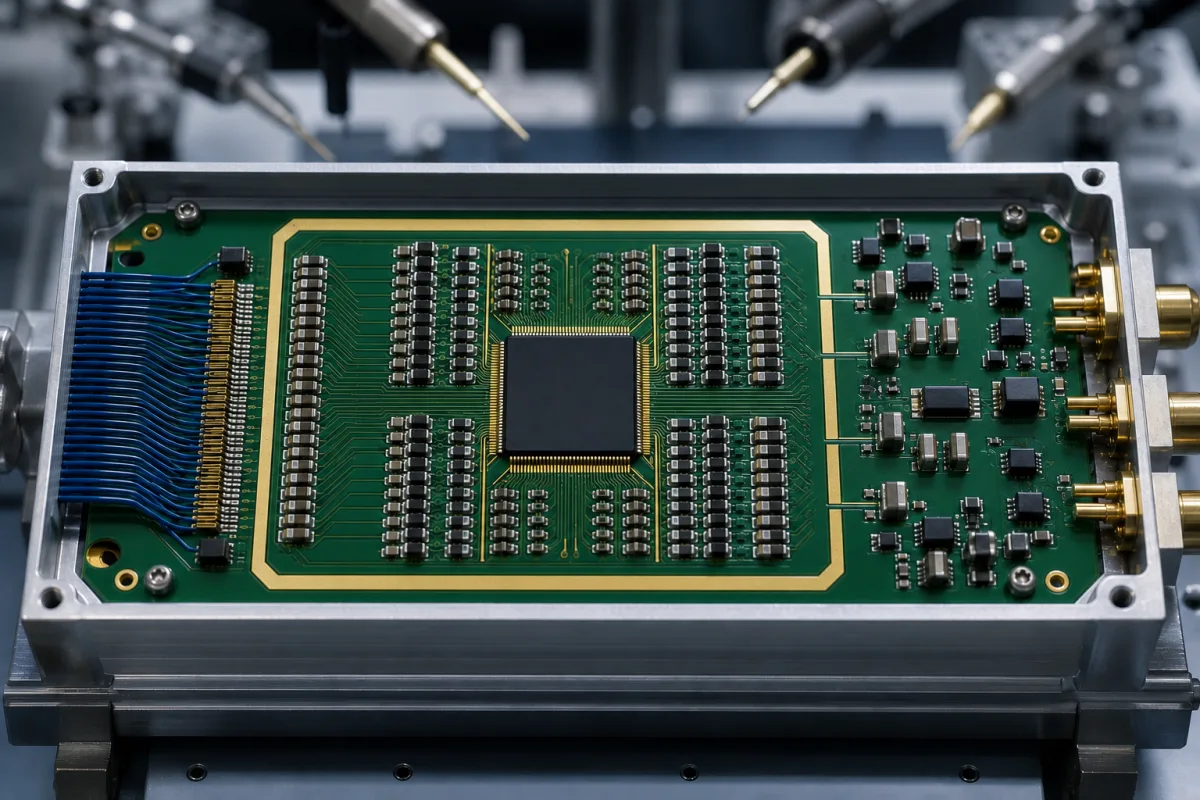
The central processing unit within a Digital-to-Analog Converter (DAC) responsible for transforming digital input signals into analog output signals.
Product Specifications

Technical details and manufacturing context for Conversion Core

Definition
The Conversion Core is the fundamental component of a Digital-to-Analog Converter that executes the primary conversion algorithm. It interprets discrete digital codes (typically binary) and generates a corresponding continuous analog voltage or current waveform. Its performance directly determines the DAC's key specifications such as resolution, accuracy, linearity, and conversion speed.
Working Principle
The core operates by receiving a digital input word (e.g., from a register or digital interface). Based on this input, it controls internal circuitry—such as a resistor ladder network (R-2R), current steering array, or sigma-delta modulator—to produce a precise analog output level proportional to the digital value. This process involves precise timing, reference voltage/current management, and often includes error correction mechanisms.
Common Materials
Silicon (for integrated circuits), Precision resistors, Metal interconnects
Technical Parameters
  • Resolution, defining the number of discrete output levels the core can produce (e.g., 8-bit, 16-bit, 24-bit). (bits) Standard Spec
Components / BOM
  • Digital Register/Latch
    Temporarily holds the incoming digital input word for processing by the conversion logic.
    Material: Silicon (transistors)
  • Reference Circuitry
    Provides a stable voltage or current reference against which the digital code is compared to generate the analog output.
    Material: Precision resistors, bandgap reference cells
  • Switching Network/Current Source Array
    The active element (e.g., switches in an R-2R ladder, current sources) controlled by the digital code to generate the analog signal.
    Material: Silicon (MOSFETs), metal interconnects
  • Output Buffer/Amplifier
    Conditions the raw analog signal from the switching network to provide adequate drive current, low output impedance, and signal integrity.
    Material: Silicon (operational amplifier circuitry)
Engineering Reasoning
0-5 VDC analog output, 0-3.3 VDC digital input, -40°C to +85°C ambient temperature
Digital input voltage exceeding 3.6 VDC causes CMOS latch-up, analog output current exceeding 20 mA causes thermal runaway
Design Rationale: Electromigration in 65nm CMOS transistors at current densities above 10^6 A/cm², dielectric breakdown at electric fields exceeding 10 MV/cm
Risk Mitigation (FMEA)
Trigger Clock jitter exceeding 50 ps RMS in digital timing signals
Mode: Signal-to-noise ratio degradation below 70 dB at 1 kHz output
Strategy: Phase-locked loop with 0.1 ppm frequency stability and differential clock distribution
Trigger Thermal gradient exceeding 15°C/mm across silicon die
Mode: Differential nonlinearity error exceeding 0.5 LSB at 16-bit resolution
Strategy: Thermal vias with 0.8 W/m·K conductivity and symmetric power distribution network

Industry Taxonomies & Aliases

Commonly used trade names and technical identifiers for Conversion Core.

Applied To / Applications

This component is essential for the following industrial systems and equipment:

Industrial Ecosystem & Supply Chain DNA

Complementary Systems
Downstream Applications
Specialized Tooling

Application Fit & Sizing Matrix

Operational Limits
pressure: Not applicable (solid-state component)
other spec: Digital input voltage range: 0V to 5V, Analog output voltage range: 0V to 10V
temperature: -40°C to +85°C
Media Compatibility
✓ Clean electronic signal environments ✓ Low-electromagnetic-interference (EMI) enclosures ✓ Temperature-controlled industrial control systems
Unsuitable: High-vibration, high-shock mechanical environments
Sizing Data Required
  • Digital input resolution (bits)
  • Analog output voltage/current range
  • Sampling/update rate (Hz)

Reliability & Engineering Risk Analysis

Failure Mode & Root Cause
Thermal fatigue cracking
Cause: Cyclic thermal stresses from repeated heating/cooling cycles during conversion processes, often exacerbated by rapid temperature changes or poor thermal management.
Corrosion-induced material degradation
Cause: Chemical attack from process fluids, catalysts, or byproducts, particularly at high temperatures and pressures, leading to thinning, pitting, or stress corrosion cracking.
Maintenance Indicators
  • Unusual vibration patterns or audible knocking sounds during operation, indicating potential internal component failure or imbalance.
  • Sudden pressure drop or temperature anomalies outside normal operating ranges, suggesting leaks, blockages, or heat transfer issues.
Engineering Tips
  • Implement predictive maintenance using vibration analysis and thermal imaging to detect early signs of fatigue and corrosion before catastrophic failure.
  • Optimize process parameters to minimize thermal cycling and chemical exposure, and apply protective coatings or linings to critical surfaces.

Compliance & Manufacturing Standards

Reference Standards
ISO 9001:2015 - Quality Management Systems ASTM A36/A36M - Standard Specification for Carbon Structural Steel CE Marking - Conformity with EU Directives for Machinery Safety
Manufacturing Precision
  • Bore Diameter: +/-0.02mm
  • Surface Flatness: 0.1mm per 100mm
Quality Inspection
  • Dimensional Verification with CMM (Coordinate Measuring Machine)
  • Ultrasonic Testing for Internal Defects

Factories Producing Conversion Core

Verified manufacturers with capability to produce this product in China

✓ 93% Supplier Capability Match Found

S Sourcing Manager from Germany Feb 25, 2026
★★★★★
"Great transparency on the Conversion Core components. Essential for our Computer, Electronic and Optical Product Manufacturing supply chain."
Technical Specifications Verified
P Procurement Specialist from Brazil Feb 22, 2026
★★★★☆
"The Conversion Core we sourced perfectly fits our Computer, Electronic and Optical Product Manufacturing production line requirements. (Delivery took slightly longer than expected, but technical support was excellent.)"
Technical Specifications Verified
T Technical Director from Canada Feb 19, 2026
★★★★★
"Found 24+ suppliers for Conversion Core on CNFX, but this spec remains the most cost-effective."
Technical Specifications Verified
Verification Protocol

“Feedback is collected from verified sourcing managers during RFQ (Request for Quote) and factory evaluation processes on CNFX. These reports represent historical performance data and technical audit summaries from our B2B manufacturing network.”

13 sourcing managers are analyzing this specification now. Last inquiry for Conversion Core from India (36m ago).

Supply Chain Compatible Machinery & Devices

Modular Industrial Edge Computing Device

Rugged computing platform for industrial data processing at the network edge

Explore Specs →
Industrial Smart Camera Module

Embedded vision system for industrial automation and quality inspection.

Explore Specs →
Industrial Wireless Power Transfer Module

Wireless power transfer module for industrial equipment applications

Explore Specs →
Industrial Smart Sensor Module

Modular industrial sensor with embedded processing and wireless connectivity

Explore Specs →

Frequently Asked Questions

What is the primary function of the Conversion Core in a DAC?

The Conversion Core serves as the central processing unit within a Digital-to-Analog Converter, responsible for accurately transforming digital input signals into analog output signals for applications like audio systems, industrial controls, and telecommunications.

What materials are used in manufacturing the Conversion Core?

The Conversion Core is manufactured using silicon for integrated circuits, precision resistors for signal accuracy, and metal interconnects for electrical connections, ensuring reliable performance in electronic and optical product manufacturing.

How does the Conversion Core's BOM components work together?

The Bill of Materials includes a Digital Register/Latch for input storage, Reference Circuitry for voltage stability, a Switching Network/Current Source Array for signal conversion, and an Output Buffer/Amplifier to deliver clean analog signals to downstream components.

Can I contact factories directly on CNFX?

CNFX is an open directory, not a transaction platform. Each factory profile provides direct contact information and production details to help you initiate direct inquiries with Chinese suppliers.

Get Quote for Conversion Core

Request technical pricing, lead times, or customized specifications for Conversion Core directly from verified manufacturing units.

Your business information is encrypted and only shared with verified Conversion Core suppliers.

Thank you! Your message has been sent. We'll respond within 1–3 business days.

Need to Manufacture Conversion Core?

Connect with verified factories specializing in this product category

Add Your Factory Contact Us
Previous Product
Controller IC
Next Product
Conveyor Integration Module