Editorial Technical Reference

Dispenser Unit

This page explains how Dispenser Unit is classified within Computer, Electronic and Optical Product Manufacturing. Technical values and manufacturer relationships are research references; confirm the current specification and supplier evidence for each order.

Technical Definition & Core Assembly

Precision dispensing component for applying adhesives or epoxies in semiconductor die attachment
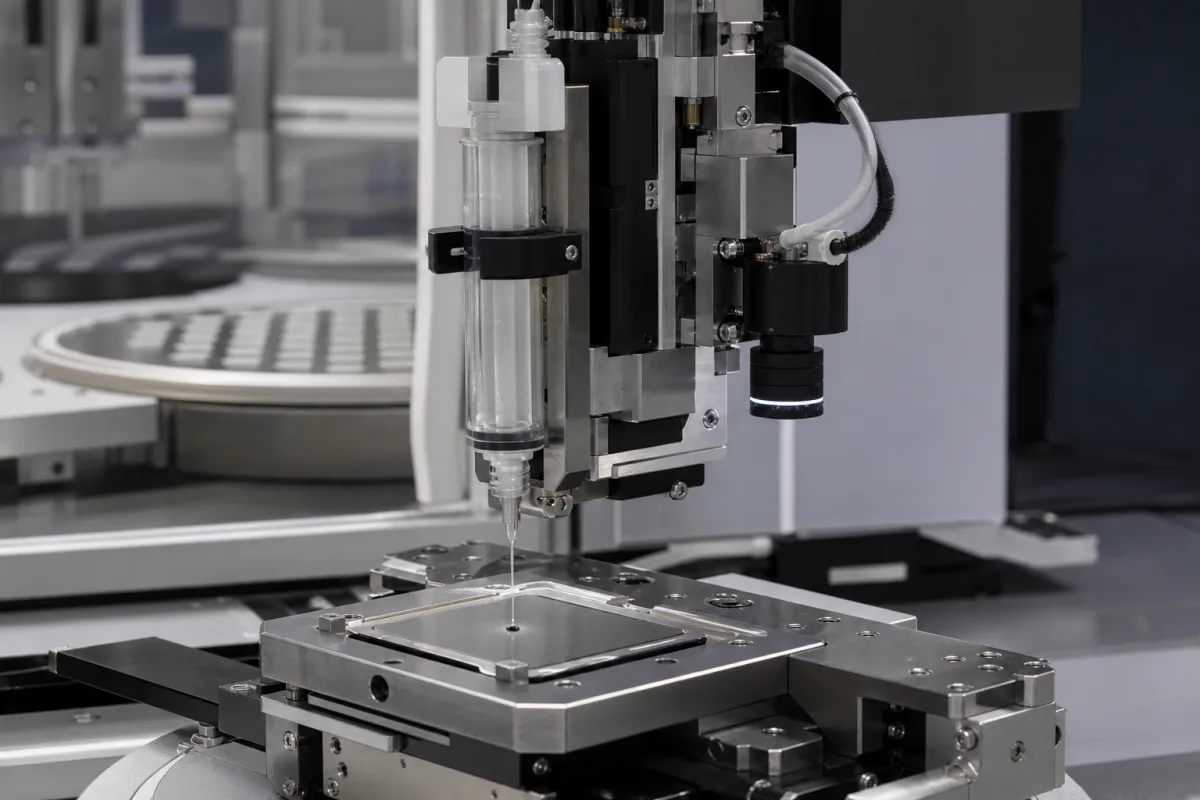
Representative product image. Confirm appearance and specifications with the manufacturer.

Product Specifications

Technical details and manufacturing context for Dispenser Unit

Definition
A Dispenser Unit is a precision component used in automated die attach machines within the semiconductor and microelectronics assembly industry. Its primary function is to accurately dispense controlled amounts of adhesive, epoxy, or other bonding materials onto substrates or leadframes, facilitating the attachment of semiconductor dies. The unit operates by drawing material from a reservoir and expelling it through a fine nozzle, with precise control over pressure, volume, and timing. This control is often synchronized with machine vision systems to ensure positional accuracy, critical for high-yield production.

The unit is designed for integration into larger automated systems, typically as a replaceable or serviceable part. It is constructed from materials such as stainless steel, ceramic, and PTFE, which provide chemical resistance and durability. Key parameters include a dispensing volume range of 0.01–5.0 mL per shot, with a repeatability accuracy of ±1%. Operating pressure is specified at 1.0–1.6 MPa, and the unit requires a 24 V DC supply (24 ±10%) with reverse polarity protection. Power consumption ranges from 15–60 W, depending on actuation frequency. The unit operates in non-condensing environments between 5–40 °C and can be stored at -10–60 °C. Ingress protection is rated IP54–IP65 per IEC 60529, and wetted parts are made of 316L stainless steel (ASTM A240). Weight varies from 1.2–2.5 kg, and dimensions are 120×80×150 mm (L×W×H).

These specifications are typical reference ranges; actual values must be confirmed with the manufacturer for the specific model and application. The unit is not a standalone product but a component that requires proper integration, calibration, and maintenance. Verification of compliance with standards such as IEC 60529 should be performed with the supplier. Regular inspection for wear, clogging, or leakage is recommended to maintain performance. Failure to operate within specified parameters may lead to inconsistent dispensing, affecting product quality.
Working Principle
The Dispenser Unit operates by using precision pneumatic or mechanical mechanisms to draw adhesive material from a reservoir and dispense it through a fine nozzle. The dispensing process is controlled by regulating pressure, volume, and timing, often synchronized with machine vision systems for accurate placement. The unit typically includes a valve or pump mechanism that opens and closes to release precise amounts of material. The control system adjusts the dispensing parameters based on the application requirements, ensuring consistent and repeatable results. The unit is designed to handle various viscosities and materials, with wetted parts made of corrosion-resistant materials like stainless steel and ceramic.
Common Materials
Stainless steel, Ceramic, PTFE
Technical Parameters
ParameterTypical rangeNotes & selection driver
Dispensing Volume0.01–5.0 mLAdjustable per shot
Dispensing Accuracy±1 %Repeatability of dispensed volume
Supply Voltage24 ±10% V DCProtected against reverse polarity
Power Consumption15–60 WDepends on actuation frequency
Operating Temperature5–40 °CNon-condensing environment
Storage Temperature-10–60 °CAvoid extreme temperature swings
Ingress ProtectionIP54–IP65Protection against dust and water jetsIEC 60529
Material316LStainless steel wetted partsASTM A240
Weight1.2–2.5 kgDepends on configuration
Dimensions (L×W×H)120×80×150 mmCompact design for tight spaces

Ranges are indicative industry figures for RFQ preparation, not a supplier commitment. Confirm every value and standard with the legal manufacturer before ordering.

Components / BOM
  • Dispensing Nozzle Part
    Forms and directs adhesive stream onto substrate
    Material: Stainless steel or ceramic
  • Pressure Regulator
    Controls air pressure for consistent dispensing
    Material: Brass or stainless steel
  • Material Reservoir
    Stores adhesive material for dispensing
    Material: PTFE or stainless steel
  • Dispensing Valve
    Opens and closes to release the metered shot of adhesive.
  • Dispensing Control
    Sets pressure, shot volume and timing, and syncs the shot to the vision system.

Industrial Ecosystem & Supply Chain Structure

Complementary Systems
Downstream Applications
Specialized Tooling

Application Fit & Sizing Matrix

Operational Limits
pressure: 0.1 to 0.5 MPa (1 to 5 bar)
flow rate: 0.1 to 10 µL/min (adjustable)
temperature: +5°C to +40°C (operating), -10°C to +60°C (storage)
slurry concentration: Up to 70% solids by weight
Media Compatibility
✓ Silver-filled epoxy adhesives ✓ Thermally conductive pastes ✓ UV-curable die attach materials
Unsuitable: Highly corrosive acidic or alkaline media (pH <2 or >12)
Sizing Data Required
  • Required dispense volume per unit (µL)
  • Production throughput (units/hour)
  • Viscosity of adhesive material (cP)

Reliability & Engineering Risk Analysis

Failure Mode & Root Cause
Seal degradation and leakage
Cause: Chemical incompatibility with dispensed fluids leading to swelling, hardening, or cracking of elastomeric seals; excessive pressure cycling causing fatigue failure; improper installation leading to misalignment and uneven wear
Valve sticking or binding
Cause: Particulate contamination in fluid stream causing buildup on valve seats and moving parts; corrosion from aggressive chemicals or moisture ingress; lack of lubrication on mechanical linkages; thermal expansion/contraction causing tolerance issues
Maintenance Indicators
  • Visible fluid leakage around seals, connections, or housing indicating seal failure or component damage
  • Irregular dispensing patterns, inconsistent flow rates, or unusual noises (clicking, grinding, hissing) during operation suggesting internal obstruction or mechanical issues
Engineering Tips
  • Implement proactive seal replacement based on chemical compatibility charts and service hours rather than waiting for failure; use compatible lubricants on moving parts and establish regular cleaning protocols to prevent contamination buildup
  • Install proper filtration upstream to remove particulates; conduct regular calibration checks to ensure consistent performance; maintain environmental controls to prevent moisture ingress and temperature extremes that accelerate degradation

Indicative industry ranges for design and RFQ preparation. Confirm the exact figures and applicable standard with the manufacturer before specifying.

Compliance & Manufacturing Standards

Applicable Standards
ANSI/ASME B46.1-2019 - Surface Texture DIN 11866-1 - Fittings for the food industry

Quoted from the published standard.

Manufacturing Precision
  • Dispensing Nozzle Bore: +/-0.01mm
  • Mounting Surface Flatness: 0.05mm
Quality Inspection
  • Leak Test at 1.5x Operating Pressure
  • Material Composition Verification via XRF Analysis

Manufacturers of Dispenser Unit

Manufacturer profiles associated with Dispenser Unit.

Sourcing Dispenser Unit from China?
Tell us your specification and target quantity — we will match it against manufacturer records and come back with the factories that fit.
Request manufacturers We manufacture this

Manufacturer listings support early research and capability understanding. They are not certification, ranking, or transaction guarantees.

Technical documentation
Request current drawings, revision history, and a signed specification sheet.
Manufacturing capability
Verify equipment lists, process limits, capacity, and representative production evidence.
Inspection readiness
Confirm test methods, calibrated equipment, sampling plans, and traceable reports.
Supplier transparency
Check the legal entity, factory address, ownership, certifications, and direct contacts.

CNFX does not score or rank suppliers. Buyers must verify all claims and documents with the legal manufacturer before ordering.

Supply Chain Compatible Machinery & Devices

Industrial Smart Camera Module

The Industrial Smart Camera Module is a compact, self-contained vision processing unit designed for integration into industrial machinery and production lines.

Explore Specs →
Surface Mount Resistor

Passive electronic component for current limiting and voltage division in circuits

Explore Specs →
Surface Mount Capacitor

A surface mount capacitor is a fundamental electronic component used for energy storage, filtering, coupling, and decoupling in electronic circuits.

Explore Specs →
Surface Mount Technology (SMT) Pick-and-Place Machine

Automated machine that precisely places electronic components onto printed circuit boards.

Explore Specs →

Frequently Asked Questions

What is the dispensing volume range of this unit?

The dispensing volume is adjustable per shot, ranging from 0.01 to 5.0 mL. The exact volume depends on the application and must be set and verified according to the manufacturer's instructions.

What is the operating pressure requirement?

The operating pressure is specified as 1.0–1.6 MPa. The unit must be operated within this range to ensure proper sealing and dispensing.

What are the electrical requirements?

The unit requires a 24 V DC supply with a tolerance of ±10%. It is protected against reverse polarity. Power consumption ranges from 15 to 60 W, depending on actuation frequency.

What environmental conditions can the unit withstand?

The unit operates in non-condensing environments with temperatures between 5 and 40 °C. Storage temperature is -10 to 60 °C. It has an ingress protection rating of IP54–IP65 per IEC 60529, protecting against dust and water jets.

Data Basis

Editorial classification, named public sources where available, and source-reviewed manufacturer records.

Preliminary Technical Classification
This page supports structured research, RFQ preparation, and supplier evaluation. It does not replace buyer-led supplier qualification, standards review, or technical approval.
Buyer enquiry

Request manufacturing insight for Dispenser Unit

Ask for use case, specification boundaries, supplier type, and RFQ preparation information for this product.

Where it goes
Straight to the CNFX editorial desk, and to the manufacturer if this product is linked to a claimed profile. Nothing is broadcast to a supplier list.
Your details stay here
We do not sell or rent enquiry data, and we do not add you to a mailing list. Used only to answer this request.
No commission, no middleman
CNFX is a directory. We take no cut of any order and never negotiate on a supplier's behalf.
What we don't claim
A listing is not an endorsement. Qualify every supplier and verify every figure yourself before ordering.

Your business information is used only to process this request.

Thank you! Your message has been sent. We'll respond within 1–3 business days.
Sorry, we couldn't send your message. Please try again, or email us at contact@cnfx.com.

Need to Manufacture Dispenser Unit?

Compare manufacturer profiles with relevant product and process capability.

Previous Product
XY Positioning Stage
Last Product
Get QuotesChat