Gas and pneumatic control · Flow curve, supply pressure effect and creep
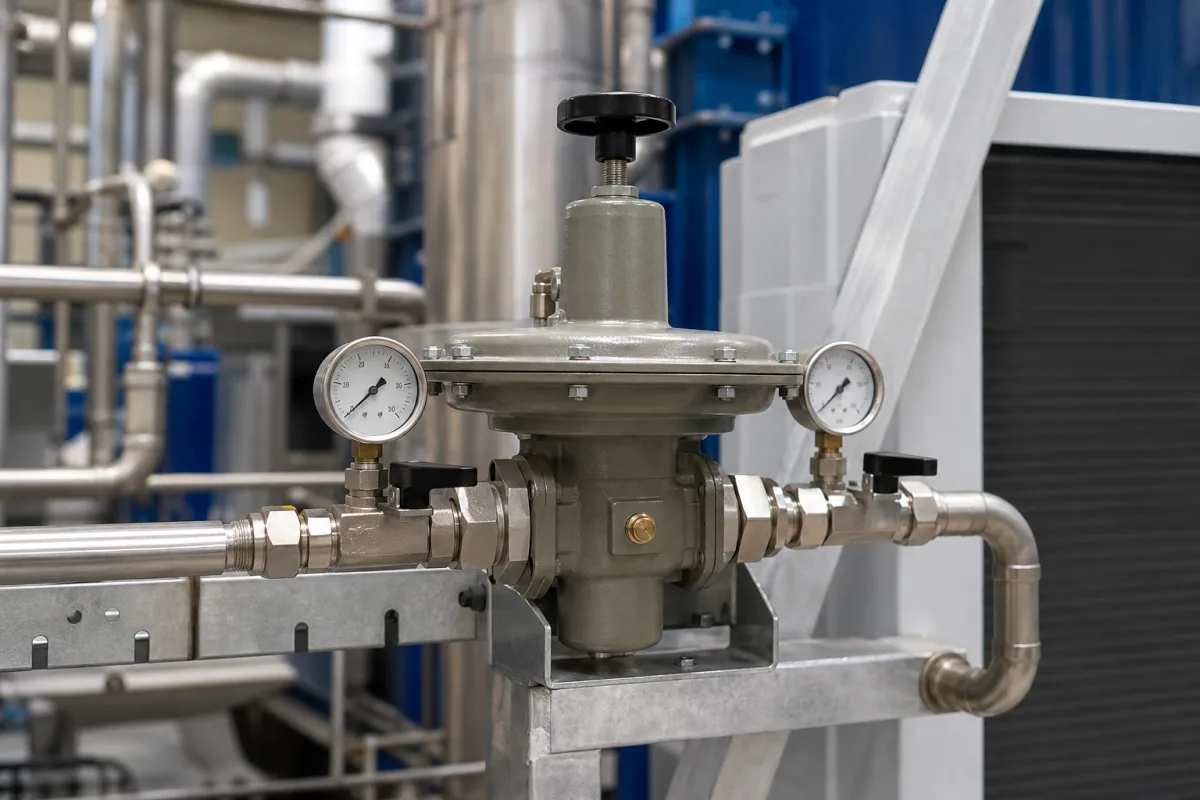
A pressure-reducing regulator holds outlet pressure while flow and inlet pressure change, but never perfectly. Read the maker's flow curve at your inlet pressure and flow, check how much outlet pressure rises as a cylinder empties, and keep the seat clean.
Spring-loaded and dome-loaded pressure-reducing and back-pressure regulators for compressed gases, instrument air and pneumatic systems, including precision and electro-pneumatic types. Steam and water pressure reducing valves are covered on the pressure reducing valve page.
CNFX editorial research · Sources checked October 11, 2026 · 4 sources
Read the flow curve at your inlet pressure and flow
Swagelok's technical bulletin explains that a regulator's flow curve plots outlet pressure against flow, and that flow is set downstream, not by the regulator. Each curve has a flat middle that slopes downward (droop), a steep drop at the far left (seat-load drop or lockup) and a steep drop at the far right (choked flow). Operate on the flat part. [1]
Cv is measured fully open, where the regulator is no longer controlling; Swagelok warns that selecting by Cv alone can give unsatisfactory performance. Swagelok states that “Typically, lock-up pressures will be less than 5 % of the total control range for a given model”, and a regulator nearing lockup may chatter. [1]
A regulator rated for a much higher inlet pressure than the system supplies shows more droop and coarser adjustment; choose an inlet rating close to actual system pressure. [1]
Give the supplier the gas, inlet pressure range, required outlet pressure, minimum and maximum flow, and how much outlet variation you can accept. Ask for the flow curve at those conditions.
02
Control the supply pressure effect
Swagelok defines supply pressure effect (SPE) as the change in outlet pressure per 100 psi (6.8 bar) change in inlet pressure: for standard pressure-reducing regulators, outlet pressure rises as supply pressure falls, as when a gas cylinder empties. [1]
Editorial calculation: a cylinder falling from 2,200 to 200 psi drops 2,000 psi, twenty steps of 100 psi, so outlet pressure rises by 20 times the regulator's SPE value. Ask for the SPE of the model you are buying.
Swagelok's troubleshooting guide lists a balanced poppet, or two single-stage regulators in series or an integral two-stage regulator, as ways to reduce SPE. It also advises setting the regulator to its off position before turning supply on or off, so SPE does not over-pressurise diaphragms, gauges or downstream equipment. [2][1]
03
Correct the curve for your gas and fluid
Swagelok notes that “Manufacturers usually create gas flow curves using air or nitrogen”. Swagelok gives a correction factor FG = √(0.97 / G) from nitrogen; for carbon dioxide FG is 0.80, so a curve point at 100 std ft³/min of nitrogen corresponds to 80 std ft³/min of carbon dioxide. Denser fluids also droop more and choke at lower flow. [1]
Swagelok also lists hydrogen at 3.72 and helium at 2.65, so light gases flow far more through the same regulator at the same curve point. Check seat and seal materials against the gas, and its temperature. [1][3]
04
Diagnose droop, creep and the wrong regulator type
Swagelok's troubleshooting guide separates three faults: pressure falling below set point (droop) is “commonly caused by one of two things”: an undersized regulator or an incorrectly set pressure spring and range; pressure rising above set point is SPE or creep, where contamination holds the seat slightly open. Use a pressure-reducing regulator to control downstream pressure and a back-pressure regulator to control upstream pressure. [2]
For droop it suggests a set-pressure range closer to the required pressure, a larger flow coefficient or a dome-loaded regulator; for creep, an inline filter upstream and a relief valve to protect downstream equipment. [2]
Hysteresis means outlet pressure differs slightly for rising and falling flow; Swagelok recommends approaching set pressure from below and fitting gauges to fine-tune. [1]
05
Instrumentation, precision, pneumatic and LP gas regulators, with Hikelok's PR1 data
Hikelok's PR1 general-purpose regulator states a 3500 psig (241 bar) maximum inlet, outlet ranges from 0–25 to 0–500 psig, Cv 0.06, bubble-tight internal leakage and PCTFE, PEEK or PI seats with temperature limits of 80, 200 and 260 °C; it also lists back-pressure and two-stage models. NNT lists electro-pneumatic proportional regulators. These are suppliers' own data. [3][4]
06
Loading element, sensing element, poppet and seat, body and ports, filter and relief
The seat row carries two limits at once: its material sets the temperature rating, as in Hikelok's PCTFE, PEEK and PI options at 80, 200 and 260 °C, and its cleanliness decides whether the regulator creeps. [3][2]
Part
Role
Fix in the order
Loading element
Spring or dome pressure sets outlet pressure. [2][3]
Set pressure range, droop and SPE, inlet rating, seat temperature, Cv and leakage for a regulator order
Cv is the one row that should not drive the choice: Swagelok measures it fully open, where the regulator no longer controls, so ask for the flow curve at your inlet pressure and gas instead. [1]
Paste it into your enquiry below or into an email to a maker, then replace every bracket.
Gas: [name; purity; corrosive or toxic; temperature]
Pressures: [inlet range, e.g. full to empty cylinder; required outlet; acceptable variation]
Flow: [minimum; normal; maximum]
Type: [pressure-reducing or back-pressure; single or two-stage; spring or dome loaded; electronic]
Construction: [body, diaphragm and seat materials; ports; panel mounting; gauges]
Protection: [inline filter; relief valve setting]
Documents: [flow curve at your conditions; SPE value; leakage test]
12 companies list this product among what they make. Company figures are quoted from each
company's own website; every card states where the relationship came from.
Hikelok
Manufacturing site to be confirmed for the order
Lists PR1–PR6 pressure-reducing, back-pressure and two-stage instrumentation regulators.
Lists air filter-regulators, high-pressure air, digital and gas pressure regulators; some series are named after other pneumatic brands, so confirm whether they are compatible designs.
Explore company information and manufacturing capabilities, then discuss the scope of your project with a relevant supplier.
Share this page
Compiled and source-reviewed by the CNFX editorial team.
Each manufacturer above links to the page on that company's own website where the product is listed, with the date we checked it. How we source and review
· Page last updated 13 October 2026
Buyer questions
Why does regulator outlet pressure rise as the cylinder empties?
Supply pressure effect: for standard pressure-reducing regulators, outlet pressure rises as inlet pressure falls; two-stage regulation or a balanced poppet reduces it. [1][2]
Can I size a regulator by Cv?
Not alone. Swagelok notes Cv is measured fully open, where the regulator no longer controls pressure; use the flow curve. [1]
What causes regulator creep?
Contamination holding the seat and poppet slightly apart, so outlet pressure rises over time; fit an upstream filter and a relief valve. [2]
Sources and what still needs a direct check
Sources checked 2026-10-11. Swagelok is a fluid system manufacturer; its technical bulletin MS-06-114 explains regulator flow curves and its troubleshooting guide (republished by Fluid Handling Pro) covers droop, SPE and creep. Supplier pages describe their own offers.