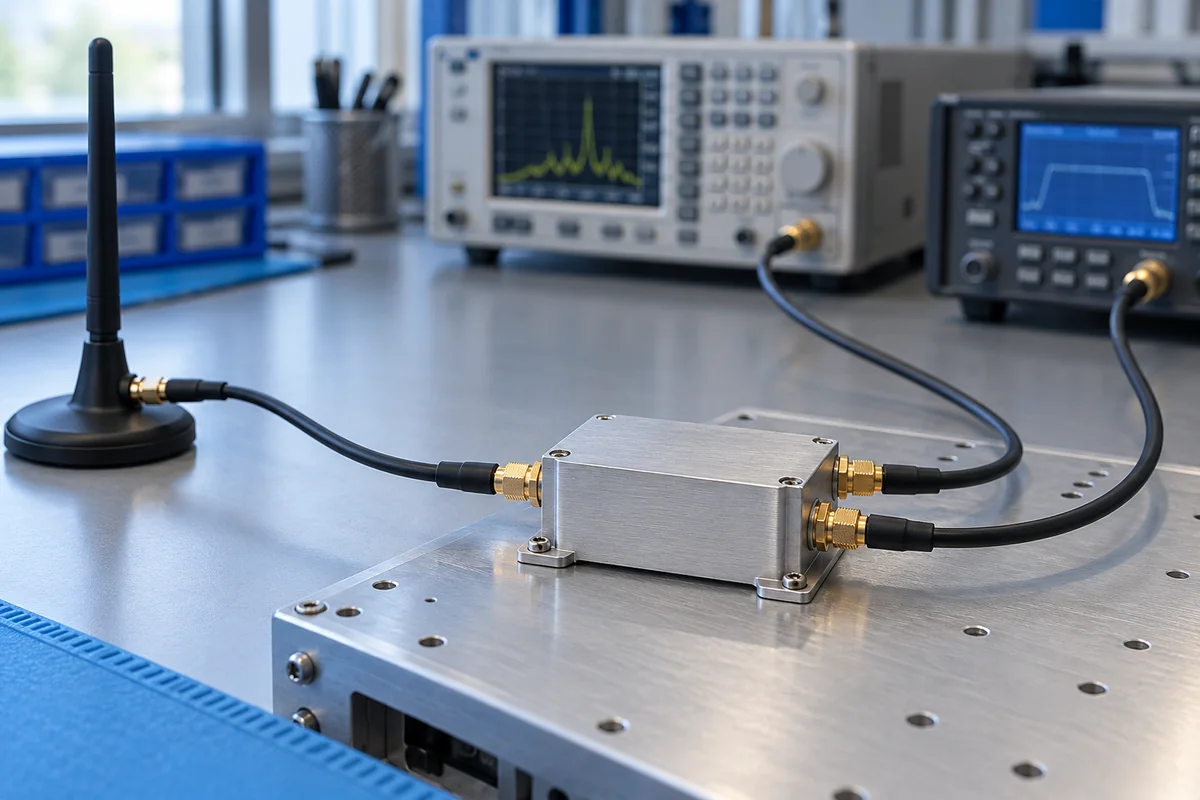
RF duplexers and diplexers · Transmit and receive bands, isolation and rejection between paths, insertion and return loss, power and PIM, technology and connectors
A duplexer (or diplexer) is a three-port passive RF filter network that lets two frequency bands share one antenna or cable: for example a transmitter and a receiver in a duplexer, or two bands combined or split in a diplexer. Fix three things before ordering: the two bands and the gap between them, the isolation and rejection needed so one path does not desensitize or damage the other, and the loss, power, PIM, connectors and environment the installation sets.
Cavity, LC, ceramic, dielectric, microstrip, helical and waveguide duplexers and diplexers for radio, repeater, cellular, satellite and test systems. Single band-pass filters, combiners with more than two inputs, circulators and power dividers are outside this page; RF band-pass filters have their own page.
CNFX editorial research · Sources checked October 12, 2026 · 4 sources
Keenlion lists a broadband VHF two-way cavity duplexer for radio repeaters with passbands of 145–155 MHz and 170–175 MHz, insertion loss of 1.8 dB or less, return loss of 15 dB or more and rejection of at least 75 dB of each band in the other path, at 50 Ω with N-female ports. It describes the duplexer's job as isolating transmit and receive signals so both can work at the same time. [1]
Its cavity duplexer for 898.5 MHz and 937.5 MHz lists insertion loss of 2.0 dB or less, passband ripple of 0.8 dB over 5 MHz (2.4 dB over 7 MHz), return loss of 18 dB or more, rejection of at least 120 dB at the opposite band, and isolation of at least 117 dB, with SMA-female ports. [2]
Editorial calculation: a 50 W transmitter is about +47 dBm; with 75 dB rejection into the receive path, up to about −28 dBm of transmit power reaches the receiver port (47 − 75). Whether that is acceptable depends on the receiver's blocking and desensitization limits, so state the transmit power and receiver sensitivity in the request. [1]
Editorial note: in the 898.5/937.5 MHz example the bands are 39 MHz apart and the maker meets ≥117 dB isolation with a cavity design; ask what technology a supplier proposes for your spacing and why. [2][3]
Give the supplier both passbands, the guard band, required isolation and rejection, insertion loss and ripple per path, return loss, transmit power (average and peak) and PIM limit, impedance and connectors, size and mounting, temperature range and ingress protection, and quantity.
02
Check loss, power handling and construction
Apex lists custom duplexers and diplexers from 10 MHz to 67.5 GHz in cavity, LC, ceramic, dielectric, microstrip, helical and waveguide technologies, citing low insertion loss, high isolation, high power handling, low PIM, compact size, vibration and shock resistance and waterproof designs. Examples on the same page range from DC–400 MHz / 440–520 MHz LC duplexers to 4.9–5.35 / 5.65–5.85 GHz cavity duplexers. [3]
Editorial note: ask the supplier for measured S-parameter plots (insertion loss, return loss, isolation) across both bands, not only the spec-sheet limits. [3][2]
03
Expect size and weight to grow at low band and close spacing
Telewave's data sheet TWDS-6007 for its TPRD-0354, 0454 and 0554 pass/reject duplexers covers 30–60 MHz in three models, each tunable ±2.5 MHz, with a minimum transmit–receive separation of 600 kHz. It lists maximum input power of 350 W, insertion loss of 1.0 dB from transmit or receive to antenna, receive isolation and transmit noise suppression of 80 dB at ±600 kHz, and VSWR of 1.5:1 maximum. The pass/reject design adds a tunable notch at the receive frequency to a bandpass response, and selectivity and insertion loss are set by rotating calibrated connector loops. Each unit uses four 5-inch cavities with welded aluminium top plates, silver-plated tuners and Invar tuning rods for temperature stability; the 30–40 MHz model measures 224 × 48 × 28 cm (246 cm with tuners extended) and weighs 29.5 kg, the others 183 × 48 × 28 cm and 23.2 kg, for 19-inch rack or wall mounting with N or UHF female connectors. [4]
Editorial calculation: 600 kHz at 40 MHz is a spacing of 1.5% of the carrier, against about 4.2% for the 39 MHz split of the 898.5/937.5 MHz cavity duplexer on this page; closer relative spacing and longer wavelength are why a low-band unit runs to over 2 m tall. A VSWR of 1.5:1 equals a return loss of about 14 dB, and 350 W is about +55.4 dBm, so 80 dB isolation leaves about −24.6 dBm at the receive port at the transmit frequency. [4][2]
Measured plots, power rating and PIM to request from each maker
The listings reviewed cover custom cavity, LC and other duplexers and diplexers for VHF, UHF, cellular and microwave bands; ask each for measured isolation, loss and return loss across both bands, power rating and PIM.
05
Two path filters, the antenna junction and the housing
The antenna-port junction is the only part in this table without a published value; judge it by the return loss the supplier measures at the antenna port.
Keenlion cavity duplexers and Apex Microwave custom designs
Sichuan Keenlion Microwave Technology Co., Ltd. lists cavity duplexers and diplexers for VHF, UHF and cellular bands with published loss, rejection and isolation; Apex Microwave Co., Ltd. lists custom duplexers and diplexers from 10 MHz to 67.5 GHz in cavity, LC, ceramic and other technologies.
Sichuan Keenlion Microwave Technology Co., Ltd.
Manufacturing site to be confirmed for the order
Lists cavity duplexers and diplexers for VHF, UHF and cellular bands with published loss, rejection and isolation.
Explore company information and manufacturing capabilities, then discuss the scope of your project with a relevant supplier.
Share this page
Compiled and source-reviewed by the CNFX editorial team.
Each manufacturer above links to the page on that company's own website where the product is listed, with the date we checked it. How we source and review
· Page last updated 13 October 2026
Buyer questions
How much isolation does a repeater duplexer need?
Keenlion lists ≥75 dB rejection for a VHF repeater duplexer and ≥117 dB isolation for a 900 MHz cavity duplexer. [1][2]
What insertion loss does a cavity duplexer have?
Keenlion's examples list 1.8–2.0 dB or less per path. [1][2]
Apex lists custom designs from 10 MHz to 67.5 GHz. [3]
How close can transmit and receive frequencies be on a low-band duplexer?
One maker's 30–60 MHz pass/reject cavity duplexer lists a minimum separation of 600 kHz, with 80 dB isolation at ±600 kHz, 1.0 dB insertion loss and 350 W maximum input. [4]
Sources and what still needs a direct check
Sources checked 2026-10-12. Keenlion and Apex Microwave are RF filter makers publishing duplexer specifications and technology ranges; both are linked suppliers.