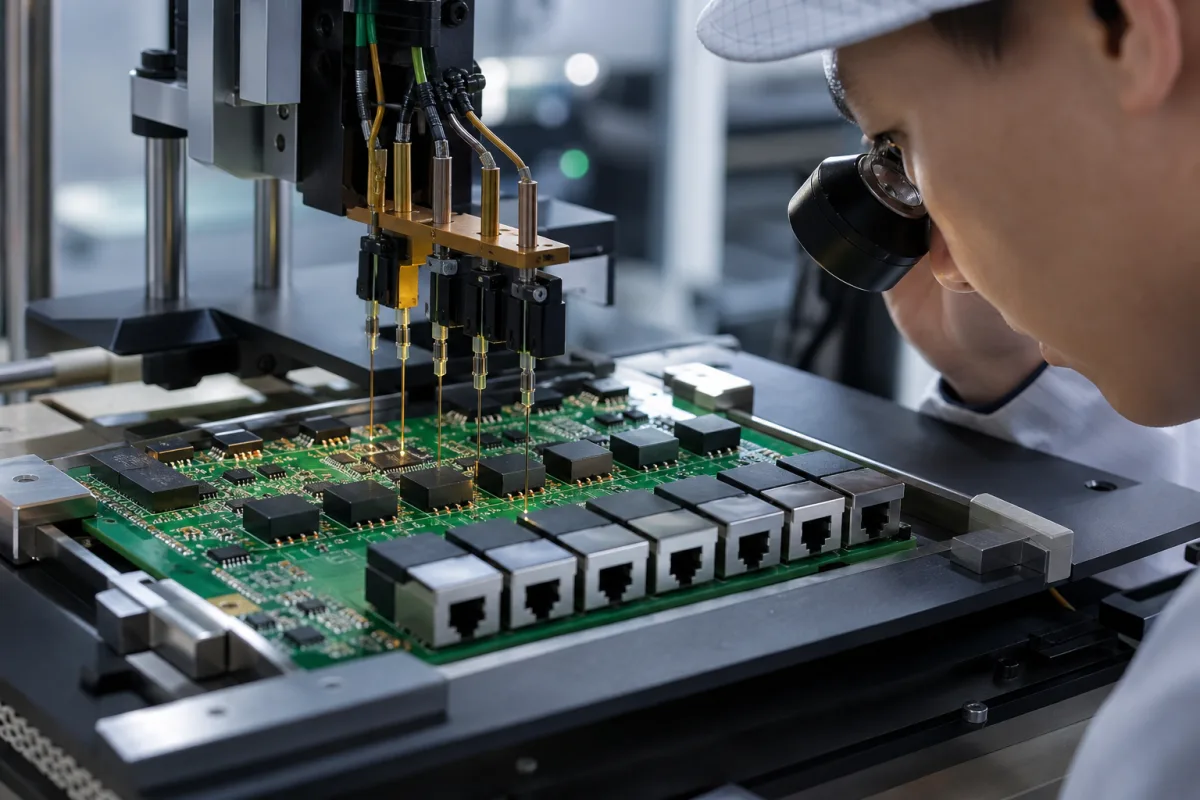
Ethernet magnetics (LAN transformers and RJ45 magnetic modules)
LAN transformers · Open-circuit inductance with DC bias, hipot isolation, insertion and return loss, common-mode rejection
Ethernet magnetics are the small pulse transformers and common-mode chokes, sold as discrete modules or built into RJ45 jacks, that sit between an Ethernet PHY chip and the cable. They isolate the equipment from the network, couple the differential signal and suppress common-mode noise. Ask three things first: which speeds and PoE they are designed for and what inductance they keep under DC bias, what isolation (hipot) they are tested to, and what insertion loss, return loss, crosstalk and common-mode rejection they guarantee across frequency.
LAN pulse transformers, common-mode chokes and magnetics modules, discrete or integrated in RJ45 jacks, for twisted-pair Ethernet. Power transformers, DC-DC converter transformers, RF baluns and Ethernet PHY chips are outside this page.
CNFX editorial research · Sources checked October 12, 2026 · 4 sources
In a 2004 presentation to the IEEE 802.3 interim meeting, Pulse's Thuyen Dinh notes that 10BASE-T sets no inductance requirement for magnetics, while 100BASE-TX magnetics carry an open-circuit inductance (OCL) requirement of 350 µH minimum with 8 mA of DC bias, from clause 9.1.7 of ANSI X3.263 (FDDI-TP-PMD). He reports that in tests with two 10/100/1000 network cards over about 140 m of Cat-5 cable, 10 and 100 Mbps links began to show errors when OCL was reduced to about 100 µH, while 1 Gbps showed none. [1]
The 10GBASE-T prototype magnetics Pulse showed to IEEE 802.3 in 2003 were insulated to meet 1500 VAC and used lower inductance, about 80–100 µH, to reach a wider bandwidth. [2] Sumida's catalogue lists its CLP-series LAN pulse transformers with a minimum 350 µH OCL at 8 mA bias, 1500 Vrms hipot isolation and a 1CT:1CT turns ratio, for 10/100/1000BASE-T. [3]
EPCOS (TDK) defines OCL as the inductance of the transformer's primary winding and the test voltage Vtest as the maximum primary-to-secondary voltage that does not cause breakdown, with frequency and duration stated for AC tests. [4] Editorial note: the 8 mA bias represents DC flowing through the winding; if Power over Ethernet or an unbalanced load adds current, ask for inductance at your actual bias.
Give the supplier the Ethernet speeds, number of ports, PHY chip and its reference design, PoE type if any, discrete module or RJ45 with integrated magnetics, isolation test voltage, operating temperature range, package and footprint, and the loss, crosstalk and common-mode rejection limits needed.
02
Read insertion loss, return loss and common-mode figures
EPCOS defines insertion loss as the power lost at the load when a magnetic component is inserted between source and load, return loss as the ratio of reflected to source power caused by impedance mismatch, crosstalk as power coupled into a neighbouring path, and differential-to-common-mode rejection (DCMR) as the common-mode voltage produced from a differential signal by asymmetry, all in dB. [4]
Sumida's C26100 lists, at 25 °C and for 0–70 °C operation: insertion loss −1.0 dB from 0.1 to 100 MHz; return loss −18, −14, −12 and −10 dB at 30, 50, 80 and 100 MHz; crosstalk −45, −40 and −33 dB (typ.) at 30, 60 and 100 MHz; DCMR −40, −37 and −33 dB (typ.) at the same frequencies; and 1500 Vrms minimum hipot. Its PoE versions add −1.5 dB insertion loss at 125 MHz. [3]
Editorial calculation: −1.0 dB insertion loss passes 10^(−0.1) ≈ 79% of the power; −18 dB return loss means a reflection coefficient of 10^(−18/20) ≈ 0.13, about 1.6% of the power reflected. [3][4]
03
Choose discrete modules or RJ45 integrated magnetics
EPCOS describes Bob Smith Termination (BST) as matching the common-mode impedance of Cat5 cable so that the cable does not act as a resonant antenna. It describes Cat5 as balanced 100 Ω and 120 Ω cabling specified up to 100 MHz, and PoE to IEEE 802.3af as 48 V and up to 15.4 W. [4]
Pulse's 2003 work found high-frequency performance very sensitive to package size and to whether centre taps are needed. [2] Editorial note: integrated RJ45 magnetics save board space, while discrete modules leave freedom to place common-mode parts and termination; in both cases follow the PHY maker's reference design for centre-tap connections.
04
LAN transformers, RJ45 transformers and chokes from the reviewed supplier
The supplier reviewed lists LAN transformers up to multi-gigabit BASE-T alongside RJ45 transformers and common-mode chokes; ask for the full data sheet with OCL, hipot and loss tables.
Sumida's C26100 data sheet fills the loss, isolation, common-mode and operating-temperature rows and Pulse's IEEE presentation the inductance row; DC resistance, leakage inductance and interwinding capacitance have no published value here.
Explore company information and manufacturing capabilities, then discuss the scope of your project with a relevant supplier.
Share this page
Compiled and source-reviewed by the CNFX editorial team.
Each manufacturer above links to the page on that company's own website where the product is listed, with the date we checked it. How we source and review
· Page last updated 13 October 2026
Buyer questions
Why do Ethernet magnetics specify 350 µH with 8 mA bias?
Pulse's IEEE 802.3 presentation traces this 100BASE-TX OCL requirement to ANSI X3.263 clause 9.1.7. [1]
What isolation voltage do LAN transformers have?
Sumida's CLP series and Pulse's prototypes cite 1500 Vrms or 1500 VAC insulation. [3][2]
What is return loss in Ethernet magnetics?
The ratio of reflected power to source power caused by impedance mismatch, in dB. [4]
Sources and what still needs a direct check
Sources checked 2026-10-12. Pulse's slides were presented to IEEE 802.3 working-group meetings; Sumida and EPCOS (TDK) describe their own magnetics. Figures for another part must come from its own data sheet.