Industry-Verified Manufacturing Data (2026)

ESD-Safe Work Surface

Based on aggregated insights from multiple verified factory profiles within the CNFX directory, the standard ESD-Safe Work Surface used in the Computer, Electronic and Optical Product Manufacturing sector typically supports operational capacities ranging from standard industrial configurations to heavy-duty production requirements.

Technical Definition & Core Assembly

A canonical ESD-Safe Work Surface is characterized by the integration of Conductive Layer and Grounding Point. In industrial production environments, manufacturers listed on CNFX commonly emphasize Conductive laminate construction to support stable, high-cycle operation across diverse manufacturing scenarios.

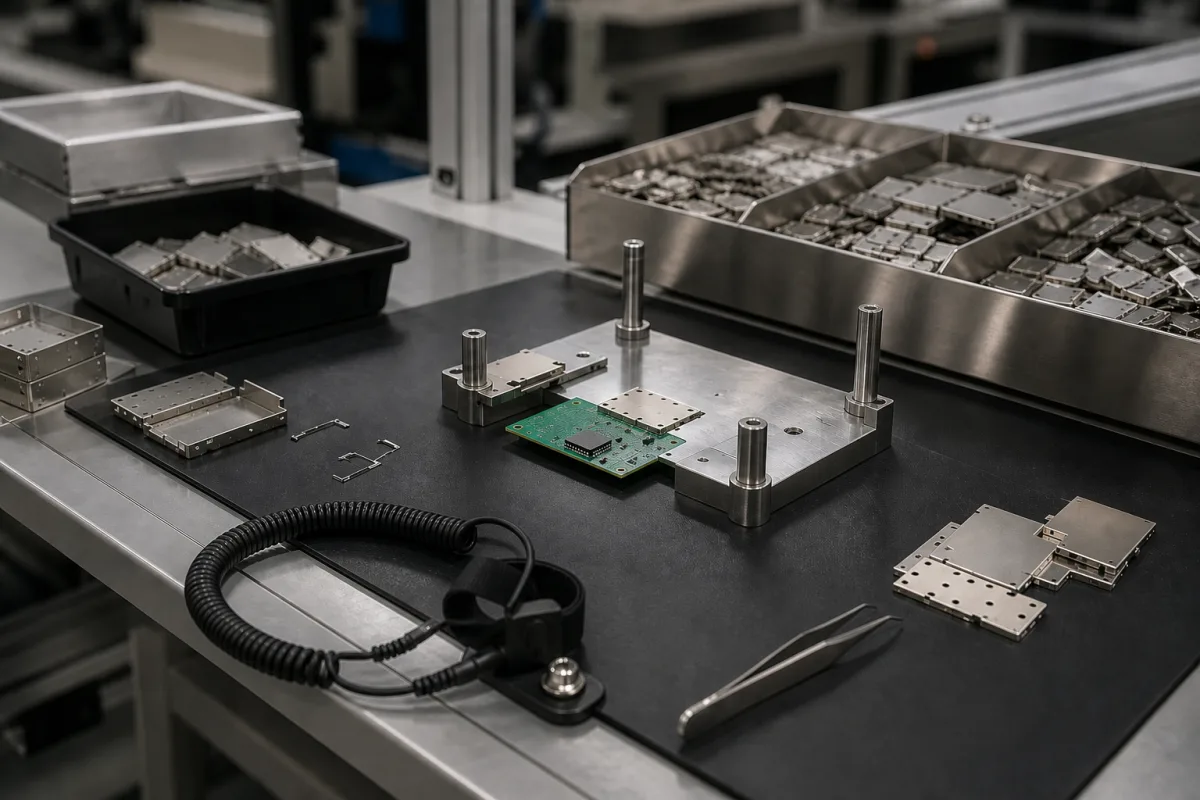
A specialized work surface designed to prevent electrostatic discharge (ESD) during assembly operations.
Product Specifications

Technical details and manufacturing context for ESD-Safe Work Surface

Definition
An essential component of an RF Shield Assembly Station, this work surface provides a controlled environment that dissipates static electricity to protect sensitive electronic components from ESD damage during assembly, testing, and handling of RF shielding materials and devices.
Working Principle
The surface is constructed with conductive or dissipative materials that provide a controlled path to ground, allowing static charges to flow safely away from sensitive components rather than building up and discharging suddenly.
Common Materials
Conductive laminate, Dissipative vinyl, Stainless steel
Technical Parameters
  • Surface dimensions (length × width × thickness) (mm) Per Request
Components / BOM
  • Conductive Layer
    Provides the primary path for static charge dissipation
    Material: Conductive laminate or carbon-loaded material
  • Grounding Point
    Connection point for attaching ground wires to earth the surface
    Material: Stainless steel or brass
  • Surface Coating
    Protective layer that maintains conductivity while providing durability
    Material: Dissipative vinyl or epoxy coating
Engineering Reasoning
Surface resistance: 1.0×10^6 to 1.0×10^9 ohms/square
Surface resistance exceeds 1.0×10^9 ohms/square (insulative) or falls below 1.0×10^6 ohms/square (conductive)
Design Rationale: Polymer chain degradation in dissipative layer due to UV exposure exceeding 50 MJ/m² cumulative dose, altering electron mobility pathways
Risk Mitigation (FMEA)
Trigger Surface contamination with ionic compounds exceeding 100 μg/cm²
Mode: Resistance drop below 1.0×10^6 ohms/square causing rapid discharge > 1000V/ns
Strategy: Embedded conductivity monitoring grid with 5mm spacing and automated ethanol cleaning at 15-minute intervals
Trigger Mechanical abrasion depth exceeding 0.5mm into dissipative layer
Mode: Localized resistance increase above 1.0×10^9 ohms/square creating charge accumulation zones
Strategy: Wear-resistant ceramic nanoparticle coating with hardness of 8.5 GPa and thickness of 200μm

Industry Taxonomies & Aliases

Commonly used trade names and technical identifiers for ESD-Safe Work Surface.

Applied To / Applications

This component is essential for the following industrial systems and equipment:

Industrial Ecosystem & Supply Chain DNA

Complementary Systems
Downstream Applications
Specialized Tooling

Application Fit & Sizing Matrix

Operational Limits
pressure: Max 5 psi distributed load
other spec: Surface resistance: 10^6 to 10^9 ohms/sq (per ANSI/ESD S20.20)
temperature: 15°C to 35°C (operating range)
Media Compatibility
✓ Electronic components (PCBs, ICs) ✓ Sensitive semiconductor devices ✓ ESD-sensitive assemblies
Unsuitable: High-moisture or conductive fluid environments
Sizing Data Required
  • Work area dimensions (length x width)
  • Required ESD protection level (e.g., Class 0, Class 1A)
  • Integration method (bench-mounted, standalone, or modular)

Reliability & Engineering Risk Analysis

Failure Mode & Root Cause
Surface Resistance Degradation
Cause: Accumulation of conductive contaminants (dust, oils, metal particles) or physical damage (scratches, cuts) compromising the static-dissipative layer, leading to inadequate electrostatic discharge protection.
Material Delamination or Warping
Cause: Exposure to excessive heat, UV radiation, or chemical solvents, causing the layered construction (typically vinyl or rubber with conductive elements) to separate, bubble, or distort, resulting in an uneven or ineffective work surface.
Maintenance Indicators
  • Visible cracks, peeling, or bubbling on the surface, indicating material breakdown and loss of ESD-safe properties.
  • Increased static discharge events (audible snaps or visible sparks) during normal use, signaling failure of the surface's static-dissipative capability.
Engineering Tips
  • Implement regular cleaning with ESD-safe cleaners and lint-free wipes to remove contaminants without damaging the conductive layer, and perform periodic surface resistance testing (e.g., using a megohmmeter) to verify compliance with ANSI/ESD S20.20 standards.
  • Avoid placing hot objects, direct sunlight, or harsh chemicals on the surface, and use protective mats or covers during non-ESD tasks to prevent physical abrasion and environmental degradation.

Compliance & Manufacturing Standards

Reference Standards
ANSI/ESD S20.20 IEC 61340-5-1 ISO 9001
Manufacturing Precision
  • Surface Resistance: 10^6 to 10^9 ohms/sq
  • Flatness: ±0.5 mm/m
Quality Inspection
  • Surface Resistance Verification
  • Grounding Continuity Test

Factories Producing ESD-Safe Work Surface

Verified manufacturers with capability to produce this product in China

✓ 92% Supplier Capability Match Found

S Sourcing Manager from United States Jan 04, 2026
★★★★★
"Found 56+ suppliers for ESD-Safe Work Surface on CNFX, but this spec remains the most cost-effective."
Technical Specifications Verified
P Procurement Specialist from United Arab Emirates Jan 01, 2026
★★★★☆
"The technical documentation for this ESD-Safe Work Surface is very thorough, especially regarding technical reliability. (Delivery took slightly longer than expected, but technical support was excellent.)"
Technical Specifications Verified
T Technical Director from Australia Dec 29, 2025
★★★★★
"Reliable performance in harsh Computer, Electronic and Optical Product Manufacturing environments. No issues with the ESD-Safe Work Surface so far."
Technical Specifications Verified
Verification Protocol

“Feedback is collected from verified sourcing managers during RFQ (Request for Quote) and factory evaluation processes on CNFX. These reports represent historical performance data and technical audit summaries from our B2B manufacturing network.”

19 sourcing managers are analyzing this specification now. Last inquiry for ESD-Safe Work Surface from Vietnam (53m ago).

Supply Chain Compatible Machinery & Devices

Industrial Smart Camera Module

Embedded vision system for industrial automation and quality inspection.

Explore Specs →
Industrial Wireless Power Transfer Module

Wireless power transfer module for industrial equipment applications

Explore Specs →
Industrial Smart Sensor Module

Modular industrial sensor with embedded processing and wireless connectivity

Explore Specs →
Surface Mount Resistor

Passive electronic component for current limiting and voltage division in circuits

Explore Specs →

Frequently Asked Questions

How does this ESD-safe work surface protect electronic components during assembly?

The work surface uses conductive laminate and dissipative vinyl materials to safely drain electrostatic charges through grounding points, preventing electrostatic discharge that could damage sensitive electronic components during assembly operations.

What materials make this work surface suitable for computer and optical product manufacturing?

The surface combines conductive laminate for charge dissipation, dissipative vinyl for controlled static decay, and stainless steel for durability and grounding, making it ideal for handling sensitive computer, electronic, and optical components.

How do I properly ground this ESD-safe work surface in my manufacturing facility?

Connect the integrated grounding point to your facility's common point ground using appropriate grounding cords and wrist straps. Regular testing with a surface resistance meter ensures proper conductivity (typically 10^6-10^9 ohms) for effective ESD protection.

Can I contact factories directly on CNFX?

CNFX is an open directory, not a transaction platform. Each factory profile provides direct contact information and production details to help you initiate direct inquiries with Chinese suppliers.

Get Quote for ESD-Safe Work Surface

Request technical pricing, lead times, or customized specifications for ESD-Safe Work Surface directly from verified manufacturing units.

Your business information is encrypted and only shared with verified ESD-Safe Work Surface suppliers.

Thank you! Your message has been sent. We'll respond within 1–3 business days.

Need to Manufacture ESD-Safe Work Surface?

Connect with verified factories specializing in this product category

Add Your Factory Contact Us
Previous Product
Error Logger
Next Product
Ethernet Magnetics