Industry-Verified Manufacturing Data (2026)

FPGA/ASIC Processing Core

Based on aggregated insights from multiple verified factory profiles within the CNFX directory, the standard FPGA/ASIC Processing Core used in the Computer, Electronic and Optical Product Manufacturing sector typically supports operational capacities ranging from standard industrial configurations to heavy-duty production requirements.

Technical Definition & Core Assembly

A canonical FPGA/ASIC Processing Core is characterized by the integration of Processing Logic Array and Memory Blocks. In industrial production environments, manufacturers listed on CNFX commonly emphasize Silicon wafer construction to support stable, high-cycle operation across diverse manufacturing scenarios.

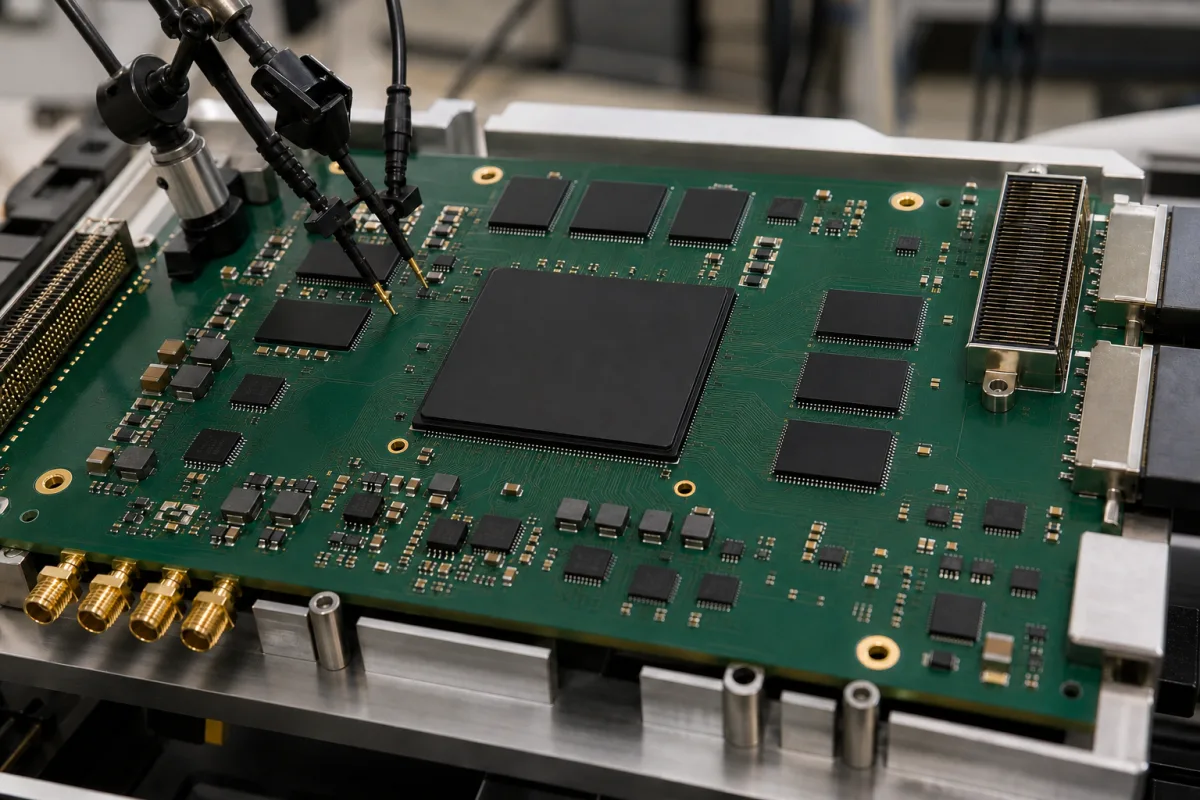
A specialized hardware processing unit implemented in FPGA or ASIC technology for high-speed data processing within capture systems.
Product Specifications

Technical details and manufacturing context for FPGA/ASIC Processing Core

Definition
The FPGA/ASIC Processing Core is a dedicated hardware component within the High-Speed Capture Module that performs real-time data processing, signal conditioning, and protocol handling. It serves as the computational engine that enables high-speed data acquisition, filtering, and preprocessing before transmission to downstream systems.
Working Principle
The core operates by implementing custom digital logic circuits in either FPGA (Field-Programmable Gate Array) or ASIC (Application-Specific Integrated Circuit) technology. It receives raw data from capture interfaces, processes it through parallel processing pipelines, applies algorithms for data reduction or enhancement, and outputs processed data streams with minimal latency.
Common Materials
Silicon wafer, Copper interconnects, Dielectric materials
Technical Parameters
  • Clock frequency determining processing speed (MHz) Per Request
Components / BOM
  • Processing Logic Array
    Implements custom digital logic for data processing algorithms
    Material: Silicon
  • Memory Blocks
    Provides local storage for intermediate data and configuration
    Material: SRAM cells
  • I/O Interfaces
    Handles data input from capture sources and output to system
    Material: Copper interconnects
Engineering Reasoning
0.85-1.15V core voltage, -40°C to 125°C junction temperature
1.25V core voltage sustained for >10ms, 150°C junction temperature
Design Rationale: Electromigration at >1.25V accelerates metal migration in interconnects; thermal runaway above 150°C causes silicon lattice damage and dopant diffusion
Risk Mitigation (FMEA)
Trigger Clock signal jitter exceeding 50ps RMS
Mode: Setup/hold timing violations causing metastability and data corruption
Strategy: Phase-locked loop with <10ps jitter, balanced clock tree routing with matched trace lengths
Trigger Simultaneous switching noise generating 200mV ground bounce
Mode: False logic transitions and reduced noise margins
Strategy: Distributed decoupling capacitors (100nF ceramic + 10μF tantalum per power domain), dedicated power planes with <5mΩ impedance

Industry Taxonomies & Aliases

Commonly used trade names and technical identifiers for FPGA/ASIC Processing Core.

Applied To / Applications

This component is essential for the following industrial systems and equipment:

Industrial Ecosystem & Supply Chain DNA

Complementary Systems
Downstream Applications
Specialized Tooling

Application Fit & Sizing Matrix

Operational Limits
pressure: N/A (solid-state device)
other spec: Power consumption: 5-50W typical, Clock frequency: 100-500 MHz
temperature: -40°C to 100°C
Media Compatibility
✓ Digital signal processing environments ✓ Network packet processing systems ✓ Image/video processing pipelines
Unsuitable: High-voltage or high-current analog environments
Sizing Data Required
  • Required processing throughput (Gbps/Tbps)
  • Available FPGA/ASIC resources (LUTs, DSP slices, memory)
  • Interface bandwidth requirements (PCIe lanes, Ethernet speed)

Reliability & Engineering Risk Analysis

Failure Mode & Root Cause
Thermal runaway leading to permanent damage
Cause: Inadequate cooling, excessive ambient temperature, or poor thermal interface material causing junction temperatures to exceed maximum ratings, resulting in electromigration, gate oxide breakdown, or latch-up events.
Electrostatic discharge (ESD) or electrical overstress (EOS) damage
Cause: Improper handling during installation or maintenance, insufficient grounding, or transient voltage spikes from power supplies or connected peripherals, leading to immediate or latent failures in sensitive semiconductor structures.
Maintenance Indicators
  • Unexpected system resets, lockups, or data corruption during operation, indicating potential core instability or intermittent faults.
  • Abnormally high case or heatsink temperatures detected via thermal sensors or infrared imaging, suggesting cooling system degradation or excessive power dissipation.
Engineering Tips
  • Implement robust thermal management: Use high-quality thermal interface materials, ensure proper airflow with clean, filtered cooling systems, and monitor junction temperatures with embedded sensors to prevent thermal degradation.
  • Enforce strict ESD protocols during handling and maintenance, utilize surge protection on power and I/O lines, and maintain stable, clean power supplies with appropriate decoupling capacitors to minimize electrical stress.

Compliance & Manufacturing Standards

Reference Standards
ISO 9001:2015 - Quality Management Systems IEC 61508 - Functional Safety of Electrical/Electronic/Programmable Electronic Safety-related Systems IPC-7093 - Design and Assembly Process Implementation for Bottom Termination Components
Manufacturing Precision
  • Signal Integrity: Eye Diagram Mask Compliance (e.g., Jitter < 0.1 UI)
  • Thermal: Junction Temperature Tolerance +/-5°C
Quality Inspection
  • Scan Chain Testing (Structural Test)
  • Built-In Self-Test (BIST) Verification

Factories Producing FPGA/ASIC Processing Core

Verified manufacturers with capability to produce this product in China

✓ 94% Supplier Capability Match Found

P Project Engineer from United Arab Emirates Jan 13, 2026
★★★★★
"Standard OEM quality for Computer, Electronic and Optical Product Manufacturing applications. The FPGA/ASIC Processing Core arrived with full certification."
Technical Specifications Verified
S Sourcing Manager from Australia Jan 10, 2026
★★★★★
"Great transparency on the FPGA/ASIC Processing Core components. Essential for our Computer, Electronic and Optical Product Manufacturing supply chain."
Technical Specifications Verified
P Procurement Specialist from Singapore Jan 07, 2026
★★★★★
"The FPGA/ASIC Processing Core we sourced perfectly fits our Computer, Electronic and Optical Product Manufacturing production line requirements."
Technical Specifications Verified
Verification Protocol

“Feedback is collected from verified sourcing managers during RFQ (Request for Quote) and factory evaluation processes on CNFX. These reports represent historical performance data and technical audit summaries from our B2B manufacturing network.”

10 sourcing managers are analyzing this specification now. Last inquiry for FPGA/ASIC Processing Core from Turkey (32m ago).

Supply Chain Compatible Machinery & Devices

Industrial Smart Camera Module

Embedded vision system for industrial automation and quality inspection.

Explore Specs →
Industrial Wireless Power Transfer Module

Wireless power transfer module for industrial equipment applications

Explore Specs →
Industrial Smart Sensor Module

Modular industrial sensor with embedded processing and wireless connectivity

Explore Specs →
Surface Mount Resistor

Passive electronic component for current limiting and voltage division in circuits

Explore Specs →

Frequently Asked Questions

What are the main advantages of using an FPGA/ASIC processing core over traditional processors in capture systems?

FPGA/ASIC cores provide hardware-level parallel processing, deterministic low latency, and energy-efficient performance for high-speed data capture applications, outperforming general-purpose processors in specialized tasks.

How does the processing logic array in this core enhance data processing capabilities?

The configurable processing logic array allows for custom hardware acceleration tailored to specific algorithms, enabling simultaneous processing of multiple data streams with optimized throughput for capture system requirements.

What industries benefit most from implementing this FPGA/ASIC processing core?

Computer, electronic, and optical product manufacturing industries benefit significantly, particularly in applications requiring real-time data capture, signal processing, image analysis, and high-throughput industrial automation systems.

Can I contact factories directly on CNFX?

CNFX is an open directory, not a transaction platform. Each factory profile provides direct contact information and production details to help you initiate direct inquiries with Chinese suppliers.

Get Quote for FPGA/ASIC Processing Core

Request technical pricing, lead times, or customized specifications for FPGA/ASIC Processing Core directly from verified manufacturing units.

Your business information is encrypted and only shared with verified FPGA/ASIC Processing Core suppliers.

Thank you! Your message has been sent. We'll respond within 1–3 business days.

Need to Manufacture FPGA/ASIC Processing Core?

Connect with verified factories specializing in this product category

Add Your Factory Contact Us
Previous Product
FPGA or ASIC
Next Product
FPGA/microcontroller