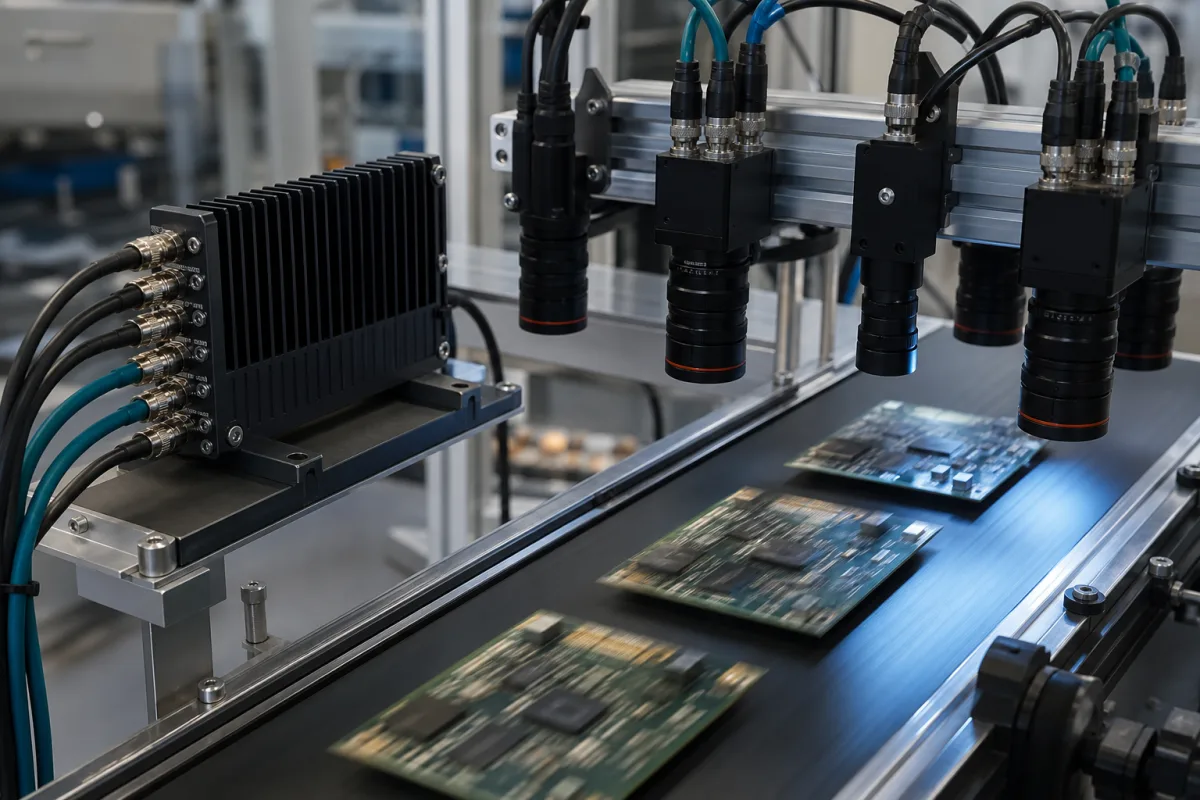
High-speed capture module for remote CoaXPress cameras: the camera-side box that turns CXP-12 coax links into CoaXPress-over-Fiber
Remote machine-vision cameras · CXP-12 coax in, CoaXPress-over-Fiber out, four links of 12.5 Gb/s, 30–40 m of copper against 400 m multimode or 10–80 km single-mode, PoCXP at 13–17 W per link
A CXP-12 camera can deliver 12.5 Gb/s per coax link, but only over a few tens of metres of copper. When the cameras sit on a long line, in a tunnel or far from the control cabinet, a capture module beside the cameras takes in their coax links, powers them, and repackages the stream as CoaXPress-over-Fiber for the trip to the frame grabber. Settle three things when buying one: how many links at which CXP speed it accepts and what aggregate bandwidth it carries, which fiber, optics and distance it uses, and how it powers the cameras and survives where it is mounted.
Camera-side CoaXPress-to-CoaXPress-over-Fiber (CXPoF) converters, bridges and extenders for machine-vision and high-speed cameras: number of CXP input links and speeds, aggregate bandwidth, SFP+ or QSFP+ optics and connectors, multimode and single-mode reach, Power over CoaXPress to the cameras, supply power, housing, cooling and operating temperature, and the matching frame-grabber side. Plug-in CoaXPress and Camera Link frame grabbers, their bus bandwidth and coax cable lengths are covered on the Frame grabber (vision interface card) page; on-board FPGA processing on the Processing Board page; multi-port GigE PoE camera boards on the Interface board for a vision processing unit page. Ethernet network adapters are covered on the Network interface controller (NIC / Ethernet adapter card) and 2.5 Gigabit PCIe network card pages, and network traffic capture and protocol analysis instruments on the Multi-protocol network protocol analyzer page.
CNFX editorial research · Sources checked October 13, 2026 · 4 sources
Four CXP-12 micro-BNC inputs, one QSFP+ or four SFP+ outputs: links, speeds and the 50 Gbps aggregate
Euresys's Coaxlink CXP-12 to QSFP+ Converter is a stand-alone aluminium box with four micro-BNC 75 Ω CoaXPress inputs on the front and one QSFP+ port for 40 Gbps optical modules on the rear. It accepts one 1-, 2- or 4-connection camera, or four 1-connection cameras on request, at every CXP speed from CXP-1 (1.25 Gbps) to CXP-12 (12.5 Gbps), and carries up to 50 Gbps (5,000 MB/s) to a Coaxlink QSFP+ frame grabber under the CXP-over-Fiber Bridge Protocol 1.1, with a stated maximum fiber link speed of CoF-10. [1]
Editorial calculation: four links at the 12.5 Gbps of CXP-12 add up to 50 Gbps, the aggregate Euresys states for its converter. [1] The up-connection back to the camera runs far slower: Euresys lists 20.83 Mbps for CXP-1 to CXP-6 and 41.66 Mbps for CXP-10 and CXP-12, and KAYA gives a 41.6 Mbps downlink against a 12.5 Gbps uplink, using the opposite naming for the two directions. [1][2]
The four products split the work differently. BitFlow designed the QFi for a single compact camera far from the host, because converting to fiber with a dedicated pair of boxes was, in its words, quite cost prohibitive; one QFi handles one link, a multi-link camera takes one QFi per link, and the fiber plugs straight into a BitFlow Claxon fiber frame grabber without a second converter. [4] Phrontier's PHORTE pairs a camera-side module (PHORTE-CM) with a frame-grabber-side module (PHORTE-FG) when neither camera nor grabber supports CXPoF, with other combinations depending on the camera and grabber; the conversion is transparent, so the host sees an ordinary CoaXPress connection with no drivers or configuration. [3]
Give the supplier the camera model and its number of CXP links and speed, whether one multi-link camera or up to four single-link cameras share the module, and whether the frame grabber already accepts CoaXPress-over-Fiber or needs a second converter at the host end.
02
From 30–40 m of coax to 400 m multimode and 10–80 km single-mode: optics, fiber count and reach
Phrontier, as described by its distributor Stemmer Imaging, puts the copper limit for CXP-12 at roughly 30 m because of attenuation, while BitFlow rates its QFi for camera-to-module coax runs of up to 40 m at CXP-12, longer at lower speeds. [3][4] On the fiber side the published reach depends on optics and fiber type.
KAYA adds reasons beyond distance for going to fiber: the link is electrically isolated, does not radiate or pick up electromagnetic interference, avoids grounding problems and is not easily tapped. [2] BitFlow notes that off-the-shelf fiber cables combine multiple SFP+ connections into one QSFP+ connection, so four QFi modules can feed one quad-link grabber. [4]
Editorial calculation: replacing a 30 m CXP-12 coax run with Phrontier's 10 km single-mode link is a reach about 330 times longer, and KAYA's 80 km rating is eight times Phrontier's single-mode figure; the reach actually achieved still depends on the SFP+ or QSFP+ optics fitted, which each maker leaves to the module chosen. [3][2]
State the distance from camera to frame grabber, the fiber already installed on site (multimode grade or single-mode, fibre count, MPO or LC), and whether the optics are to be supplied with the module.
03
Powering the cameras over coax, 24 V supply, heatsinks and the temperature where the box is mounted
Each module can power the cameras through the coax, so the camera end needs no separate supply. Euresys budgets 4 × 17 W of PoCXP plus 19.5 W for its own electronics from a 24 V DC ±3 % input, cooled by a fan-cooled heatsink, and offers a 160 W 24 V adapter as a related product. KAYA's converter draws under 11 W itself, delivers 13 W per link, takes 24 V DC and is fanless with a passive heatsink. BitFlow's QFi provides up to 13 W to its camera. [1][2][4]
Editorial calculation: Euresys's worst case is 19.5 + 4 × 17 = 87.5 W, about 3.6 A at 24 V; KAYA's is under 11 + 4 × 13 = 63 W. [1][2]
Size, mass and environment set where the module can go. Euresys's box measures 208 × 113 × 56.5 mm, weighs 776 g net and is rated for 0 to +50 °C and 10–90 % RH non-condensing; KAYA's measures 117 × 114.5 × 23.5 mm, weighs 300 g and is rated for -40 to +80 °C; Phrontier's PHORTE modules measure 88 × 147 × 41.25 mm, sized to fit inside camera housings. [1][2][3] Phrontier reports link state through a UART port and LEDs, KAYA through a micro-USB port that also takes firmware updates, and BitFlow through a side channel showing temperature and link speed. [3][2][4]
Give the supplier each camera's PoCXP power draw, the 24 V supply available at the camera end, the mounting place and its temperature range, and whether a fan is acceptable there.
04
Camera, distance and site data for a CoaXPress-over-Fiber capture module
Paste it into your enquiry below or into an email to a maker, then replace every bracket.
Cameras: [model; number of CXP links; CXP speed; PoCXP draw]
Layout: [one multi-link camera or up to four single-link cameras per module]
Distance: [camera to module coax length; module to frame grabber fiber length]
Fiber: [multimode grade or single-mode; fibre count; MPO or LC; optics supplied or not]
Frame grabber: [model; CXPoF input or copper input needing a host-side converter]
Power: [24 V DC available; total budget]
Site: [ambient temperature; enclosure; fan acceptable or not]
Monitoring: [link status, temperature, firmware updates]
Explore company information and manufacturing capabilities, then discuss the scope of your project with a relevant supplier.
Share this page
Compiled and source-reviewed by the CNFX editorial team.
Each manufacturer above links to the page on that company's own website where the product is listed, with the date we checked it. How we source and review
· Page last updated 13 October 2026
Buyer questions
How far can a CXP-12 camera be from the frame grabber on copper?
Phrontier's distributor puts the CXP-12 copper limit at roughly 30 m; BitFlow rates coax runs to its QFi at up to 40 m at CXP-12. [3][4]
How far can CoaXPress-over-Fiber reach?
Phrontier lists up to 10 km on single-mode and 150–400 m on multimode; KAYA rates its converter to 80 km single-mode and 300 m multimode; BitFlow states fiber lengths well over 100 km for the QFi. [3][2][4]
How much bandwidth does a four-link CXP-12 to fiber converter carry?
Euresys states 50 Gbps (5,000 MB/s) for its four-input Coaxlink CXP-12 to QSFP+ Converter. [1]
Can the fiber converter power the camera?
Yes: Euresys budgets 17 W of PoCXP per connection, and KAYA and BitFlow 13 W per link. [1][2][4]
Sources and what still needs a direct check
Sources checked 2026-10-13. Product specifications from four machine-vision hardware makers: Euresys's data sheet for its CXP-12 to QSFP+ converter, KAYA Instruments' CXP-to-CoF converter page, BitFlow's QFi page, and Stemmer Imaging's page for the Phrontier PHORTE extenders it distributes.