Industry-Verified Manufacturing Data (2026)

Gain Stage

Based on aggregated insights from multiple verified factory profiles within the CNFX directory, the standard Gain Stage used in the Computer, Electronic and Optical Product Manufacturing sector typically supports operational capacities ranging from standard industrial configurations to heavy-duty production requirements.

Technical Definition & Core Assembly

A canonical Gain Stage is characterized by the integration of Differential Pair and Active Load. In industrial production environments, manufacturers listed on CNFX commonly emphasize Semiconductor (Silicon) construction to support stable, high-cycle operation across diverse manufacturing scenarios.

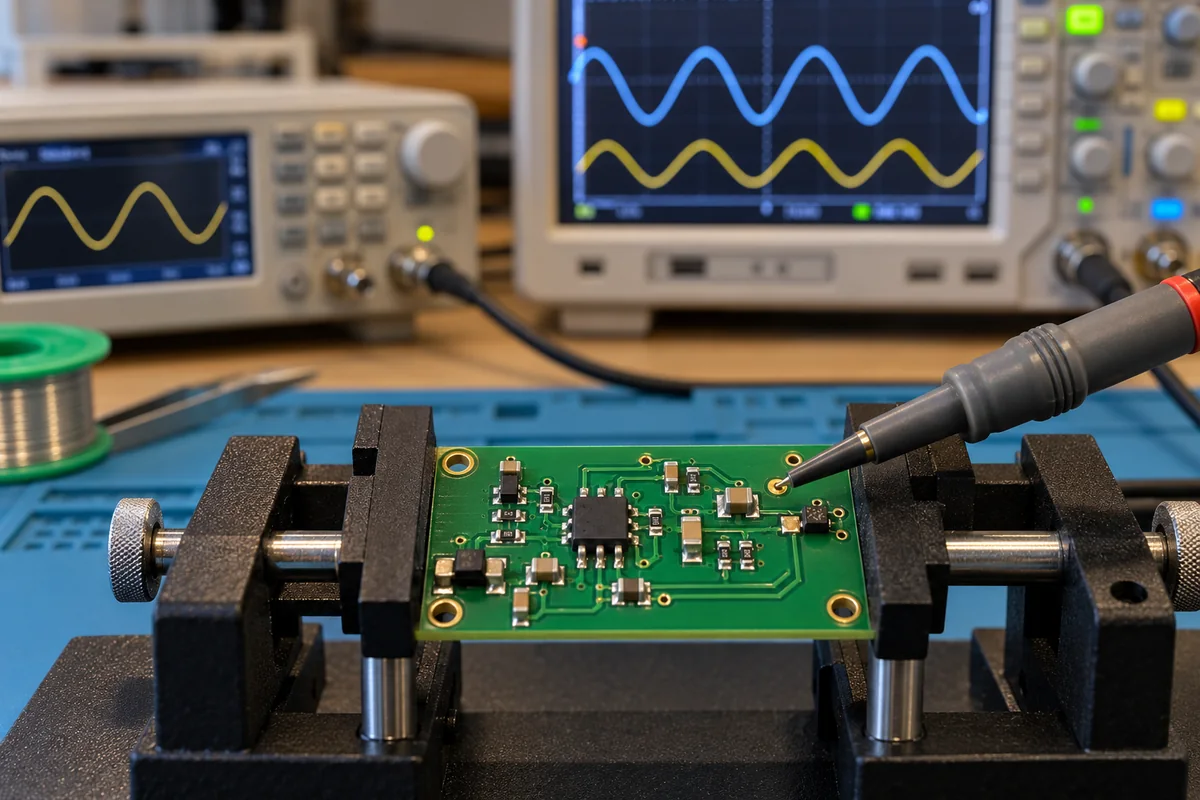
An amplification stage within an operational amplifier that increases signal amplitude.
Product Specifications

Technical details and manufacturing context for Gain Stage

Definition
A gain stage is a fundamental circuit block within an operational amplifier responsible for providing voltage or current amplification to the input signal. It is a core part that determines the amplifier's primary gain characteristics and often involves transistors or other active devices configured to multiply the signal level before further processing or output.
Working Principle
The gain stage typically uses a differential amplifier configuration (in op-amps) where a small differential input voltage controls a much larger output current or voltage. This is achieved through the transconductance of active devices like BJTs or MOSFETs, often with current mirrors and active loads to set a high, stable gain. The amplified output is then passed to subsequent stages like the output buffer.
Common Materials
Semiconductor (Silicon), Doped Semiconductor Regions, Metal Interconnects, Dielectric Layers
Technical Parameters
  • Voltage gain of the stage, typically high (e.g., 1000 V/V or 60 dB) in open-loop configuration. (V/V or dB) Standard Spec
Components / BOM
  • Differential Pair
    Amplifies the difference between two input signals.
    Material: Semiconductor (BJT or MOSFET)
  • Active Load
    Provides high impedance to increase gain, often implemented with current mirrors.
    Material: Semiconductor
  • Bias Circuit
    Sets the operating point (quiescent current) for the active devices.
    Material: Semiconductor, Resistors
Engineering Reasoning
0.1-15 V input, 1-150 V output, -40°C to 125°C ambient
Input voltage exceeding 18 V causes saturation, output current surpassing 25 mA induces thermal runaway, junction temperature above 150°C triggers permanent damage
Design Rationale: Semiconductor junction breakdown at 18 V reverse bias, thermal runaway due to positive temperature coefficient in BJT transistors exceeding 25 mA, electromigration in aluminum interconnects at 150°C junction temperature
Risk Mitigation (FMEA)
Trigger Input voltage transient exceeding 18 V peak
Mode: Output signal clipping at rail voltages, harmonic distortion exceeding 0.5% THD
Strategy: Zener diode clamping at 15 V with 100 Ω series resistor, input RC filter with 10 nF capacitor and 1 kΩ resistor
Trigger Ambient temperature rise above 85°C with 20 mA continuous output
Mode: Thermal shutdown at 150°C junction temperature, gain reduction of 3 dB per 10°C above 100°C
Strategy: Copper heat sink with 15°C/W thermal resistance, current limiting to 15 mA maximum, temperature compensation using PTAT bias circuit

Industry Taxonomies & Aliases

Commonly used trade names and technical identifiers for Gain Stage.

Applied To / Applications

This component is essential for the following industrial systems and equipment:

Industrial Ecosystem & Supply Chain DNA

Complementary Systems
Downstream Applications
Specialized Tooling

Application Fit & Sizing Matrix

Operational Limits
pressure: Not applicable (electronic component)
other spec: Supply Voltage: ±5V to ±18V, Bandwidth: 1MHz to 100MHz (application dependent)
temperature: -40°C to +125°C (typical semiconductor operating range)
Media Compatibility
✓ Low-noise audio signal processing ✓ Precision instrumentation amplification ✓ Sensor signal conditioning
Unsuitable: High-voltage power switching environments (>100V transients)
Sizing Data Required
  • Required voltage gain (V/V or dB)
  • Input signal frequency range (Hz)
  • Desired output impedance (Ω)

Reliability & Engineering Risk Analysis

Failure Mode & Root Cause
Cavitation
Cause: Excessive pressure drop across the gain stage causing vapor bubble formation and implosion, damaging internal surfaces.
Thermal Overload
Cause: Prolonged operation beyond rated power levels or inadequate cooling, leading to component degradation or failure.
Maintenance Indicators
  • Abnormal audible noise (hissing, crackling, or popping sounds) indicating cavitation or arcing.
  • Unexpected output distortion, gain reduction, or erratic signal behavior during operation.
Engineering Tips
  • Implement proper system impedance matching and ensure adequate upstream/downstream pressure conditions to prevent cavitation.
  • Maintain strict thermal management through regular cleaning of heat sinks, verifying cooling system operation, and monitoring operating temperatures.

Compliance & Manufacturing Standards

Reference Standards
ISO 9001:2015 Quality Management Systems ANSI/ASME B46.1-2019 Surface Texture DIN 8580:2003-09 Manufacturing Processes
Manufacturing Precision
  • Gain Accuracy: +/-0.5 dB
  • Frequency Response Flatness: +/-0.1 dB
Quality Inspection
  • Total Harmonic Distortion (THD) Test
  • Signal-to-Noise Ratio (SNR) Test

Factories Producing Gain Stage

Verified manufacturers with capability to produce this product in China

✓ 96% Supplier Capability Match Found

P Procurement Specialist from Australia Mar 01, 2026
★★★★★
"Impressive build quality. Especially the technical reliability is very stable during long-term operation."
Technical Specifications Verified
T Technical Director from Singapore Feb 26, 2026
★★★★★
"As a professional in the Computer, Electronic and Optical Product Manufacturing sector, I confirm this Gain Stage meets all ISO standards."
Technical Specifications Verified
P Project Engineer from Germany Feb 23, 2026
★★★★★
"Standard OEM quality for Computer, Electronic and Optical Product Manufacturing applications. The Gain Stage arrived with full certification."
Technical Specifications Verified
Verification Protocol

“Feedback is collected from verified sourcing managers during RFQ (Request for Quote) and factory evaluation processes on CNFX. These reports represent historical performance data and technical audit summaries from our B2B manufacturing network.”

10 sourcing managers are analyzing this specification now. Last inquiry for Gain Stage from Germany (1h ago).

Supply Chain Compatible Machinery & Devices

Modular Industrial Edge Computing Device

Rugged computing platform for industrial data processing at the network edge

Explore Specs →
Industrial Smart Camera Module

Embedded vision system for industrial automation and quality inspection.

Explore Specs →
Industrial Wireless Power Transfer Module

Wireless power transfer module for industrial equipment applications

Explore Specs →
Industrial Smart Sensor Module

Modular industrial sensor with embedded processing and wireless connectivity

Explore Specs →

Frequently Asked Questions

What is the primary function of a gain stage in operational amplifiers?

The gain stage amplifies the voltage difference between input signals, increasing signal amplitude while maintaining signal integrity for further processing in electronic systems.

What materials are typically used in manufacturing gain stages?

Gain stages are primarily fabricated using silicon semiconductors with doped regions, metal interconnects for electrical pathways, and dielectric layers for insulation between components.

How does the differential pair contribute to gain stage performance?

The differential pair provides high input impedance, common-mode rejection, and linear amplification by comparing two input signals and amplifying their difference, which is essential for precision amplification.

Can I contact factories directly on CNFX?

CNFX is an open directory, not a transaction platform. Each factory profile provides direct contact information and production details to help you initiate direct inquiries with Chinese suppliers.

Get Quote for Gain Stage

Request technical pricing, lead times, or customized specifications for Gain Stage directly from verified manufacturing units.

Your business information is encrypted and only shared with verified Gain Stage suppliers.

Thank you! Your message has been sent. We'll respond within 1–3 business days.

Need to Manufacture Gain Stage?

Connect with verified factories specializing in this product category

Add Your Factory Contact Us
Previous Product
Gain Control Interface
Next Product
Gamma Correction Unit