Industry-Verified Manufacturing Data (2026)

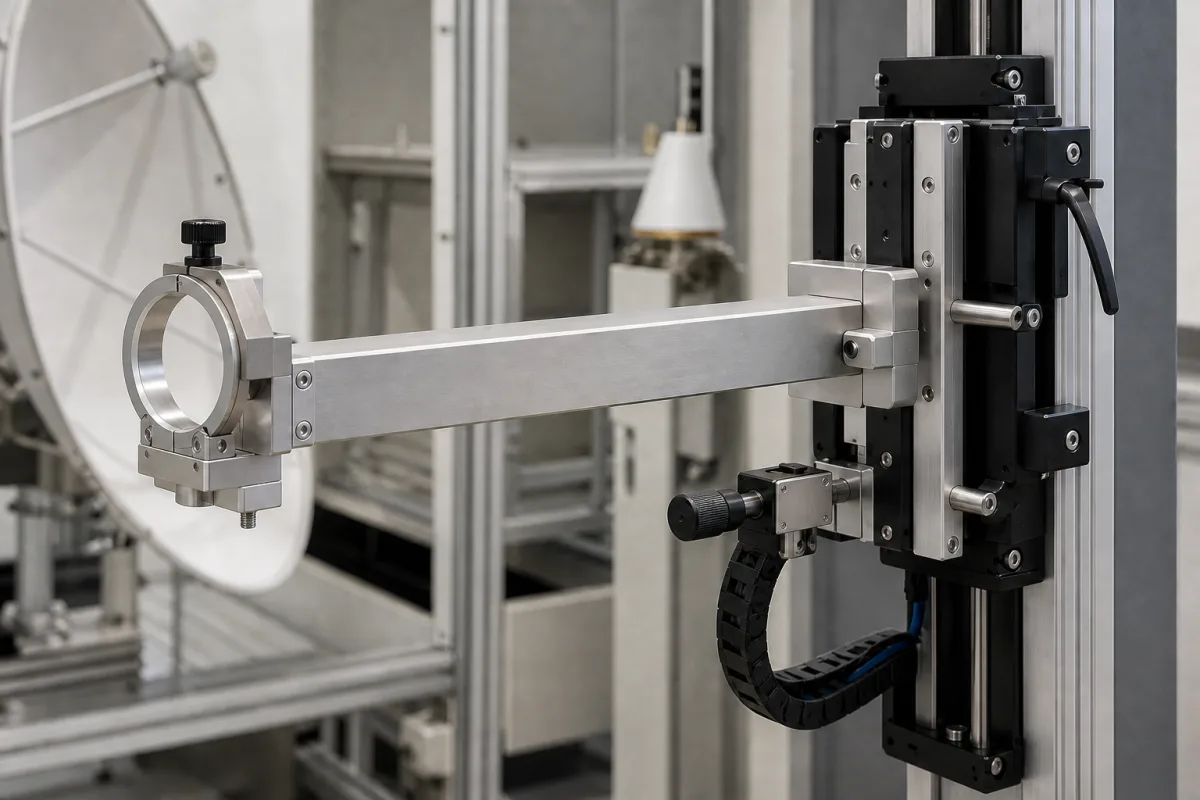
Horizontal Positioning Arm

Based on aggregated insights from multiple verified factory profiles within the CNFX directory, the standard Horizontal Positioning Arm used in the Computer, Electronic and Optical Product Manufacturing sector typically supports operational capacities ranging from standard industrial configurations to heavy-duty production requirements.

Technical Definition & Core Assembly

A canonical Horizontal Positioning Arm is characterized by the integration of Mounting Bracket and Adjustment Mechanism. In industrial production environments, manufacturers listed on CNFX commonly emphasize Aluminum alloy construction to support stable, high-cycle operation across diverse manufacturing scenarios.

A mechanical arm component designed to provide precise horizontal adjustment and positioning for antennas within a mounting system.
Product Specifications

Technical details and manufacturing context for Horizontal Positioning Arm

Definition
The Horizontal Positioning Arm is a critical component of the Internal Antenna Mounting System that enables fine-tuned horizontal alignment of antennas. It functions as an adjustable linkage that allows operators to precisely position antennas along the horizontal plane to optimize signal reception, transmission patterns, and spatial orientation within confined internal spaces.
Working Principle
The arm operates through a combination of mechanical linkages and adjustment mechanisms (such as telescoping sections, sliding tracks, or articulated joints) that allow controlled horizontal movement. Locking mechanisms secure the arm at desired positions once optimal antenna placement is achieved, ensuring stable positioning during operation.
Common Materials
Aluminum alloy, Stainless steel
Technical Parameters
  • Horizontal travel range (mm) Standard Spec
Components / BOM
  • Mounting Bracket
    Secures the arm to the mounting system base
    Material: Stainless steel
  • Adjustment Mechanism
    Enables controlled horizontal movement and locking
    Material: Aluminum alloy
  • Antenna Interface Plate
    Connection point for mounting the antenna
    Material: Aluminum alloy
Engineering Reasoning
0-150 N·m torque, ±0.1 mm positioning accuracy, -40°C to +85°C temperature
Exceeding 180 N·m torque causes permanent gear deformation, positioning accuracy degradation beyond ±0.5 mm, or operation outside -40°C to +85°C temperature range
Design Rationale: Gear tooth yielding at 250 MPa stress (exceeding 4140 steel yield strength), thermal expansion coefficient mismatch (11.7×10⁻⁶/°C aluminum vs 1.2×10⁻⁶/°C steel) causing binding, or lubricant viscosity breakdown at 90°C
Risk Mitigation (FMEA)
Trigger Backlash accumulation exceeding 0.15 mm due to gear wear
Mode: Positional drift exceeding ±0.3 mm specification during antenna alignment
Strategy: Dual-encoder feedback system with 0.01 mm resolution and automatic backlash compensation algorithm
Trigger Corrosion-induced pitting on worm gear surface from chloride exposure exceeding 500 ppm
Mode: Increased friction torque to 200 N·m causing motor overload protection activation
Strategy: 316L stainless steel worm gear with PTFE coating and IP67-rated environmental sealing

Industry Taxonomies & Aliases

Commonly used trade names and technical identifiers for Horizontal Positioning Arm.

Applied To / Applications

This component is essential for the following industrial systems and equipment:

Industrial Ecosystem & Supply Chain DNA

Complementary Systems
Downstream Applications
Specialized Tooling

Application Fit & Sizing Matrix

Operational Limits
pressure: N/A (mechanical positioning component)
other spec: Max Load Capacity: 50 kg, Positioning Accuracy: ±0.5 mm, Operating Humidity: 0-95% RH non-condensing
temperature: -40°C to +85°C
Media Compatibility
✓ Antenna mounting systems ✓ Outdoor telecom installations ✓ Industrial positioning applications
Unsuitable: Marine/saltwater corrosive environments without protective coating
Sizing Data Required
  • Antenna weight and dimensions
  • Required horizontal travel distance
  • Mounting surface/interface specifications

Reliability & Engineering Risk Analysis

Failure Mode & Root Cause
Bearing fatigue and wear
Cause: Cyclic loading from repeated positioning movements leading to material fatigue, combined with inadequate lubrication or contamination ingress causing accelerated wear.
Hydraulic cylinder seal failure
Cause: Degradation of elastomeric seals due to thermal cycling, chemical exposure, or particulate contamination in hydraulic fluid, resulting in fluid leakage and loss of positioning accuracy.
Maintenance Indicators
  • Unusual grinding or knocking noises during arm movement indicating bearing or gear damage
  • Visible hydraulic fluid leaks around cylinder seals or connections, especially with reduced positioning precision
Engineering Tips
  • Implement condition-based lubrication with high-quality grease specifically rated for oscillating movements, using ultrasonic or vibration analysis to optimize intervals
  • Install inline filtration for hydraulic systems with regular fluid analysis to maintain ISO cleanliness codes, and use compatible seal materials for operating environment

Compliance & Manufacturing Standards

Reference Standards
ISO 230-1:2012 (Test code for machine tools - Geometric accuracy of machines operating under no-load or quasi-static conditions) ANSI B5.54-2005 (Methods for Performance Evaluation of Computer Numerically Controlled Machining Centers) DIN 8602-1:2016 (Machine tools - Test conditions for machining centres - Part 1: Geometric tests for machines with horizontal spindle)
Manufacturing Precision
  • Linear positioning accuracy: +/-0.01 mm per 300 mm travel
  • Repeatability of positioning: +/-0.005 mm
Quality Inspection
  • Laser interferometer calibration for positioning accuracy verification
  • Ball bar test for circular interpolation accuracy and backlash assessment

Factories Producing Horizontal Positioning Arm

Verified manufacturers with capability to produce this product in China

✓ 93% Supplier Capability Match Found

S Sourcing Manager from Germany Jan 08, 2026
★★★★★
"Great transparency on the Horizontal Positioning Arm components. Essential for our Computer, Electronic and Optical Product Manufacturing supply chain."
Technical Specifications Verified
P Procurement Specialist from Brazil Jan 05, 2026
★★★★☆
"The Horizontal Positioning Arm we sourced perfectly fits our Computer, Electronic and Optical Product Manufacturing production line requirements. (Delivery took slightly longer than expected, but technical support was excellent.)"
Technical Specifications Verified
T Technical Director from Canada Jan 02, 2026
★★★★★
"Found 32+ suppliers for Horizontal Positioning Arm on CNFX, but this spec remains the most cost-effective."
Technical Specifications Verified
Verification Protocol

“Feedback is collected from verified sourcing managers during RFQ (Request for Quote) and factory evaluation processes on CNFX. These reports represent historical performance data and technical audit summaries from our B2B manufacturing network.”

5 sourcing managers are analyzing this specification now. Last inquiry for Horizontal Positioning Arm from Germany (35m ago).

Supply Chain Compatible Machinery & Devices

Modular Industrial Edge Computing Device

Rugged computing platform for industrial data processing at the network edge

Explore Specs →
Industrial Smart Camera Module

Embedded vision system for industrial automation and quality inspection.

Explore Specs →
Industrial Wireless Power Transfer Module

Wireless power transfer module for industrial equipment applications

Explore Specs →
Industrial Smart Sensor Module

Modular industrial sensor with embedded processing and wireless connectivity

Explore Specs →

Frequently Asked Questions

What materials are used in the horizontal positioning arm?

The arm is constructed from high-grade aluminum alloy for lightweight strength and stainless steel components for corrosion resistance in mounting systems.

How does the adjustment mechanism provide precise positioning?

The adjustment mechanism allows fine-tuned horizontal movement with secure locking to maintain exact antenna alignment for optimal signal performance.

What industries commonly use this positioning arm?

Primarily used in computer, electronic, and optical product manufacturing for antenna systems requiring precise horizontal alignment and stability.

Can I contact factories directly on CNFX?

CNFX is an open directory, not a transaction platform. Each factory profile provides direct contact information and production details to help you initiate direct inquiries with Chinese suppliers.

Get Quote for Horizontal Positioning Arm

Request technical pricing, lead times, or customized specifications for Horizontal Positioning Arm directly from verified manufacturing units.

Your business information is encrypted and only shared with verified Horizontal Positioning Arm suppliers.

Thank you! Your message has been sent. We'll respond within 1–3 business days.

Need to Manufacture Horizontal Positioning Arm?

Connect with verified factories specializing in this product category

Add Your Factory Contact Us
Previous Product
HMI Touchscreen
Next Product
Host Bus Interface