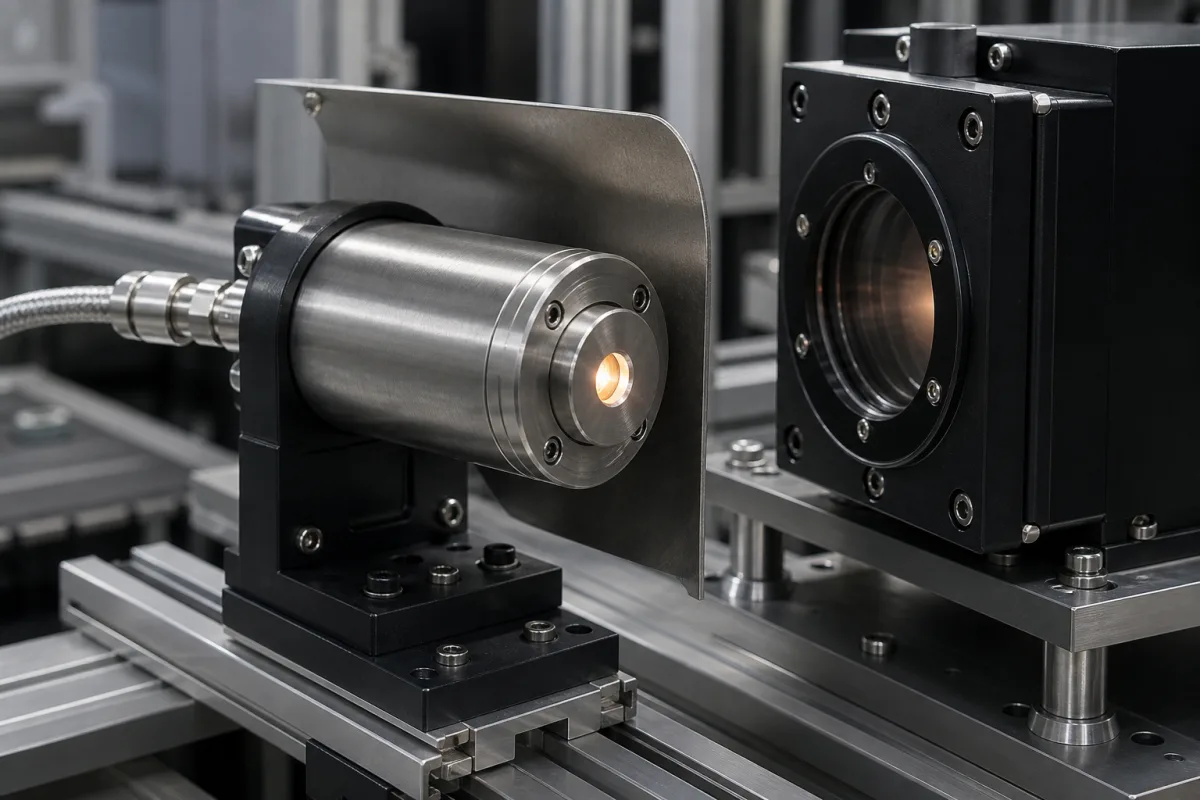
IR emitters · Infrared LEDs, miniature IR lamps and thermal (black-body) MEMS emitters — wavelength range, radiant power, drive voltage and current, modulation speed, beam angle, temperature, lifetime and package
An infrared source supplies the radiation that a detector measures in gas analysers, optical counters, remote controls and sensing systems. Settle three things before choosing one: the source type and wavelength band your detector and target absorption need, the radiant power, drive and modulation speed your electronics provide, and the lifetime, temperature range and package the product requires.
Infrared emitting diodes, miniature infrared lamps and thermal (black-body) MEMS infrared emitters used as sources in sensors, NDIR gas detectors, optical counters and IR links. Infrared detectors, laser diodes and laser modules, IR heaters and illuminated LED lighting are outside this page; infrared detectors and gas sensors have their own pages.
CNFX editorial research · Sources checked October 12, 2026 · 4 sources
Heimann Sensor offers two infrared source types for gas detection. Its HSL lamps are low-cost sources for wavelengths shorter than about 4.5 µm, run in DC or AC mode, for gases such as CO₂ and hydrocarbons; their quartz glass housing transmits little above 4.5 µm, so for CO, NO and gases at longer wavelengths Heimann points to its broadband EMIRS emitters. The EMIRS series, offered with Axetris, has a near black-body spectrum, modulation up to 100 Hz for wavelengths up to 16 µm, and an optional reflector giving seven times higher power on axis. [2][3]
Vishay's TSAL6200 is a narrow-band infrared emitting diode: GaAlAs multi-quantum-well, 940 nm peak with 30 nm spectral bandwidth, ±17° half-intensity angle and a 5 mm T-1¾ leaded package, matched to silicon photodetectors, for remote controls, free-air transmission and optical counters and card readers. [1]
Give the supplier the source type, wavelength band or target gas absorption line, radiant power or intensity at your drive, drive voltage and current (DC or pulsed), modulation frequency, beam angle or reflector, window or filter material, operating and case temperature, lifetime, package and quantity.
02
Check radiant power, drive, modulation and lifetime
The TSAL6200 lists 40 mW radiant power and 72 mW/sr radiant intensity (typ.) at 100 mA, forward voltage of 1.35 V (typ.; 1.6 V max) at 100 mA, 15 ns rise and fall times, 100 mA continuous and 1.5 A surge forward current, 160 mW power dissipation, and −40 to +85 °C operation. [1]
Heimann's HSL 5-115 and 5-60 lamps run at 5 V and 115 or 60 mA, with average lifetimes of 40,000 and 100,000 hours and −20 to 100 °C operation. Its EMIRS 200 (TO-39) and EMIRS 50 (TO-46) take 450 and 187 mW at 5.6 and 2.7 V, reach 450 and 463 °C working temperature with emissivity above 0.85, have heating time constants of 18 and 10 ms, and a measured lifetime of 10 years. [2][3]
Editorial calculation: an HSL 5-115 lamp draws 5 V × 115 mA = 575 mW, against 187 mW for an EMIRS 50 at 2.7 V; for battery gas sensors, compare the power at your duty cycle as well as the wavelength band each source reaches. [2][3]
03
Read a thermal emitter's power, temperature and housing limits
LASER COMPONENTS' data sheet for the Infrasolid HIS550R-0 (V4, July 2025) describes a NiCr-filament thermal emitter in a TO-39/TO-5 package with a gold-plated reflector that sends rear radiation forward, which it says almost doubles optical output. It lists an 11 mm² radiating element with emissivity above 0.9, reaching 600 °C at 650 mW; optical output up to 195 mW; maximum DC electrical power of 700 mW at up to 4.0 V and 175 mA; hot and cold resistance both 22 ± 3 Ω; a 2–20 µm wavelength range with no window and no filling gas; and a Lambertian angular distribution. Without a heat sink at 20 °C ambient and 700 mW, the maximum housing temperature is given as 80 °C in DC operation and 55 °C pulsed at 1 Hz. The maker states compliance with JEDEC tests for temperature cycling (−45/+90 °C, 100 cycles), vibration (20–2,000 Hz, 20 g peak) and drop (5,000 m/s²). [4]
Editorial calculation: 195 mW out for 650 mW in is about 30%, against the 40 mW from 100 mA for the TSAL6200 LED; a 22 Ω filament at 650 mW draws about 172 mA at 3.8 V, inside the 175 mA and 4.0 V limits. By Wien's law a 600 °C (873 K) black body peaks near 3.3 µm, in the mid-infrared region used for the CO₂ and hydrocarbon detection Heimann describes, which a 940 nm LED does not reach. Because the hot and cold resistance match, a constant-voltage drive gives near-constant power. [4][1][2]
NationStar lists 3 mm and 5 mm infrared emitting LEDs, the narrow-band LED type described above rather than lamps or thermal emitters.
Ask each supplier for the datasheet with spectral output, radiant power at your drive, modulation response, lifetime test conditions and package drawing. [1][2][3]
05
Emitter element, window or lens, reflector and package
Reflectors make a stated difference: Heimann quotes seven times higher on-axis power with its EMIRS reflector option, and LASER COMPONENTS says the HIS550R's gold-plated reflector almost doubles optical output. [3][4]
Wavelength band, radiant power, drive voltage and current, modulation, beam angle and package for an IR source order
The rows mix three source types — LED, lamp and thermal emitter — so read each value against the type it belongs to; only weight has no published figure.
Field
What it means and published values
Ask the supplier for
Wavelength
940 nm LED; lamp under about 4.5 µm; MEMS up to 16 µm; thermal 2–20 µm. [1][2][3][4]
nm or µm band.
Radiant Power
40 mW at 100 mA (TSAL6200); up to 195 mW (thermal emitter). [1][4]
mW at drive.
Forward Voltage
1.35 V (typ.) at 100 mA; lamps 5 V; MEMS 2.7–5.6 V. [1][2][3]
1 company lists this product among what they make. Company figures are quoted from each
company's own website; every card states where the relationship came from.
Foshan Nationstar Optoelectronics Co.,Ltd.
Manufacturing site to be confirmed for the order
Its website lists 3 mm and 5 mm infrared emitting LEDs.
Explore company information and manufacturing capabilities, then discuss the scope of your project with a relevant supplier.
Share this page
Compiled and source-reviewed by the CNFX editorial team.
Each manufacturer above links to the page on that company's own website where the product is listed, with the date we checked it. How we source and review
· Page last updated 13 October 2026
Buyer questions
Which infrared source suits NDIR gas detection?
Heimann uses low-cost lamps for absorption wavelengths below about 4.5 µm (such as CO₂) and broadband thermal MEMS emitters for CO, NOx and longer wavelengths up to 16 µm. [2][3]
How fast can an infrared source be modulated?
Vishay's TSAL6200 IR LED switches in 15 ns; Heimann's EMIRS thermal emitters modulate up to 100 Hz. [1][3]
How long do infrared sources last?
Heimann lists 40,000–100,000 h average for HSL lamps and a measured 10 years for EMIRS emitters. [2][3]
What wavelength do IR LEDs emit?
The TSAL6200 peaks at 940 nm with 30 nm spectral bandwidth. [1]
How much optical power does a thermal infrared emitter give?
One TO-39 thermal emitter data sheet lists up to 195 mW optical output, with the element at 600 °C at 650 mW electrical input and a 2–20 µm range. [4]
Sources and what still needs a direct check
Sources checked 2026-10-12. Vishay's TSAL6200 datasheet, Heimann Sensor's HSL and EMIRS product pages and LASER COMPONENTS' Infrasolid HIS550R-0 data sheet are used to show what an infrared source specification covers; values for your order must come from the supplier's datasheet.