Editorial Technical Reference

Lens Mounting Fixture

This page explains how Lens Mounting Fixture is classified within Computer, Electronic and Optical Product Manufacturing. Technical values and manufacturer relationships are research references; confirm the current specification and supplier evidence for each order.

Technical Definition & Core Assembly

A precision fixture designed to securely hold and position optical lenses during polishing operations.
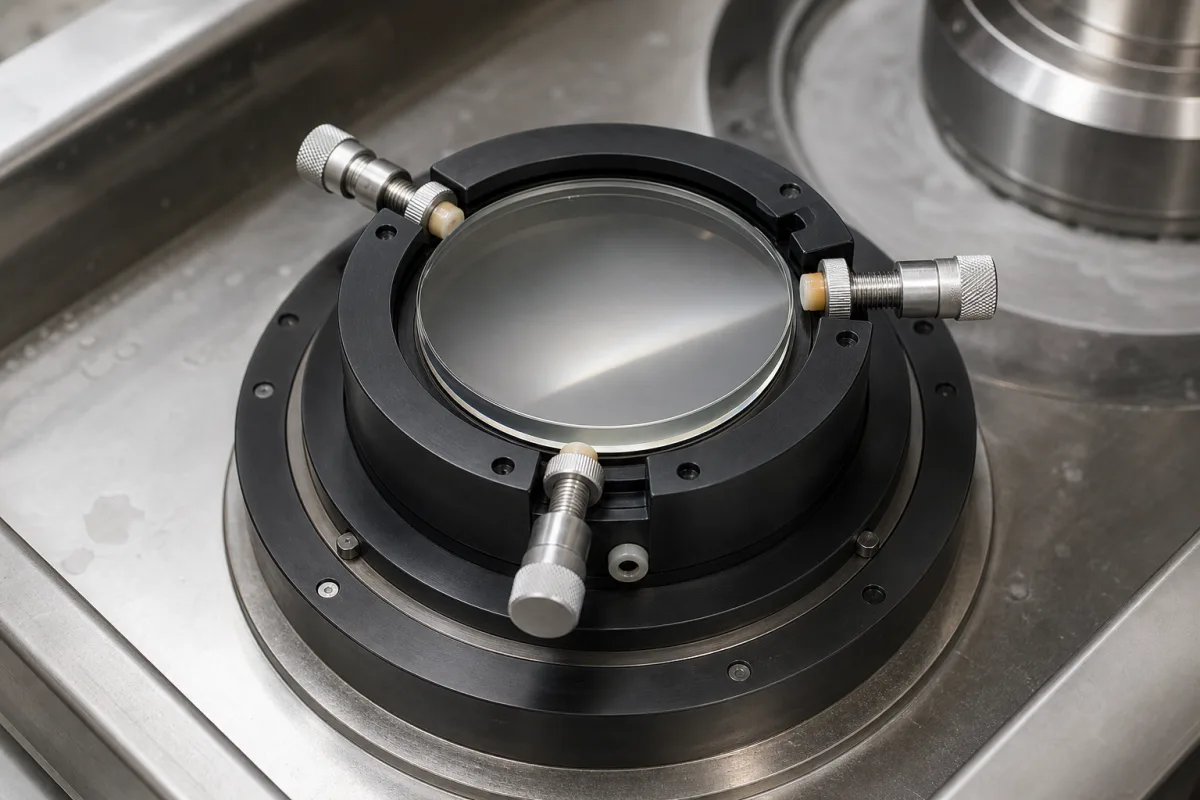
Representative product image. Confirm appearance and specifications with the manufacturer.

Product Specifications

Technical details and manufacturing context for Lens Mounting Fixture

Definition
The Lens Mounting Fixture is a precision component used in the Polishing Spindle Assembly of optical manufacturing equipment. Its primary function is to provide a stable and accurate mounting platform for optical lenses during polishing, ensuring precise alignment and secure clamping to achieve required surface finishes and optical specifications. The fixture is designed to accommodate lenses with diameters ranging from 5 to 100 mm, with positioning accuracy of ±0.01 mm and repeatability of ±0.005 mm, ensuring consistent lens placement. Clamping force is adjustable between 50 and 200 N, providing sufficient grip without deforming the lens. The fixture operates within a temperature range of -10 to 50 °C, and requires a pneumatic supply of 0.4 to 0.6 MPa for actuation. It is constructed from materials such as stainless steel, aluminum alloy, or precision ceramic, with a material hardness of 45–55 HRC (per ASTM E18) and surface roughness of Ra 0.4–0.8 µm (per ISO 4287) to prevent lens scratching. The fixture weighs between 1.5 and 3.5 kg, and has an ingress protection rating of IP54 (per IEC 60529) to guard against dust and water splashes. This component is essential for maintaining controlled material removal and surface refinement during polishing. It is used in the computer, electronic, and optical product manufacturing industry. For specific applications, it is critical to verify model-specific values and standards with the legal manufacturer or supplier, as the listed parameters are reference ranges that must be confirmed for the actual model and application.
Working Principle
The fixture uses mechanical clamping mechanisms, such as collets, vacuum chucks, or precision jaws, to securely hold the lens periphery or edge. It interfaces with the polishing spindle to maintain consistent positioning and orientation throughout the polishing cycle. The clamping force is pneumatically actuated, typically within 0.4–0.6 MPa, and is adjustable to ensure lens stability without deformation. The fixture's precise alignment and repeatability ensure that the lens remains in the correct position during polishing, allowing for controlled material removal and surface refinement.
Common Materials
Stainless Steel, Aluminum Alloy, Precision Ceramic
Technical Parameters
ParameterTypical rangeNotes & selection driver
Clamping Force50–200 NEnsures lens stability without deformation
Positioning Accuracy±0.01 mmCritical for optical alignment
Repeatability±0.005 mmEnsures consistent lens placement
Lens Diameter Range5–100 mmAccommodates common optical lens sizes
Operating Temperature-10–50 °COutside this range, material properties may degrade
Material Hardness45–55 HRCHardness ensures wear resistanceASTM E18
Surface RoughnessRa 0.4–0.8 µmSmooth finish prevents lens scratchingISO 4287
Weight1.5–3.5 kgLightweight for ease of handling
Operating Pressure0.4–0.6 MPaPneumatic actuation; below 0.4 MPa clamping force insufficient
Ingress ProtectionIP54Protects against dust and water splashesIEC 60529

Ranges are indicative industry figures for RFQ preparation, not a supplier commitment. Confirm every value and standard with the legal manufacturer before ordering.

Components / BOM
  • Collet Chuck
    Provides concentric clamping force around lens periphery
    Material: Stainless Steel
  • Mounting Plate Part
    Interface between fixture and polishing spindle
    Material: Aluminum Alloy
  • Alignment Pins Part
    Ensures precise angular positioning of lens
    Material: Hardened Steel
  • Pneumatic Actuation Unit
    Supplies and adjusts the clamping force at 0.4–0.6 MPa so the lens is held without being deformed.

Applied To / Applications

This component is essential for the following industrial systems and equipment:

Industrial Ecosystem & Supply Chain Structure

Complementary Systems
Downstream Applications
Specialized Tooling

Application Fit & Sizing Matrix

Operational Limits
pressure: Max 0.5 MPa clamping pressure, 0.1-0.3 MPa typical polishing pressure
other spec: Slurry concentration: 5-20% abrasive by weight, Max lens diameter: 200mm, Vibration tolerance: <5μm RMS
temperature: 15-35°C (operating), -10 to 60°C (storage)
Media Compatibility
✓ Cerium oxide polishing slurry ✓ Diamond abrasive suspension ✓ Silica-based colloidal polishing compounds
Unsuitable: Hydrofluoric acid or strong alkaline cleaning solutions
Sizing Data Required
  • Lens diameter and curvature radius
  • Required positional accuracy (microns)
  • Polishing machine interface specifications

Reliability & Engineering Risk Analysis

Failure Mode & Root Cause
Misalignment-induced stress cracking
Cause: Improper lens seating during mounting creates uneven pressure distribution, leading to micro-fractures in the fixture material, especially at stress concentration points like mounting holes or edges.
Thread galling or stripping
Cause: Repeated tightening/loosening cycles with inadequate lubrication or using incorrect torque values causes wear on threaded components, eventually leading to loss of clamping force or complete thread failure.
Maintenance Indicators
  • Visible lens wobble or play when mounted, indicating loss of precise alignment or clamping force
  • Audible clicking or grinding sounds during lens insertion/removal, suggesting worn or damaged mating surfaces
Engineering Tips
  • Implement torque-controlled tightening procedures using calibrated tools to ensure consistent, manufacturer-specified clamping force without overstressing components
  • Establish regular cleaning and inspection protocols for all contact surfaces, using appropriate optical-grade lubricants on moving parts to prevent abrasive wear and corrosion

Indicative industry ranges for design and RFQ preparation. Confirm the exact figures and applicable standard with the manufacturer before specifying.

Compliance & Manufacturing Standards

Applicable Standards
ISO 10110-7:2017 (Optics and photonics - Preparation of drawings for optical elements and systems - Surface imperfection tolerances) ANSI/ASME B46.1-2019 (Surface Texture, Surface Roughness, Waviness, and Lay) DIN 3140-1:2015 (Optics and optical instruments - Mounting of optical elements - Part 1: General principles)

Quoted from the published standard.

Manufacturing Precision
  • Bore concentricity: +/-0.01mm
  • Mounting surface flatness: 0.005mm
Quality Inspection
  • Coordinate Measuring Machine (CMM) dimensional verification
  • Interferometric surface flatness testing

Manufacturers of Lens Mounting Fixture

Manufacturer profiles associated with Lens Mounting Fixture.

Sourcing Lens Mounting Fixture from China?
Tell us your specification and target quantity — we will match it against manufacturer records and come back with the factories that fit.
Request manufacturers We manufacture this

Manufacturer listings support early research and capability understanding. They are not certification, ranking, or transaction guarantees.

Technical documentation
Request current drawings, revision history, and a signed specification sheet.
Manufacturing capability
Verify equipment lists, process limits, capacity, and representative production evidence.
Inspection readiness
Confirm test methods, calibrated equipment, sampling plans, and traceable reports.
Supplier transparency
Check the legal entity, factory address, ownership, certifications, and direct contacts.

CNFX does not score or rank suppliers. Buyers must verify all claims and documents with the legal manufacturer before ordering.

Supply Chain Compatible Machinery & Devices

Modular Industrial Edge Computing Device

This modular industrial edge computing device is a ruggedized system designed for deployment in harsh industrial environments to perform real-time data processing, analytics, and control functions at the network edge.

Explore Specs →
Industrial Smart Camera Module

The Industrial Smart Camera Module is a compact, self-contained vision processing unit designed for integration into industrial machinery and production lines.

Explore Specs →
Surface Mount Resistor

Passive electronic component for current limiting and voltage division in circuits

Explore Specs →
Surface Mount Capacitor

A surface mount capacitor is a fundamental electronic component used for energy storage, filtering, coupling, and decoupling in electronic circuits.

Explore Specs →

Frequently Asked Questions

What is the clamping force range of the lens mounting fixture?

The clamping force is adjustable from 50 to 200 N, ensuring lens stability without deformation. The exact force required depends on the lens material and geometry, so it should be set according to the manufacturer's recommendations.

What is the positioning accuracy and repeatability?

The positioning accuracy is ±0.01 mm, and repeatability is ±0.005 mm. These values are critical for optical alignment and consistent lens placement. Verify these specifications with the supplier for the specific model.

What materials are used for the fixture?

The fixture is available in stainless steel, aluminum alloy, or precision ceramic. Material hardness is 45–55 HRC (ASTM E18), and surface roughness is Ra 0.4–0.8 µm (ISO 4287) to prevent lens scratching.

What are the operating pressure and temperature requirements?

The fixture requires a pneumatic supply of 0.4–0.6 MPa for actuation. It operates within a temperature range of -10 to 50 °C. Outside this range, material properties may degrade, so ensure the environment meets these conditions.

Data Basis

Editorial classification, named public sources where available, and source-reviewed manufacturer records.

Preliminary Technical Classification
This page supports structured research, RFQ preparation, and supplier evaluation. It does not replace buyer-led supplier qualification, standards review, or technical approval.
Buyer enquiry

Request manufacturing insight for Lens Mounting Fixture

Ask for use case, specification boundaries, supplier type, and RFQ preparation information for this product.

Where it goes
Straight to the CNFX editorial desk, and to the manufacturer if this product is linked to a claimed profile. Nothing is broadcast to a supplier list.
Your details stay here
We do not sell or rent enquiry data, and we do not add you to a mailing list. Used only to answer this request.
No commission, no middleman
CNFX is a directory. We take no cut of any order and never negotiate on a supplier's behalf.
What we don't claim
A listing is not an endorsement. Qualify every supplier and verify every figure yourself before ordering.

Your business information is used only to process this request.

Thank you! Your message has been sent. We'll respond within 1–3 business days.
Sorry, we couldn't send your message. Please try again, or email us at contact@cnfx.com.

Need to Manufacture Lens Mounting Fixture?

Compare manufacturer profiles with relevant product and process capability.

Previous Product
XY Positioning Stage
Last Product
Get QuotesChat