Editorial Technical Reference

Linear Sensor Array

This page explains how Linear Sensor Array is classified within Computer, Electronic and Optical Product Manufacturing. Technical values and manufacturer relationships are research references; confirm the current specification and supplier evidence for each order.

Technical Definition & Core Assembly

A one-dimensional array of photosensitive elements arranged in a straight line that captures image data by detecting light intensity along a single axis.
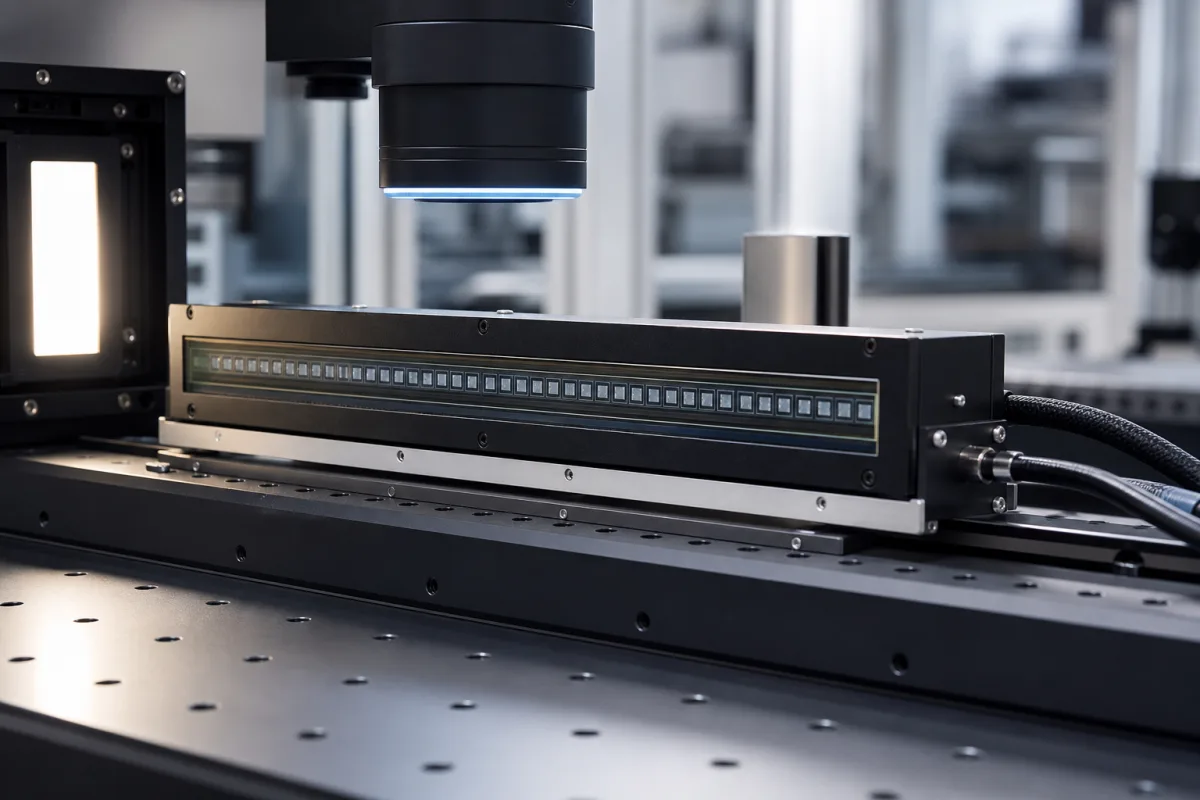
Representative product image. Confirm appearance and specifications with the manufacturer.

Product Specifications

Technical details and manufacturing context for Linear Sensor Array

Definition
The linear sensor array is the core imaging component of a line scan camera, consisting of multiple photodiodes or CCD/CMOS sensors arranged linearly. It captures image data one line at a time as objects move past the camera, converting light intensity into electrical signals that are processed to create continuous images of moving materials or products. This component is used in industrial inspection, document scanning, and other applications requiring high-speed, high-resolution imaging of moving objects. The array is typically fabricated on a silicon substrate with a glass cover and housed in a metal enclosure for protection. Key parameters include the number of pixels (128–4096), pixel pitch (5–25 μm), active length (10–100 mm), spectral response range (400–1000 nm), sensitivity (0.1–10 V/(lx·s)), dynamic range (60–80 dB), output data rate (1–10 MHz), supply voltage (3.3–5 V DC), power consumption (50–500 mW), operating temperature (-20 to 70 °C), storage temperature (-40 to 85 °C), ingress protection (IP40–IP67 per IEC 60529), package type (DIP–COB), and weight (5–50 g). These values are typical ranges and must be verified for the specific model and application. The array operates by focusing light onto the photosensitive elements, which generate charge proportional to light intensity; this charge is read out sequentially and converted to digital values. For proper integration, the user must consider the optical interface, electrical connections, and mechanical mounting. Verification questions include checking the spectral response matches the illumination source, confirming the pixel pitch and active length meet resolution requirements, and ensuring the output data rate is compatible with the camera's readout electronics. Maintenance signals include reduced sensitivity, increased noise, or non-uniform response across the array, which may indicate contamination or degradation. Failure boundaries include exposure to temperatures outside the specified range, excessive vibration, or electrical overstress. Always consult the manufacturer for model-specific specifications and compliance.
Working Principle
Light from the target object is focused onto the linear array through optics. Each photosensitive element in the array generates an electrical charge proportional to the light intensity it receives. These charges are sequentially read out and converted to digital values, creating a line of image data. Multiple lines captured over time are assembled to form a complete two-dimensional image of moving objects.
Common Materials
Silicon, Glass, Metal housing
Technical Parameters
ParameterTypical rangeNotes & selection driver
Number of Pixels128–4096 pixelsDetermines spatial resolution along the array.
Pixel Pitch5–25 μmSmaller pitch gives higher resolution but lower sensitivity.
Active Length10–100 mmTotal sensing length along the array.
Spectral Response Range400–1000 nmVisible to near-infrared.
Sensitivity0.1–10 V/(lx·s)Output voltage per unit illuminance and integration time.
Dynamic Range60–80 dBRatio of maximum to minimum detectable light intensity.
Output Data Rate1–10 MHzMaximum pixel readout rate.
Supply Voltage3.3–5 V DCTypical digital logic levels.
Power Consumption50–500 mWDepends on pixel count and readout speed.
Operating Temperature-20–70 °CExtended range may require cooling.
Storage Temperature-40–85 °CNon-operating condition.
Ingress ProtectionIP40–IP67Higher rating for dusty or wet environments.IEC 60529
Package TypeDIP–COBChip-on-board for compact designs.
Weight5–50 gDepends on package and mounting.

Ranges are indicative industry figures for RFQ preparation, not a supplier commitment. Confirm every value and standard with the legal manufacturer before ordering.

Components / BOM
  • Photosensitive Elements Part
    Convert light photons into electrical charges
    Material: Silicon
  • Readout Circuitry Part
    Transfer and amplify electrical signals from photosensitive elements
    Material: Silicon with metal interconnects
  • Protective Window Part
    Shield sensor elements from dust and physical damage while allowing light transmission
    Material: Optical glass

Applied To / Applications

This component is essential for the following industrial systems and equipment:

Industrial Ecosystem & Supply Chain Structure

Complementary Systems
Downstream Applications
Specialized Tooling

Application Fit & Sizing Matrix

Operational Limits
pressure: Atmospheric (non-pressurized)
other spec: Wavelength range: 400-1100 nm, Linearity error: <±0.5%
temperature: -20°C to +70°C (operating), -40°C to +85°C (storage)
Media Compatibility
✓ Paper/print inspection ✓ Web material edge detection ✓ Precision dimensional measurement
Unsuitable: High-vibration industrial environments
Sizing Data Required
  • Required spatial resolution (pixels/mm)
  • Scanning speed (lines/sec)
  • Required measurement length (mm)

Reliability & Engineering Risk Analysis

Failure Mode & Root Cause
Signal Drift/Calibration Loss
Cause: Thermal expansion/contraction of sensor elements causing misalignment, or electronic component aging affecting signal stability
Mechanical Damage to Sensing Elements
Cause: Physical impact, vibration-induced fatigue, or particulate contamination abrading sensitive surfaces
Maintenance Indicators
  • Inconsistent or erratic readings across the array compared to baseline performance
  • Visible physical damage (cracks, dents, misalignment) or audible abnormal clicking/grinding during operation
Engineering Tips
  • Implement regular thermal calibration cycles and environmental monitoring to compensate for temperature-induced drift
  • Install vibration dampening mounts and protective shrouds with appropriate IP ratings to shield from mechanical stress and contaminants

Indicative industry ranges for design and RFQ preparation. Confirm the exact figures and applicable standard with the manufacturer before specifying.

Compliance & Manufacturing Standards

Applicable Standards
IEC 61000-6-2:2019 - Electromagnetic Compatibility (EMC) CE Marking - Directive 2014/35/EU (Low Voltage Directive)

Quoted from the published standard.

Manufacturing Precision
  • Linear Positioning Accuracy: +/-0.01mm
  • Sensor Element Spacing Uniformity: +/-0.005mm
Quality Inspection
  • Functional Accuracy Test with Calibrated Reference Standards
  • Environmental Stress Screening (ESS) for Temperature and Humidity

Manufacturers of Linear Sensor Array

Manufacturer profiles associated with Linear Sensor Array.

Sourcing Linear Sensor Array from China?
Tell us your specification and target quantity — we will match it against manufacturer records and come back with the factories that fit.
Request manufacturers We manufacture this

Manufacturer listings support early research and capability understanding. They are not certification, ranking, or transaction guarantees.

Technical documentation
Request current drawings, revision history, and a signed specification sheet.
Manufacturing capability
Verify equipment lists, process limits, capacity, and representative production evidence.
Inspection readiness
Confirm test methods, calibrated equipment, sampling plans, and traceable reports.
Supplier transparency
Check the legal entity, factory address, ownership, certifications, and direct contacts.

CNFX does not score or rank suppliers. Buyers must verify all claims and documents with the legal manufacturer before ordering.

Supply Chain Compatible Machinery & Devices

Industrial Smart Camera Module

The Industrial Smart Camera Module is a compact, self-contained vision processing unit designed for integration into industrial machinery and production lines.

Explore Specs →
Surface Mount Resistor

Passive electronic component for current limiting and voltage division in circuits

Explore Specs →
Surface Mount Capacitor

A surface mount capacitor is a fundamental electronic component used for energy storage, filtering, coupling, and decoupling in electronic circuits.

Explore Specs →
Surface Mount Technology (SMT) Pick-and-Place Machine

Automated machine that precisely places electronic components onto printed circuit boards.

Explore Specs →

Frequently Asked Questions

What is the typical pixel count range for a linear sensor array?

The typical pixel count ranges from 128 to 4096 pixels, as listed in the directory. The exact number depends on the model and application requirements.

What spectral response range is available?

The spectral response range is typically 400 to 1000 nm, covering visible to near-infrared wavelengths. Confirm the specific range with the manufacturer for your application.

What ingress protection ratings are available?

Ingress protection ratings range from IP40 to IP67 per IEC 60529, depending on the housing and sealing. Higher ratings are suitable for dusty or wet environments.

How should I verify the compatibility of a linear sensor array with my system?

Check the pixel pitch, active length, spectral response, output data rate, and supply voltage against your system's requirements. Always consult the manufacturer for model-specific specifications and standards compliance.

Data Basis

Editorial classification, named public sources where available, and source-reviewed manufacturer records.

Preliminary Technical Classification
This page supports structured research, RFQ preparation, and supplier evaluation. It does not replace buyer-led supplier qualification, standards review, or technical approval.
Buyer enquiry

Request manufacturing insight for Linear Sensor Array

Ask for use case, specification boundaries, supplier type, and RFQ preparation information for this product.

Where it goes
Straight to the CNFX editorial desk, and to the manufacturer if this product is linked to a claimed profile. Nothing is broadcast to a supplier list.
Your details stay here
We do not sell or rent enquiry data, and we do not add you to a mailing list. Used only to answer this request.
No commission, no middleman
CNFX is a directory. We take no cut of any order and never negotiate on a supplier's behalf.
What we don't claim
A listing is not an endorsement. Qualify every supplier and verify every figure yourself before ordering.

Your business information is used only to process this request.

Thank you! Your message has been sent. We'll respond within 1–3 business days.
Sorry, we couldn't send your message. Please try again, or email us at contact@cnfx.com.

Need to Manufacture Linear Sensor Array?

Compare manufacturer profiles with relevant product and process capability.

Previous Product
XY Positioning Stage
Last Product
Get QuotesChat