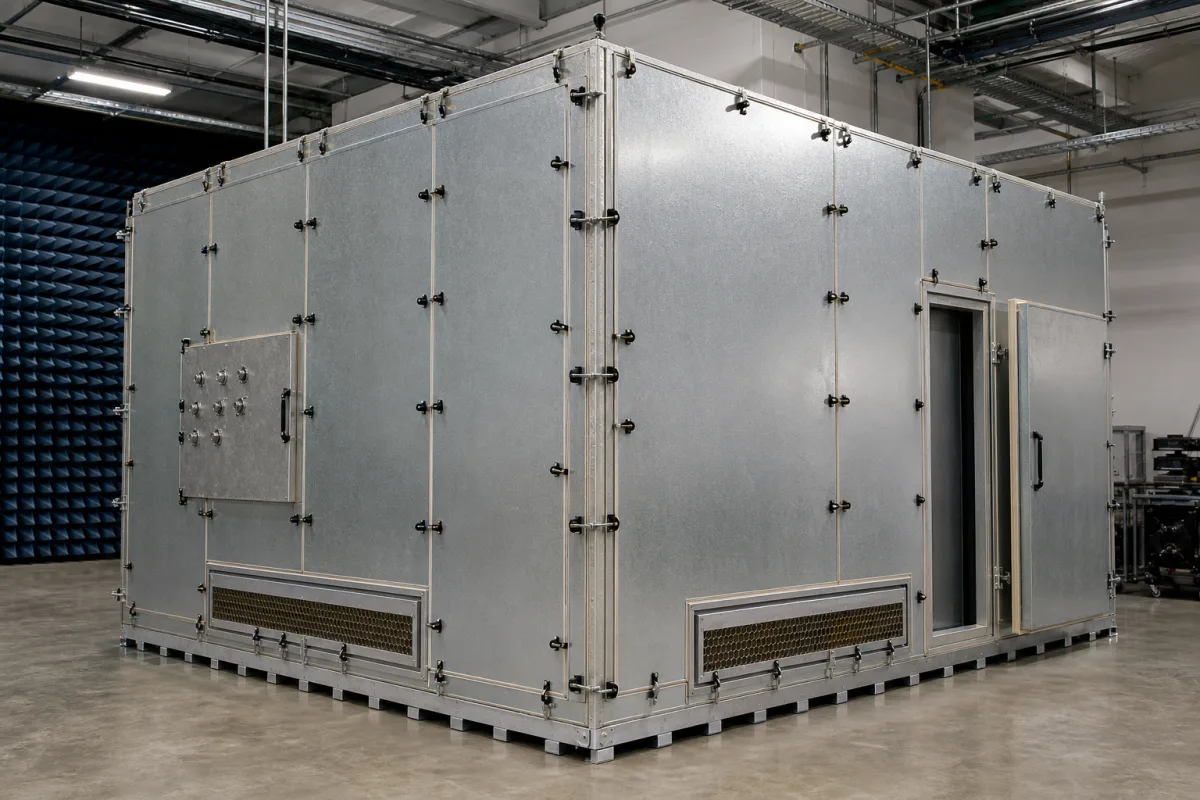
Demountable RF shielded room · Panel and seam construction, shielding effectiveness by field type, IEEE 299 testing, room sizes
A modular shielded enclosure is a walk-in room assembled from prefabricated shielded panels joined by clamped or bolted, gasketed seams, so that it can be erected inside an existing building, dismantled, moved or enlarged. Ask three things first: what panel and seam system it uses, what shielding effectiveness it is specified to reach for magnetic, electric, plane-wave and microwave fields, and how that will be measured once the room is built with its door, filters and vents.
Demountable, panel-type RF and EMI shielded enclosures (walk-in shielded rooms) for EMC testing, secure communications, metrology, MRI and laboratory use, built from clamped or bolted shielded panels with their doors, filters and penetrations. Honeycomb waveguide air vents and ventilation panels are covered on the Waveguide ventilation panel page; welded shielded rooms, benchtop shielded boxes, soft-wall shielded tents and anechoic absorber linings are outside this page except where compared.
CNFX editorial research · Sources checked October 12, 2026 · 3 sources
ETS-Lindgren's Series 81 uses a 1.9 cm (0.75 in) panel of high-density particle board or plywood laminated with 28-gauge galvanized steel, joined by an extruded 3.175 mm (0.125 in) hat-and-flat clamping system with zinc-plated clamps and self-tapping screws spaced 10.16 cm (4.0 in) apart; the enclosure is self-supporting, needs no attachment to the parent building, and sits on a 6-mil dielectric vapour barrier and a 3.175 mm dielectric underlayment that isolate the shielded floor. [1]
The Series 101, by contrast, is built from hot-galvanized rigid steel structural panels with no wooden parts, sealed with a special gasket and bolted from the inside or the outside without welding; aluminium panels are an option. On reinstallation only the gaskets and fasteners need replacing. Bolted from inside, it can be assembled within 5 cm (2 in) of existing walls; bolted from outside it gives a flat interior for ferrites or absorbers, and needs about 800 mm (31.5 in) of clearance around the whole enclosure, including above the roof. [2]
Editorial calculation: with Series 81 screws every 10.16 cm, a vertical seam on a 2.51 m high standard room carries about 251 ÷ 10.16 ≈ 25 screws, and every seam in the room depends on that clamping pressure; ask how the supplier checks seams after assembly or relocation. [1]
Give the supplier the internal dimensions, the use (EMC testing, secure room, MRI, metrology, high-voltage or partial-discharge test), the shielding effectiveness required for each field type and frequency, the test standard, the door type and count, power, signal and fibre penetrations, ventilation, the floor load, and whether absorber or ferrite lining will follow.
02
Set shielding levels by field type and plan the acceptance test
ETS-Lindgren's published performance for the Series 81 is 20 dB at 1 kHz, 56 dB at 14 kHz and 100 dB at 100 kHz for magnetic fields; 110 dB from 14 kHz to 30 MHz for electric fields; 110 dB from 30 MHz to 1 GHz for plane waves; and 110 dB at 1 GHz and 100 dB from 10 GHz to 40 GHz for microwaves. For the all-steel Series 101 it lists 40 dB at 1 kHz, 80 dB at 10 kHz and 120 dB from 5 to 30 MHz magnetic, 120 dB electric from 1 kHz to 30 MHz, and 120 dB plane-wave and microwave from 30 MHz to 40 GHz. [1][2]
IEEE 299-2006 gives uniform procedures for measuring the shielding effectiveness of enclosures from 9 kHz to 18 GHz, extendable to 50 Hz and 100 GHz, for enclosures with all dimensions of 2.0 m or more, and covers bolted demountable, welded and building-integral structures of steel plate, copper or aluminium sheet, screening, foil or shielding fabric. IEEE lists the 2006 edition as inactive-reserved since 30 March 2023. [3] Editorial note: the smallest Series 81 standard size, 2.51 × 2.52 × 2.50 m, has every dimension above 2.0 m, so ask the supplier which test standard and frequencies its acceptance test will use, and whether it is run on the finished room with doors, filters and vents installed. [1][3]
Editorial note: the magnetic figures at low frequency are far below the high-frequency figures in both datasheets — 20 dB versus 100 dB for the Series 81 at 1 kHz and 100 kHz — so state low-frequency magnetic requirements separately if your equipment is sensitive below 100 kHz. [1]
03
Panels, seams, door, filters and vents of a demountable room
Structural and shielding continuity at corners. [1][2]
Design.
04
Room size, dB levels and floor load to state in the enquiry
Ingress protection and leakage flux appear in the product record but not in the datasheets reviewed; ask the supplier how they apply to a walk-in room.
Field
What it means and published values
Ask the supplier for
Internal dimensions (W×D×H) (mm)
Series 81 standard sizes from 2.50 × 2.52 × 2.51 m; custom sizes available. [1]
Inside and outside dimensions.
Shielding effectiveness (dB)
Series 81: 100–110 dB above 100 kHz; Series 101: 120 dB to 40 GHz. [1][2]
Values per field type and frequency.
Frequency range (Hz)
IEEE 299-2006 method: 9 kHz to 18 GHz, extendable. [3]
Test frequencies.
Leakage flux density (µT)
Low-frequency magnetic field inside the room.
Required limit and test method.
Operating temperature (°C)
Room environment.
Range with ventilation.
Humidity range (% RH)
Room environment.
Range.
Ingress protection
Not a room rating in the sources reviewed.
Whether any rating applies.
Material
Galvanized steel laminate or hot-galvanized steel; aluminium option. [1][2]
Paste it into your enquiry below or into an email to a maker, then replace every bracket.
Room: [inside dimensions; use]
Shielding: [dB per field type and frequency]
Test: [standard; frequencies; with doors and filters installed]
Construction: [clamped or bolted panels; material]
Doors and penetrations: [doors; power and signal filters; vents]
Site: [clearance to walls and roof; floor load]
Wuxi Anxin lists a modular enclosure built from moulded, plastic-sprayed shielding modules.
Wuxi Anxin Shielding Equipment Co., Ltd.
Manufacturing site to be confirmed for the order
Lists a modular shielded enclosure with moulded, plastic-sprayed shielding modules that can be dismantled for relocation or expansion, alongside welded shielding rooms.
Explore company information and manufacturing capabilities, then discuss the scope of your project with a relevant supplier.
Share this page
Compiled and source-reviewed by the CNFX editorial team.
Each manufacturer above links to the page on that company's own website where the product is listed, with the date we checked it. How we source and review
· Page last updated 13 October 2026
Buyer questions
How is a modular shielded room assembled?
From prefabricated panels joined by clamps or gasketed bolts; ETS-Lindgren's Series 81 uses a hat-and-flat clamp and its Series 101 bolts all-steel panels from inside or outside. [1][2]
What shielding effectiveness does a modular room reach?
ETS-Lindgren lists 100 dB at 10–40 GHz for Series 81 and 120 dB from 1 to 40 GHz for Series 101; low-frequency magnetic values are lower. [1][2]
How is the shielding of a room measured?
IEEE 299-2006 gives procedures from 9 kHz to 18 GHz for enclosures with all dimensions of 2.0 m or more. [3]
Sources and what still needs a direct check
Sources checked 2026-10-12. ETS-Lindgren is a shielded-room maker describing two of its modular enclosure systems; IEEE's standards page states the scope of IEEE 299-2006, the shielding effectiveness measurement method.