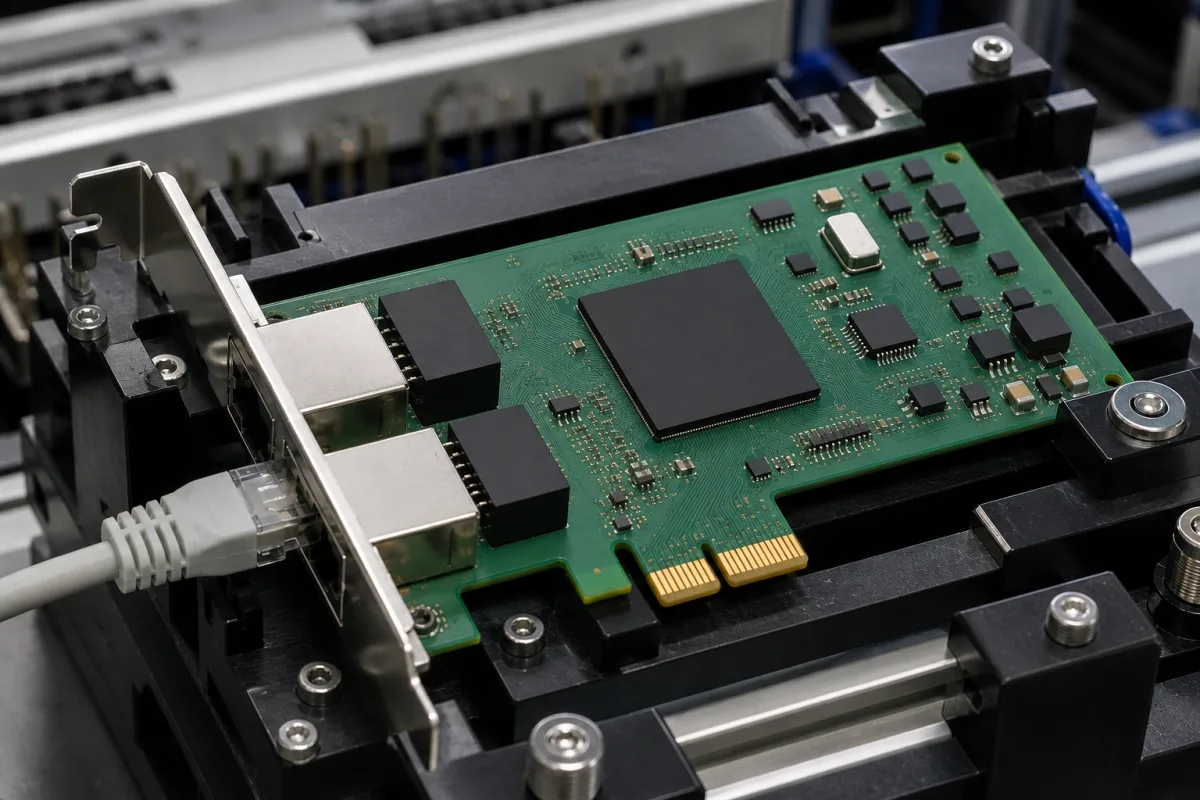
Network interface controllers (NICs) · Port speed and count, host interface and form factor, offloads (RDMA/RoCE, encryption, storage), time synchronisation, media and connectors, power, temperature and size
A network interface controller connects a computer or embedded system to an Ethernet network, moving data between the host processor's memory and the wire and, on modern cards, offloading networking, storage and security work from the CPU. Settle three things before choosing one: the port speed, count and media, the host interface, form factor and offloads the system needs, and the timing, power, temperature and size limits of the installation.
Ethernet network interface controllers and adapter cards — PCIe add-in and OCP 3.0 cards and on-board NIC controllers — from gigabit copper to 400 Gb/s ports. Ethernet PHY chips alone, switches and routers, DPUs and SuperNICs as separate platforms, and optical transceiver modules are outside this page except where compared; PHY chips and industrial network switches have their own pages.
CNFX editorial research · Sources checked October 12, 2026 · 4 sources
NVIDIA describes its ConnectX NICs as serving low-latency, high-throughput applications with one, two or four ports at 10, 25, 40, 50, 100, 200 and up to 400 Gb/s Ethernet: ConnectX-7 offers up to four ports and 400 Gb/s total, ConnectX-6 Dx up to two ports of 25, 50 or 100 Gb/s or one of 200 Gb/s using 50 Gb/s PAM4 SerDes, and ConnectX-6 Lx up to two 25 GbE ports or one 50 GbE port. [1]
At gigabit speeds on twisted-pair copper, a NIC uses an Ethernet PHY such as TI's DP83867, which supports 10BASE-Te, 100BASE-TX and 1000BASE-T to IEEE 802.3, up to 130 m of cable and IEEE 1588 start-of-frame detection, connecting to the MAC through MII, GMII or RGMII. [2]
Editorial calculation: a host slot must carry the ports' traffic — two 100 Gb/s ports in both directions need about 200 Gb/s each way, which a PCIe 4.0 x16 link (about 16 GT/s × 16 lanes, roughly 250 Gb/s raw per direction before encoding and protocol overhead) can carry, while an x8 link at half that cannot run both ports at full rate. [1]
The port speeds a NIC offers are defined in IEEE 802.3, the Ethernet standard. IEEE 802.3-2022 (approved 13 May 2022, published 29 July 2022, available free through the IEEE GET program) specifies Ethernet operation at selected speeds from 1 Mb/s to 400 Gb/s with one media access control (MAC) specification and management information base for all speeds; speed-specific media-independent interfaces let selected PHYs run over coaxial, twisted-pair or fibre cable or electrical backplanes, and it also covers power over selected twisted-pair PHY types. [3]
Editorial note: name each port's PHY type from IEEE 802.3 (for example 1000BASE-T copper or a specific optical or backplane type) as well as its speed, because cards of the same speed can use different media and cables. 800 Gb/s ports, quoted for some AI adapters, are later than the 400 Gb/s ceiling of the 2022 edition, so ask which amendment they follow. [3][1]
Give the supplier the port speeds and count, media and connectors (RJ45 copper, SFP/QSFP optical or DAC), host interface and lane count, form factor and bracket, required offloads (RDMA/RoCE, encryption, storage, virtualisation), time-sync needs, operating system and driver support, power and cooling, temperature range and quantity.
02
Choose host interface, form factor, offloads and timing
ConnectX-6 Dx uses PCI Express 4.0 host connectivity; the ConnectX-6 Lx portfolio covers low-profile PCIe and Open Compute Project (OCP) 3.0-compliant cards across a range of form factors and speeds. NVIDIA lists hardware offloads including ASAP2 accelerated switch and packet processing, RDMA over Converged Ethernet (RoCE), GPUDirect Storage, NVMe over TCP acceleration (added in ConnectX-7), in-line TLS, IPsec and MACsec encryption and decryption at up to 400 Gb/s, DPDK performance and secure boot with a hardware root of trust. [1]
Starting with ConnectX-6 Dx, ConnectX NICs provide an accurate time-synchronisation service for data-centre applications; NVIDIA's Ethernet SuperNICs for AI workloads go up to 800 Gb/s. [1]
Editorial note: offloads only help if the operating system, drivers and applications use them, so list the software stack alongside the hardware features you require. [1]
03
Ask for receive queues, RSS and steering filters
The Linux kernel's networking documentation explains how a multi-queue NIC spreads received packets across CPUs with Receive Side Scaling (RSS): the NIC computes a hash over network and transport headers, for example a 4-tuple of IP addresses and TCP ports, and uses its low-order bits to index an indirection table whose entries hold queue numbers. The document says NICs should provide an indirection table at least 4 times larger than the queue count, and that a 4x table gives about 16% imbalance between the queues. Each receive queue has its own interrupt, signalled over PCIe with MSI-X, which can route each interrupt to a particular CPU. [4]
The document advises using no more receive queues than needed to keep any queue from overflowing a saturated CPU, because with interrupt coalescing the total interrupt work grows with each added queue. [4] Editorial note: queue counts, table sizes and filter features are set by the controller and its driver, so request them for the exact card and driver version alongside the offloads NVIDIA lists, such as RoCE and in-line encryption. [1]
Feature named in the kernel document
What it does
Ask the supplier for
RSS indirection table
Maps hash values to receive queues; at least 4× queue count advised. [4]
Table size and queue count per port.
MSI-X interrupts
One interrupt per receive queue, routable to a CPU. [4]
MSI-X vectors supported.
n-tuple filters
Steer packets such as TCP port 80 to their own queue; set with ethtool. [4]
Number of filters and match fields.
Accelerated RFS
Hardware steering of each flow to the CPU running its application thread. [4]
Driver support.
04
Compare what suppliers offer
The companies in the manufacturer list below show this product on their own websites. Confirm the legal seller, factory and scope for your order.
Ask each supplier for the card's product brief or datasheet with port configurations, host interface, offloads, power, cooling airflow, operating temperature, dimensions and supported drivers and firmware lifecycle. [1]
05
Trace what each part controls
This is a functional reference built from the sources cited; it is not one maker's specification.
Fill the specification fields with values for your system
A NIC quotation needs values for your system. The table explains each field, gives published values where a reviewed source states them, and says what to obtain from the supplier.
Field
What it means and published values
Ask the supplier for
Data Rate
1–400 Gb/s per family; IEEE 802.3-2022 covers 1 Mb/s to 400 Gb/s. [1][2][3]
Explore company information and manufacturing capabilities, then discuss the scope of your project with a relevant supplier.
Share this page
Compiled and source-reviewed by the CNFX editorial team.
Published product pages show what a company offers, not tested performance. Confirm the legal seller, factory and scope for your order. How we source and review
· Page last updated 13 October 2026
Buyer questions
What port speeds do NICs offer?
NVIDIA's ConnectX NICs offer one, two or four ports at 10 to 400 Gb/s; gigabit copper NICs use PHYs such as TI's DP83867. [1][2]
What is an OCP 3.0 NIC?
A card built to the Open Compute Project 3.0 form factor; NVIDIA offers ConnectX-6 Lx in OCP 3.0 and low-profile PCIe versions. [1]
What offloads do modern NICs provide?
NVIDIA lists RoCE, GPUDirect Storage, NVMe/TCP and in-line TLS, IPsec and MACsec encryption. [1]
How far can a gigabit copper NIC reach?
TI's DP83867 Ethernet PHY supports up to 130 m of cable. [2]
Which standard defines Ethernet NIC port speeds?
IEEE 802.3; the 2022 edition covers 1 Mb/s to 400 Gb/s over coax, twisted pair, fibre and backplanes. [3]
How large should a NIC's RSS indirection table be?
The Linux kernel documentation says at least 4 times the receive queue count; a 4x table gives about 16% imbalance between queues. [4]
Sources and what still needs a direct check
Sources checked 2026-10-12. NVIDIA's Ethernet adapters page and Texas Instruments' DP83867 PHY datasheet are used to show what a NIC specification covers; IEEE 802.3 defines the Ethernet speeds; the Linux kernel documentation explains multi-queue receive scaling. Values for your order must come from the supplier's product brief.