Industry-Verified Manufacturing Data (2026)

Power Conversion Circuit

Based on aggregated insights from multiple verified factory profiles within the CNFX directory, the standard Power Conversion Circuit used in the Computer, Electronic and Optical Product Manufacturing sector typically supports operational capacities ranging from standard industrial configurations to heavy-duty production requirements.

Technical Definition & Core Assembly

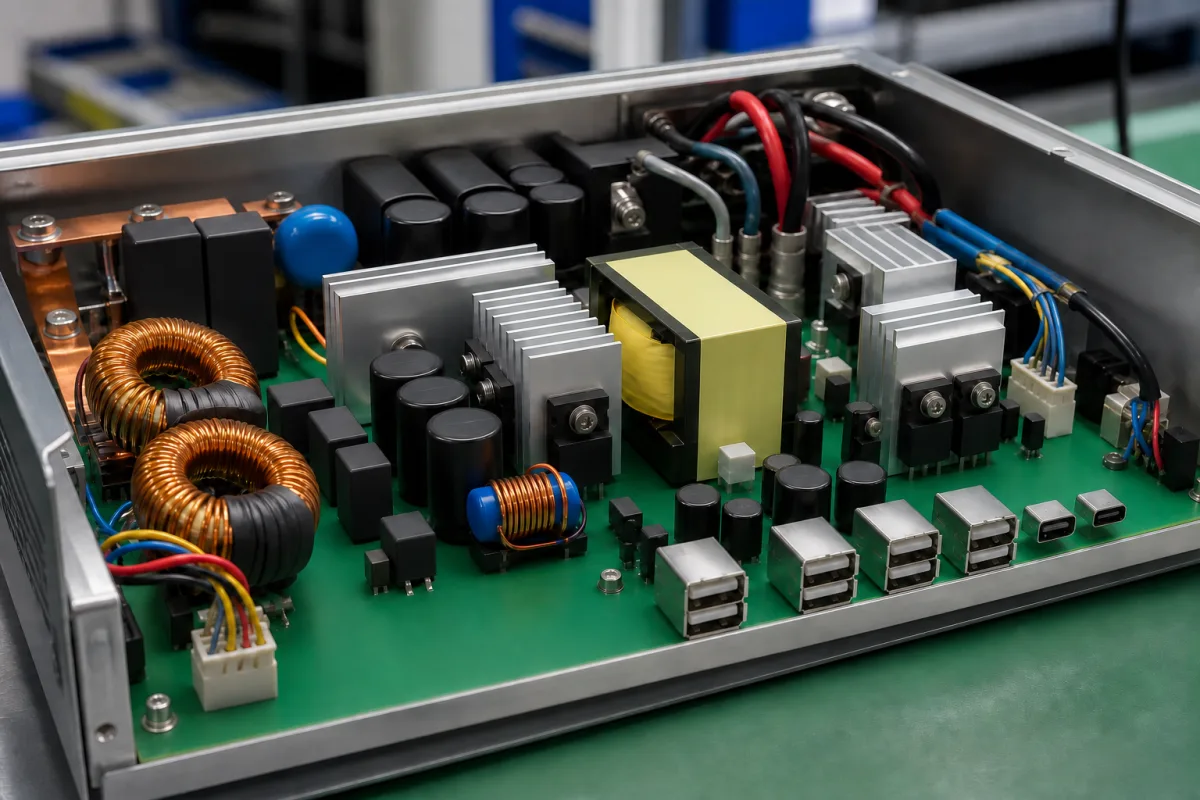
A canonical Power Conversion Circuit is characterized by the integration of Controller IC and Power MOSFET. In industrial production environments, manufacturers listed on CNFX commonly emphasize Printed Circuit Board (PCB) construction to support stable, high-cycle operation across diverse manufacturing scenarios.

Electronic circuit that converts input power to the required output voltage and current for USB charging.
Product Specifications

Technical details and manufacturing context for Power Conversion Circuit

Definition
A specialized electronic circuit within a USB Charging Module responsible for converting the input power source (typically AC mains or DC input) to the precise DC voltage and current levels required for safe and efficient USB charging of connected devices. It regulates and conditions the power to meet USB specifications.
Working Principle
The circuit typically employs a switching regulator topology (e.g., buck, boost, or flyback converter). It uses a controller IC to rapidly switch a power transistor on and off. This creates a pulsed voltage which is then smoothed by inductors and capacitors to produce a stable, regulated DC output. Feedback loops continuously monitor the output and adjust the switching to maintain the target voltage and current, providing features like constant voltage (CV) and constant current (CC) charging modes.
Common Materials
Printed Circuit Board (PCB), Integrated Circuit (Controller IC), Power MOSFET/Transistor, Inductor, Capacitors, Resistors
Technical Parameters
  • Maximum output power rating (e.g., 5V/2A = 10W) (W) Per Request
Components / BOM
  • Controller IC
    Generates the pulse-width modulation (PWM) signal to drive the power switch and manages feedback regulation.
    Material: Semiconductor (Silicon)
  • Power MOSFET
    Acts as the main switching element, turning on and off to chop the input power.
    Material: Semiconductor (Silicon)
  • Power Inductor
    Stores and releases energy during switching cycles, essential for voltage conversion and smoothing.
    Material: Ferrite Core, Copper Wire
  • Output Capacitor
    Filters the switched output to provide a stable, low-ripple DC voltage.
    Material: Ceramic or Electrolytic
  • Feedback Network (Resistors)
    Divides the output voltage to provide a feedback signal to the controller IC for regulation.
    Material: Ceramic/Thick Film
Engineering Reasoning
4.5-5.5V input, 5.0V±0.25V output, 0-3.0A current
Input voltage > 6.0V causes MOSFET breakdown at 5.8V gate-source threshold, output current > 3.5A triggers thermal shutdown at 125°C junction temperature
Design Rationale: Electromigration in aluminum interconnects at current densities > 1×10⁶ A/cm², dielectric breakdown in MOSFET gate oxide at electric fields > 10 MV/cm
Risk Mitigation (FMEA)
Trigger Input voltage transient exceeding 20V/μs slew rate
Mode: Control IC latch-up causing continuous MOSFET conduction
Strategy: TVS diode clamping at 6.8V with 5ns response time, ferrite bead filtering
Trigger Synchronous rectifier MOSFET body diode reverse recovery charge (Qrr) of 30nC
Mode: Shoot-through current spikes exceeding 10A during dead time
Strategy: Adaptive dead time control with 15ns minimum, Schottky diode parallel path

Industry Taxonomies & Aliases

Commonly used trade names and technical identifiers for Power Conversion Circuit.

Applied To / Applications

This component is essential for the following industrial systems and equipment:

Industrial Ecosystem & Supply Chain DNA

Complementary Systems
Downstream Applications
Specialized Tooling

Application Fit & Sizing Matrix

Operational Limits
pressure: Atmospheric (sealed enclosure typical)
other spec: Input voltage range: 85-265V AC or 100-400V DC, Output: 5V DC ±5%, Efficiency: >85% at full load
temperature: -40°C to +85°C operating, -55°C to +125°C storage
Media Compatibility
✓ Indoor office environments ✓ Consumer electronics charging stations ✓ Automotive USB charging ports
Unsuitable: High-vibration industrial machinery or explosive atmospheres without additional protection
Sizing Data Required
  • Maximum output current required (e.g., 2.4A, 3A)
  • Input power source type (AC mains, DC bus, battery)
  • Required safety certifications (UL, CE, etc.)

Reliability & Engineering Risk Analysis

Failure Mode & Root Cause
Insulation breakdown
Cause: Thermal cycling, voltage spikes, or contamination leading to dielectric failure in transformers, capacitors, or semiconductor packaging
Semiconductor junction failure
Cause: Overcurrent, thermal runaway, or voltage transients causing bond wire separation, die cracking, or latch-up in power transistors/IGBTs/diodes
Maintenance Indicators
  • Audible high-frequency whine or arcing sounds from transformers/inductors
  • Visible discoloration, bulging, or leakage from capacitors or heat-damaged components
Engineering Tips
  • Implement active thermal management with temperature monitoring and derating practices to keep semiconductor junctions below 80% of rated temperature
  • Use snubber circuits and voltage clamping devices to suppress switching transients and voltage spikes that stress insulation and semiconductors

Compliance & Manufacturing Standards

Reference Standards
IEC 61000-3-2 (Electromagnetic compatibility - Limits for harmonic current emissions) UL 60950-1 (Safety of Information Technology Equipment) EN 55032 (Electromagnetic compatibility of multimedia equipment - Emission requirements)
Manufacturing Precision
  • Output Voltage Regulation: +/-2% of nominal voltage
  • Switching Frequency Tolerance: +/-5% of specified frequency
Quality Inspection
  • Hi-Pot (Dielectric Strength) Test
  • Thermal Imaging Analysis

Factories Producing Power Conversion Circuit

Verified manufacturers with capability to produce this product in China

✓ 95% Supplier Capability Match Found

P Procurement Specialist from Brazil Feb 24, 2026
★★★★★
"Standard OEM quality for Computer, Electronic and Optical Product Manufacturing applications. The Power Conversion Circuit arrived with full certification."
Technical Specifications Verified
T Technical Director from Canada Feb 21, 2026
★★★★★
"Great transparency on the Power Conversion Circuit components. Essential for our Computer, Electronic and Optical Product Manufacturing supply chain."
Technical Specifications Verified
P Project Engineer from United States Feb 18, 2026
★★★★★
"The Power Conversion Circuit we sourced perfectly fits our Computer, Electronic and Optical Product Manufacturing production line requirements."
Technical Specifications Verified
Verification Protocol

“Feedback is collected from verified sourcing managers during RFQ (Request for Quote) and factory evaluation processes on CNFX. These reports represent historical performance data and technical audit summaries from our B2B manufacturing network.”

13 sourcing managers are analyzing this specification now. Last inquiry for Power Conversion Circuit from Brazil (1h ago).

Supply Chain Compatible Machinery & Devices

Industrial Smart Camera Module

Embedded vision system for industrial automation and quality inspection.

Explore Specs →
Industrial Wireless Power Transfer Module

Wireless power transfer module for industrial equipment applications

Explore Specs →
Industrial Smart Sensor Module

Modular industrial sensor with embedded processing and wireless connectivity

Explore Specs →
Surface Mount Resistor

Passive electronic component for current limiting and voltage division in circuits

Explore Specs →

Frequently Asked Questions

What input voltage range does this power conversion circuit support?

This circuit typically supports input voltages from 5V to 24V DC, with specific ranges depending on the Controller IC selection and component ratings.

How efficient is this USB charging power conversion circuit?

With proper component selection and PCB layout, efficiency typically ranges from 85% to 95%, minimizing power loss and heat generation during operation.

What safety features are included in this power conversion design?

The circuit includes over-current protection, over-voltage protection, thermal shutdown (via Controller IC), and short-circuit protection to ensure safe USB charging operation.

Can I contact factories directly on CNFX?

CNFX is an open directory, not a transaction platform. Each factory profile provides direct contact information and production details to help you initiate direct inquiries with Chinese suppliers.

Get Quote for Power Conversion Circuit

Request technical pricing, lead times, or customized specifications for Power Conversion Circuit directly from verified manufacturing units.

Your business information is encrypted and only shared with verified Power Conversion Circuit suppliers.

Thank you! Your message has been sent. We'll respond within 1–3 business days.

Need to Manufacture Power Conversion Circuit?

Connect with verified factories specializing in this product category

Add Your Factory Contact Us
Previous Product
Power Amplifier Stage
Next Product
Power Delivery Circuitry