Industry-Verified Manufacturing Data (2026)

Power Supply Regulation

Based on aggregated insights from multiple verified factory profiles within the CNFX directory, the standard Power Supply Regulation used in the Computer, Electronic and Optical Product Manufacturing sector typically supports operational capacities ranging from standard industrial configurations to heavy-duty production requirements.

Technical Definition & Core Assembly

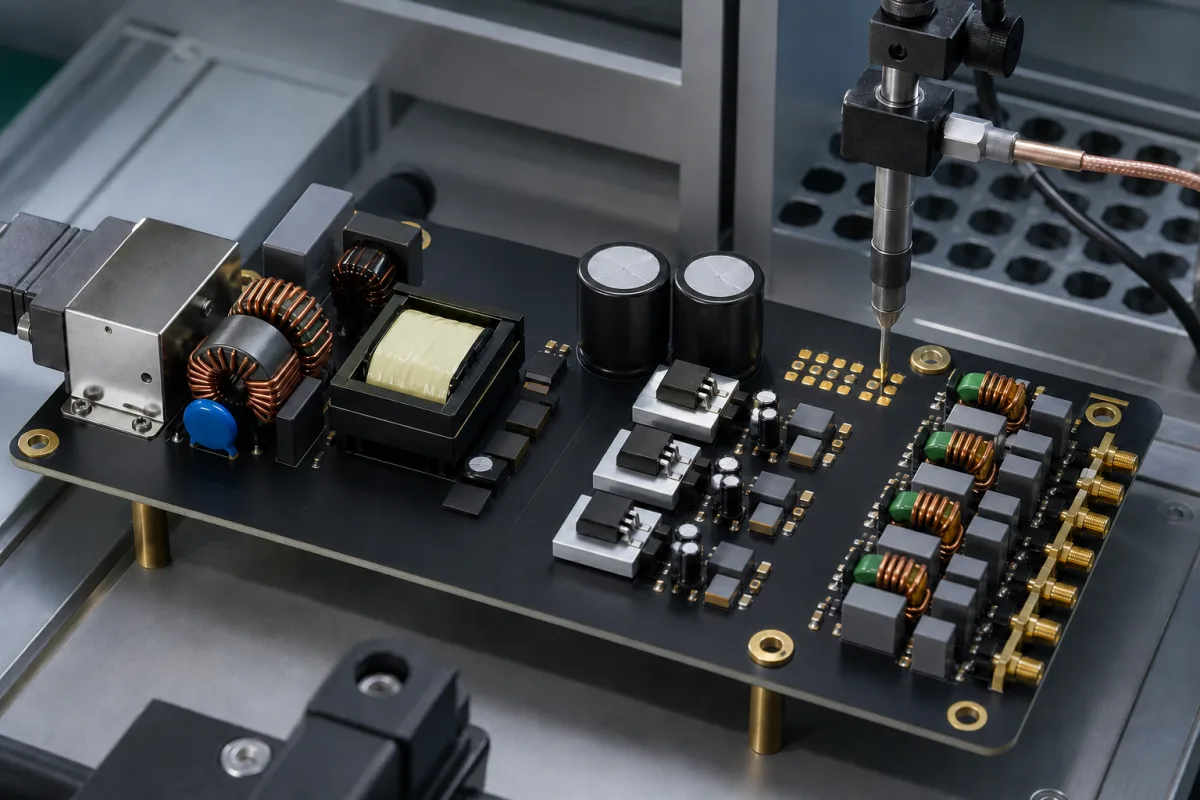
A canonical Power Supply Regulation is characterized by the integration of Voltage Regulator IC and Input Filter Capacitor. In industrial production environments, manufacturers listed on CNFX commonly emphasize Semiconductor ICs (voltage regulators) construction to support stable, high-cycle operation across diverse manufacturing scenarios.

A circuit component within a signal conditioning system that stabilizes and regulates the power supply to ensure consistent voltage/current for sensitive electronic components.
Product Specifications

Technical details and manufacturing context for Power Supply Regulation

Definition
Power Supply Regulation is a critical sub-circuit within Signal Conditioning Circuits responsible for maintaining stable, clean, and precise power delivery to sensitive measurement and processing components. It filters noise, corrects voltage fluctuations, and provides isolation to prevent interference from affecting signal integrity in industrial measurement and control systems.
Working Principle
Power Supply Regulation circuits typically use voltage regulators (linear or switching), filtering capacitors, inductors, and protection components to convert incoming power to a stable DC voltage. They monitor output voltage/current and adjust regulation elements to maintain consistent power levels despite input variations or load changes, ensuring reliable operation of signal conditioning components.
Common Materials
Semiconductor ICs (voltage regulators), Ceramic capacitors, Electrolytic capacitors, Ferrite cores/inductors, PCB substrate
Technical Parameters
  • Output voltage regulation accuracy and range (V) Per Request
Components / BOM
  • Voltage Regulator IC
    Maintains constant output voltage despite input variations
    Material: semiconductor
  • Input Filter Capacitor
    Filters high-frequency noise from input power source
    Material: aluminum/ceramic
  • Output Filter Capacitor
    Reduces output ripple and provides transient response
    Material: ceramic/tantalum
  • Inductor/Choke
    Filters low-frequency noise and provides energy storage (in switching regulators)
    Material: ferrite core with copper winding
  • Feedback Resistor Network
    Sets output voltage level and provides regulation feedback
    Material: thin-film/carbon composition
Engineering Reasoning
4.75-5.25 VDC at 0-2 A load, 0-85°C ambient temperature
Output voltage deviation beyond ±2% of nominal 5.0 VDC, or ripple voltage exceeding 50 mV peak-to-peak
Design Rationale: Electromigration in semiconductor junctions at current densities exceeding 1×10⁶ A/cm², causing open-circuit failure in voltage reference elements
Risk Mitigation (FMEA)
Trigger Input voltage transient exceeding 40 V for >100 μs
Mode: Overvoltage breakdown of pass transistor, causing short-circuit output at 0 V
Strategy: TVS diode clamping at 30 V with 1.5× derating on MOSFET Vds rating
Trigger Junction temperature sustained above 150°C for >1000 hours
Mode: Thermal runaway in voltage reference IC, causing output drift of +10 mV/°C
Strategy: Copper pour heatsinking maintaining Tj < 125°C at maximum 2 A load

Industry Taxonomies & Aliases

Commonly used trade names and technical identifiers for Power Supply Regulation.

Applied To / Applications

This component is essential for the following industrial systems and equipment:

Industrial Ecosystem & Supply Chain DNA

Complementary Systems
Downstream Applications
Specialized Tooling

Application Fit & Sizing Matrix

Operational Limits
pressure: Atmospheric to 1.5 atm (sealed enclosure)
other spec: Input voltage range: 4.5V to 36V DC, Output voltage accuracy: ±1%, Ripple/noise: <10mVp-p
temperature: -40°C to +85°C (operating), -55°C to +125°C (storage)
Media Compatibility
✓ Clean dry air environments ✓ Electronic control cabinets ✓ Laboratory instrumentation systems
Unsuitable: High-vibration industrial machinery with particulate contamination
Sizing Data Required
  • Required output voltage and current
  • Input voltage range and stability
  • Thermal dissipation requirements and ambient temperature

Reliability & Engineering Risk Analysis

Failure Mode & Root Cause
Voltage Regulation Failure
Cause: Aging or degraded capacitors causing insufficient filtering and unstable output voltage
Overheating and Thermal Shutdown
Cause: Dust accumulation on heatsinks, poor ventilation, or failing cooling fans leading to excessive component temperatures
Maintenance Indicators
  • Audible buzzing or humming from the power supply unit
  • Visible discoloration, bulging, or leaking capacitors on the circuit board
Engineering Tips
  • Implement regular thermal imaging inspections to identify hot spots before failure occurs
  • Establish a preventive maintenance schedule for cleaning air filters and verifying fan operation to ensure adequate cooling

Compliance & Manufacturing Standards

Reference Standards
IEC 61010-1: Safety requirements for electrical equipment IEC 60068-2: Environmental testing standards EN 55032: Electromagnetic compatibility requirements
Manufacturing Precision
  • Output voltage regulation: +/-2% of nominal value
  • Ripple and noise: <1% of output voltage
Quality Inspection
  • Load regulation test: Verify output stability under varying loads
  • Safety insulation test: Dielectric strength verification per IEC 61010-1

Factories Producing Power Supply Regulation

Verified manufacturers with capability to produce this product in China

✓ 97% Supplier Capability Match Found

T Technical Director from Canada Feb 03, 2026
★★★★★
"Testing the Power Supply Regulation now; the technical reliability results are within 1% of the laboratory datasheet."
Technical Specifications Verified
P Project Engineer from United States Jan 31, 2026
★★★★☆
"Impressive build quality. Especially the technical reliability is very stable during long-term operation. (Delivery took slightly longer than expected, but technical support was excellent.)"
Technical Specifications Verified
S Sourcing Manager from United Arab Emirates Jan 28, 2026
★★★★★
"As a professional in the Computer, Electronic and Optical Product Manufacturing sector, I confirm this Power Supply Regulation meets all ISO standards."
Technical Specifications Verified
Verification Protocol

“Feedback is collected from verified sourcing managers during RFQ (Request for Quote) and factory evaluation processes on CNFX. These reports represent historical performance data and technical audit summaries from our B2B manufacturing network.”

5 sourcing managers are analyzing this specification now. Last inquiry for Power Supply Regulation from Vietnam (25m ago).

Supply Chain Compatible Machinery & Devices

Industrial Smart Camera Module

Embedded vision system for industrial automation and quality inspection.

Explore Specs →
Industrial Wireless Power Transfer Module

Wireless power transfer module for industrial equipment applications

Explore Specs →
Industrial Smart Sensor Module

Modular industrial sensor with embedded processing and wireless connectivity

Explore Specs →
Surface Mount Resistor

Passive electronic component for current limiting and voltage division in circuits

Explore Specs →

Frequently Asked Questions

What is the primary function of a power supply regulation component in electronic manufacturing?

The primary function is to stabilize and regulate power supply voltage and current to ensure consistent, clean power delivery to sensitive electronic components, preventing damage from fluctuations and noise in signal conditioning systems.

Why are both ceramic and electrolytic capacitors used in power supply regulation circuits?

Ceramic capacitors handle high-frequency noise filtering due to their low ESR, while electrolytic capacitors provide bulk energy storage and smoothing for lower frequency ripple, together ensuring comprehensive power conditioning across different frequency ranges.

How does the feedback resistor network contribute to voltage regulation accuracy?

The feedback resistor network creates a voltage divider that samples the output voltage, feeding this signal back to the voltage regulator IC to continuously adjust and maintain precise output voltage levels despite load or input variations.

Can I contact factories directly on CNFX?

CNFX is an open directory, not a transaction platform. Each factory profile provides direct contact information and production details to help you initiate direct inquiries with Chinese suppliers.

Get Quote for Power Supply Regulation

Request technical pricing, lead times, or customized specifications for Power Supply Regulation directly from verified manufacturing units.

Your business information is encrypted and only shared with verified Power Supply Regulation suppliers.

Thank you! Your message has been sent. We'll respond within 1–3 business days.

Need to Manufacture Power Supply Regulation?

Connect with verified factories specializing in this product category

Add Your Factory Contact Us
Previous Product
Power Supply Circuit
Next Product
Power Supply Regulator