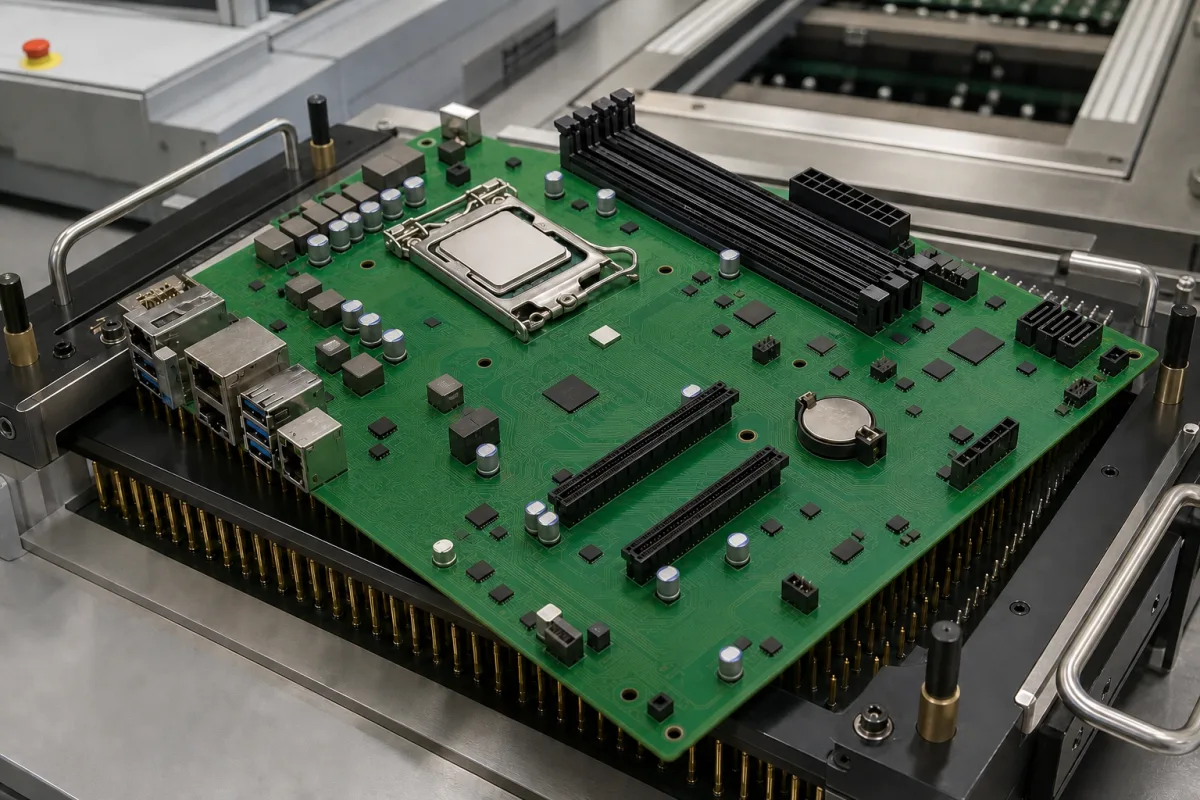
Industrial motherboards · Slot-type ATX, microATX, FlexATX and Mini-ITX boards for industrial and embedded PCs, chosen by form factor, processor generation and socket, memory type and capacity, PCIe and M.2 expansion, LAN, COM and display I/O, and long-term supply
A motherboard is the main circuit board of a computer: it carries the processor socket, memory slots, expansion slots and I/O connectors that every other component plugs into. Industrial motherboards follow standard form factors such as ATX or Mini-ITX but add legacy serial ports, more LAN ports and long product life for machines and embedded systems. Ask three things first: which form factor and enclosure it must fit, which processor and memory it must support, and which expansion and I/O ports the application needs.
Slot-type industrial motherboards in ATX, microATX, FlexATX and Mini-ITX form factors for industrial PCs, embedded systems and servers. Single-board computers in smaller form factors (see single board computer), complete industrial and embedded computers (see industrial computer and embedded computer) and consumer desktop motherboards are outside this page.
CNFX editorial research · Sources checked October 12, 2026 · 4 sources
Portwell describes its industrial ATX motherboards as Intel-platform boards with all ports on one circuit board and multiple expansion slots with flexible PCIe configuration. Its ATX range spans boards for 6th-generation (Skylake) through 14th-generation Intel Core and Intel Core Ultra (Series 2) processors. [1]
Portwell describes Mini-ITX as a highly integrated all-in-one x86 embedded board measuring 170 × 170 mm, and lists Mini-ITX boards from Skylake and Kaby Lake through 12th–14th-generation Core and Core Ultra (Series 2 and 3), including a thin Mini-ITX model and boards with R680E or Q470E chipsets. Its range also includes microATX boards (for example with the H610 or H810 chipset) and a FlexATX board for 10th-generation Xeon/Core processors. [2][1]
Editorial calculation: a 170 × 170 mm Mini-ITX board covers about 0.029 m². [2]
Give the supplier the form factor and enclosure, processor family and generation, chipset needs, memory type and capacity, PCIe and M.2 slots, number and speed of LAN ports, COM ports (RS-232/422/485), display outputs, USB, TPM and BMC needs, power input, operating temperature, required supply lifetime and quantity.
02
Match memory, expansion and I/O
Portwell's ATX listings include a Core Ultra (Series 2) board with DDR5 up to 192 GB, dual 2.5 GbE plus one GbE LAN, dual PCIe x16 (one x16 or two x8), DP/VGA/HDMI, USB 3.2 Gen2 and M.2; 12th–14th-generation boards with DDR5 up to 96 GB or DDR4 up to 64 GB; and 8th/9th and 10th-generation boards with DDR4 up to 128 GB, dual GbE and six to ten COM ports. [1]
Its microATX boards include a Core Ultra board with dual DDR5 UDIMM up to 96 GB, PCIe 5.0 x16, dual PCIe 4.0 x4, M.2, 4× SATA III, triple DP displays and 6× COM, and a server microATX board with an AST2600 BMC, 2× 10 GbE SFP+ and 4× 2.5 GbE. Its Mini-ITX boards list DDR4 SO-DIMM up to 64 GB or DDR5, PCIe Gen 5 x16, three or four displays, M.2, USB 3.2 and Type-C, up to four GbE LAN and TPM 2.0. Portwell notes specifications are subject to change. [1][2]
Advantech's AIMB-786, an ATX board for 8th/9th-generation Intel Core processors on the Q370 chipset, shows the environmental values buyers should ask for: operation from 0 to 60 °C, storage from −40 to 85 °C, 95% humidity at 40 °C non-condensing in operation and 95% RH at 60 °C in storage, on a 304.8 × 244 mm (12 × 9.6 in) board. Its expansion is one PCIe x16 (Gen 3), four PCIe x4 (Gen 3) and two 32-bit/33 MHz PCI slots, with Intel I219LM and I211AT gigabit LAN, VGA/DVI-D/DisplayPort outputs and SATA RAID 0/1/5/10. The same page gives memory as up to 128 GB DDR4 in its overview but up to 64 GB (16 GB per DIMM) in its specification table, so confirm the supported capacity in writing. [3]
Editorial calculation: the ATX board's 304.8 × 244 mm is about 0.074 m², roughly 2.6 times the 0.029 m² of a 170 × 170 mm Mini-ITX board, which is the space traded for extra slots. [3][2]
03
Board vendors: Norco's MATX-6555GC and the lifecycle questions
The one linked maker, Norco, lists the MATX-6555GC Micro-ATX industrial motherboard on its own site.
Ask any supplier for the exact model's processor support, chipset, memory, expansion, LAN controllers, COM port standards, display outputs, power input, operating temperature range, certifications, BIOS customisation, longevity and end-of-life notice policy, and lead time.
04
Budget the power rails, cooling and serial-port cabling
Kontron's K3833-Q mITX datasheet (2026) describes a 170 × 170 mm Mini-ITX board on the Intel Q670E chipset with an LGA1700 socket for processors up to 65 W TDP, two DDR5-4800/5600 SODIMM sockets for up to 96 GB of unbuffered non-ECC memory, and 0–60 °C operation for 24/7 use, with forced cooling required. DDR5-5600 needs BIOS R2.13.0 or later and a 13th or 14th-generation Core processor. [4]
Power enters through a multirail ATX 24-pin connector plus a 4-pin 12 V socket for the processor. The datasheet gives a maximum continuous motherboard current below 10 A with a 24 A surge in full Turbo mode for a 65 W TDP processor, and below 5 A with a 12 A surge for a 35 W processor, plus 5 A on +5 V, 0.5 A on +3.3 V and 2 A on 5 V standby, at ±5% tolerance, excluding drives, USB devices and PCIe cards. The single COM header needs a cable with an integrated COM transceiver. [4]
Editorial calculation: if the 24 A surge is drawn at 12 V, the supply must deliver 24 × 12 = 288 W peak for the board alone; confirm the rail with the supplier. [4]
Board-level values from form factor to operating humidity
Weight is the one row no reviewed listing states; the power row uses the rails in the Kontron Mini-ITX datasheet, so ask the supplier for its own board's input and weight.
Field
What it means and published values
Ask the supplier for
Form Factor
e.g. ATX 304.8 × 244 mm, microATX, FlexATX, Mini-ITX 170 × 170 mm. [1][2][3]
Explore company information and manufacturing capabilities, then discuss the scope of your project with a relevant supplier.
Share this page
Compiled and source-reviewed by the CNFX editorial team.
Each manufacturer above links to the page on that company's own website where the product is listed, with the date we checked it. How we source and review
· Page last updated 13 October 2026
Buyer questions
How big is a Mini-ITX industrial motherboard?
Portwell describes Mini-ITX boards as measuring 170 × 170 mm. [2]
How much memory can industrial ATX boards take?
Portwell lists up to 192 GB DDR5 on a Core Ultra (Series 2) ATX board. [1]
Do industrial motherboards still have serial ports?
Portwell's ATX and Mini-ITX boards list five to ten COM ports on some models. [1][2]
What temperature range do industrial ATX motherboards cover?
Advantech lists its AIMB-786 ATX board at 0–60 °C operating and −40 to 85 °C storage, with 95% humidity at 40 °C non-condensing. [3]
How much current does an industrial Mini-ITX board draw?
Kontron's K3833-Q mITX datasheet gives a maximum continuous current below 10 A and a 24 A surge with a 65 W TDP processor, excluding drives, USB devices and PCIe cards. [4]
Sources and what still needs a direct check
Sources checked 2026-10-12. American Portwell Technology makes industrial and embedded motherboards.