Industry-Verified Manufacturing Data (2026)

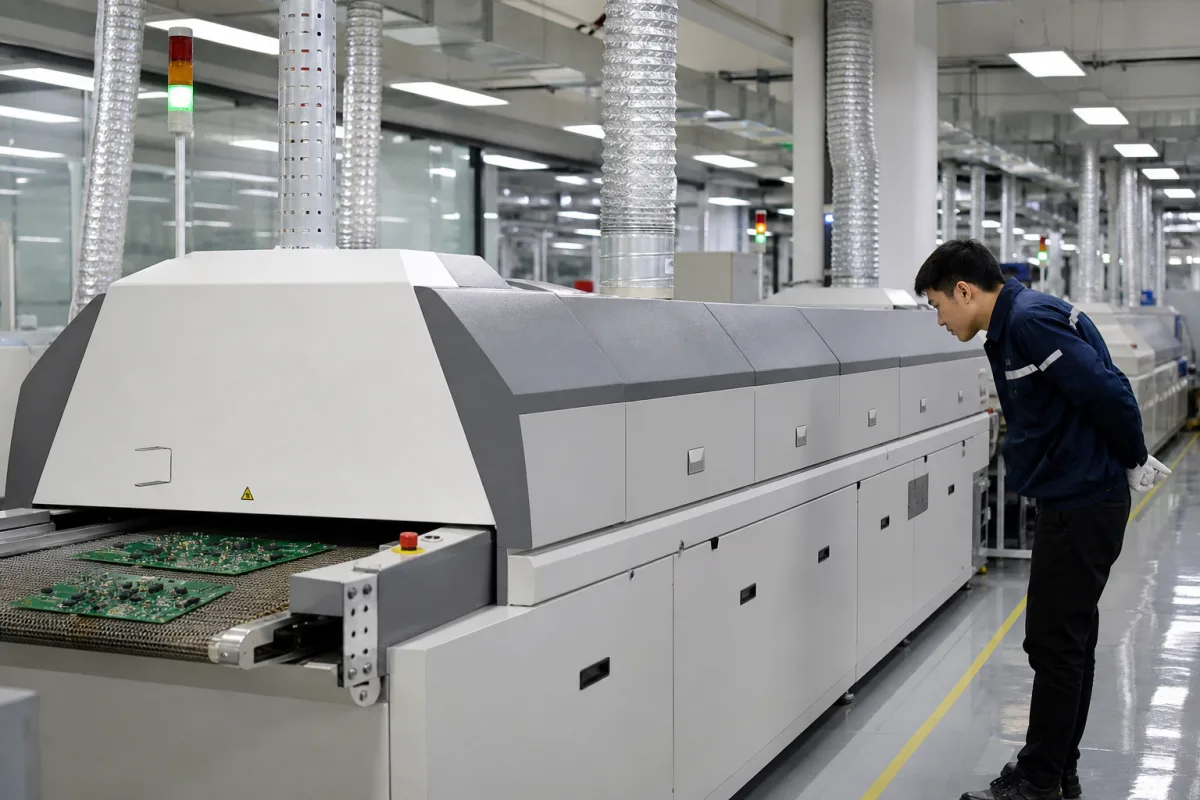
Reflow Oven

Based on aggregated insights from multiple verified factory profiles within the CNFX directory, the standard Reflow Oven used in the Computer, Electronic and Optical Product Manufacturing sector typically supports operational capacities ranging from standard industrial configurations to heavy-duty production requirements.

Technical Definition & Core Assembly

A canonical Reflow Oven is characterized by the integration of Conveyor System and Heating Elements. In industrial production environments, manufacturers listed on CNFX commonly emphasize Stainless steel construction to support stable, high-cycle operation across diverse manufacturing scenarios.

A thermal processing machine that melts solder paste to form permanent electrical connections between surface-mount components and printed circuit boards.
Product Specifications

Technical details and manufacturing context for Reflow Oven

Definition
A critical component within an Automated Printed Circuit Board Assembly Line that precisely applies controlled heat to melt solder paste deposited on PCB pads, creating reliable solder joints between surface-mount devices (SMDs) and the circuit board substrate, following a specific temperature profile to ensure proper metallurgical bonding without damaging sensitive electronic components.
Working Principle
The reflow oven transports PCBs through multiple temperature-controlled zones (preheat, soak, reflow, cooling) using a conveyor system. It heats the assembly according to a programmed thermal profile, causing the solder paste to melt (reflow) and form intermetallic bonds between component leads and PCB pads, then cools the assembly to solidify the solder joints.
Common Materials
Stainless steel, Aluminum, Ceramic heating elements, Quartz heating tubes, Insulation materials
Technical Parameters
  • Conveyor width determines maximum PCB size that can be processed (mm) Standard Spec
Components / BOM
Engineering Reasoning
200-280°C with ±2°C zone uniformity, 0.5-1.5 m/min conveyor speed
Solder paste reflow temperature threshold: 217°C for SAC305 alloy, 183°C for Sn63Pb37 alloy; Thermal shock boundary: >10°C/sec ramp rate differential between component body and PCB
Design Rationale: Solder intermetallic compound formation failure due to insufficient time above liquidus temperature (TAL < 30 seconds for SAC305); Tombstoning from unbalanced wetting forces when component termination temperature differential exceeds 5°C
Risk Mitigation (FMEA)
Trigger Heater element resistance drift exceeding ±5% from nominal 9.6Ω at 25°C
Mode: Zone temperature deviation beyond ±5°C setpoint causing cold solder joints or component thermal damage
Strategy: Closed-loop PID control with Type K thermocouples at 0.1-second sampling, redundant heating elements with 2.5:1 turndown ratio
Trigger Conveyor belt tension loss below 40 N/m causing 0.5 mm positional drift per meter
Mode: PCB dwell time variation exceeding ±3 seconds leading to inconsistent TAL and void formation >25%
Strategy: Servo-driven conveyor with 0.01 mm positional accuracy, optical encoder feedback at 1000 pulses/revolution

Industry Taxonomies & Aliases

Commonly used trade names and technical identifiers for Reflow Oven.

Industrial Ecosystem & Supply Chain DNA

Complementary Systems
Downstream Applications
Specialized Tooling

Application Fit & Sizing Matrix

Operational Limits
pressure: Atmospheric to slight positive pressure (0-0.5 psi) for inert gas environments
temperature: Ambient to 300°C (typical reflow profile: 150-250°C peak)
power rating: 10-50 kW (depending on throughput and temperature requirements)
thermal zones: 5-12 zones (preheat, soak, reflow, cooling)
conveyor speed: 0.1-2.0 m/min (adjustable for thermal profile control)
Media Compatibility
✓ Lead-free solder paste (SAC305) ✓ Lead-based solder paste (Sn63Pb37) ✓ No-clean flux formulations
Unsuitable: Corrosive or flammable chemical atmospheres (e.g., chlorine gas, solvent vapors)
Sizing Data Required
  • Maximum board dimensions (width/length)
  • Required throughput (boards per hour)
  • Solder paste type and reflow profile requirements

Reliability & Engineering Risk Analysis

Failure Mode & Root Cause
Heater Element Degradation
Cause: Thermal cycling and oxidation leading to reduced heating efficiency or complete failure, often due to prolonged high-temperature operation without proper cooling cycles.
Conveyor Belt Wear/Misalignment
Cause: Friction, thermal expansion, and mechanical stress causing belt stretching, tracking issues, or motor drive failure, typically from inadequate tension adjustment or contamination buildup.
Maintenance Indicators
  • Inconsistent temperature profiles across zones (visualized on control panel or via thermal profiling)
  • Unusual noises (grinding, squealing) from conveyor system or fans, indicating mechanical distress
Engineering Tips
  • Implement regular thermal profiling and calibration to ensure even heat distribution and prevent localized overheating stress.
  • Establish a preventive maintenance schedule for conveyor system lubrication, belt tension checks, and heater element inspection to address wear before failure.

Compliance & Manufacturing Standards

Reference Standards
ISO 9001:2015 - Quality Management Systems ANSI/ESD S20.20 - Electrostatic Discharge Control CE Marking - EU Safety, Health & Environmental Protection
Manufacturing Precision
  • Temperature Uniformity: +/-2°C across heating zones
  • Conveyor Speed Accuracy: +/-1% of setpoint
Quality Inspection
  • Thermal Profiling Verification
  • Electrical Safety Testing (Insulation Resistance, Ground Continuity)

Factories Producing Reflow Oven

Verified manufacturers with capability to produce this product in China

✓ 94% Supplier Capability Match Found

P Procurement Specialist from United Arab Emirates Mar 01, 2026
★★★★★
"The technical documentation for this Reflow Oven is very thorough, especially regarding technical reliability."
Technical Specifications Verified
T Technical Director from Australia Feb 26, 2026
★★★★★
"Reliable performance in harsh Computer, Electronic and Optical Product Manufacturing environments. No issues with the Reflow Oven so far."
Technical Specifications Verified
P Project Engineer from Singapore Feb 23, 2026
★★★★★
"Testing the Reflow Oven now; the technical reliability results are within 1% of the laboratory datasheet."
Technical Specifications Verified
Verification Protocol

“Feedback is collected from verified sourcing managers during RFQ (Request for Quote) and factory evaluation processes on CNFX. These reports represent historical performance data and technical audit summaries from our B2B manufacturing network.”

10 sourcing managers are analyzing this specification now. Last inquiry for Reflow Oven from Germany (1h ago).

Supply Chain Compatible Machinery & Devices

Modular Industrial Edge Computing Device

Rugged computing platform for industrial data processing at the network edge

Explore Specs →
Industrial Smart Camera Module

Embedded vision system for industrial automation and quality inspection.

Explore Specs →
Industrial Wireless Power Transfer Module

Wireless power transfer module for industrial equipment applications

Explore Specs →
Industrial Smart Sensor Module

Modular industrial sensor with embedded processing and wireless connectivity

Explore Specs →

Frequently Asked Questions

What temperature range does this reflow oven support for PCB assembly?

Our reflow oven typically operates between 150°C to 300°C, with precise temperature profiling capabilities to accommodate various solder paste specifications and PCB requirements.

How does the conveyor system handle different PCB sizes and weights?

The conveyor system features adjustable speed controls and rail width adjustments to accommodate PCBs from small components to large panels, with robust construction to handle varying weights without compromising thermal uniformity.

What maintenance is required for the heating elements and insulation materials?

Regular inspection of ceramic heating elements and quartz tubes is recommended every 6-12 months, with insulation materials typically lasting 3-5 years depending on usage. Our design allows for easy access to all critical components.

Can I contact factories directly on CNFX?

CNFX is an open directory, not a transaction platform. Each factory profile provides direct contact information and production details to help you initiate direct inquiries with Chinese suppliers.

Get Quote for Reflow Oven

Request technical pricing, lead times, or customized specifications for Reflow Oven directly from verified manufacturing units.

Your business information is encrypted and only shared with verified Reflow Oven suppliers.

Thank you! Your message has been sent. We'll respond within 1–3 business days.

Need to Manufacture Reflow Oven?

Connect with verified factories specializing in this product category

Add Your Factory Contact Us
Previous Product
Reflector Array
Next Product
Reflow Oven Module