Industry-Verified Manufacturing Data (2026)

Precision Thermocouple Probe Assembly

Based on aggregated insights from multiple verified factory profiles within the CNFX directory, the standard Precision Thermocouple Probe Assembly used in the Computer, Electronic and Optical Product Manufacturing sector typically supports operational capacities ranging from standard industrial configurations to heavy-duty production requirements.

Technical Definition & Core Assembly

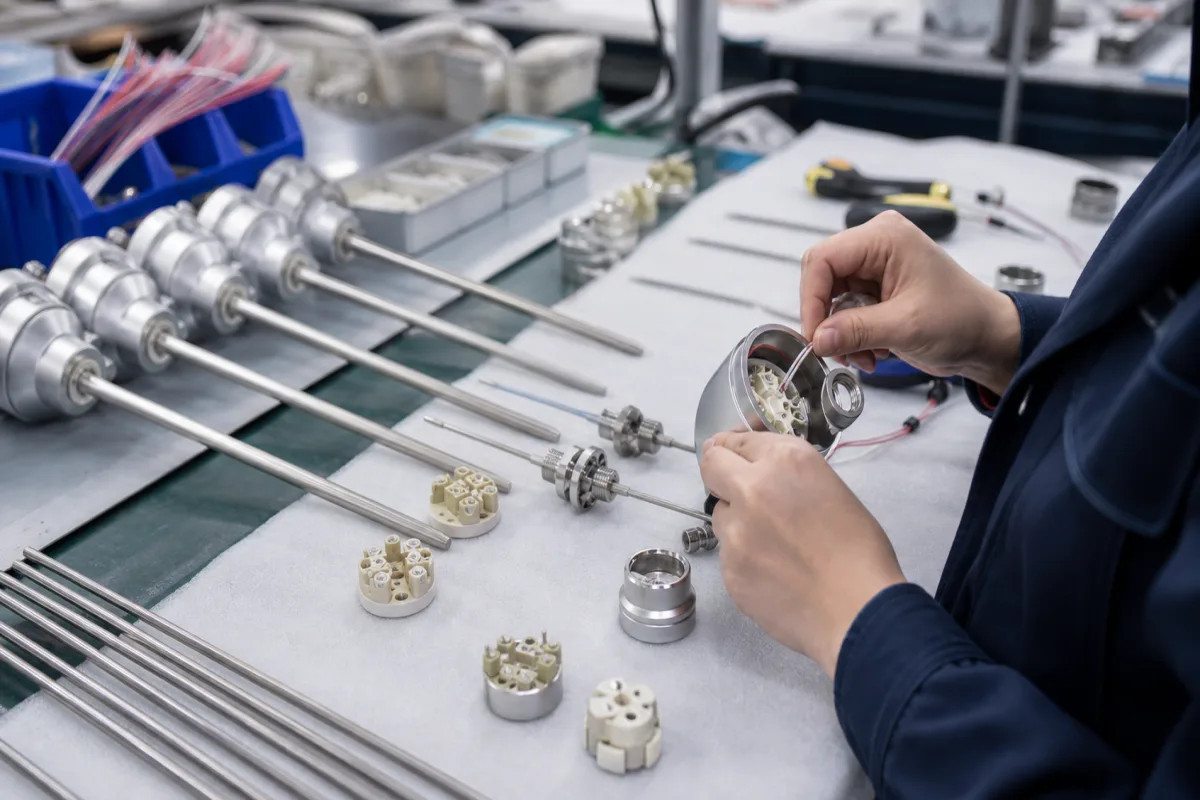
A canonical Precision Thermocouple Probe Assembly is characterized by the integration of Thermocouple Wires and Protective Sheath. In industrial production environments, manufacturers listed on CNFX commonly emphasize Inconel 600 construction to support stable, high-cycle operation across diverse manufacturing scenarios.

Temperature sensing assembly for industrial measurement and control systems

Product Specifications

Technical details and manufacturing context for Precision Thermocouple Probe Assembly

Definition
A precision thermocouple probe assembly is a critical temperature sensing component used in industrial measurement, testing, and control equipment. It converts thermal energy into electrical signals through the Seebeck effect, providing accurate temperature readings in harsh industrial environments. These assemblies are designed for integration into larger systems like process controllers, data loggers, and monitoring equipment. They ensure reliable temperature measurement for quality control, safety monitoring, and process optimization across various industries.
Working Principle
Two dissimilar metal wires joined at the measuring junction generate a voltage proportional to temperature difference between hot and cold junctions
Common Materials
Inconel 600, Stainless Steel 316, Alumina Ceramic, Magnesium Oxide
Technical Parameters
  • Time to reach 63.2% of final reading (seconds) Standard Spec
  • Operating temperature limits (°C) Standard Spec
Components / BOM
  • Thermocouple Wires
    Generate voltage signal proportional to temperature
    Material: Dissimilar metal alloys (e.g., Chromel-Alumel for Type K)
  • Protective Sheath
    Mechanical protection and environmental isolation
    Material: Stainless steel or Inconel
  • Mineral Insulation
    Electrical insulation and thermal conduction
    Material: Magnesium oxide powder
  • Termination Head
    Connection interface to instrumentation
    Material: Stainless steel or aluminum
  • Compression Fitting Optional
    Secure installation in process connection
    Material: Stainless steel
Engineering Reasoning
-200°C to 1200°C
1350°C for Type K thermocouple wire (melting point of Chromel-P), 0.5% measurement error threshold at 1000°C
Design Rationale: Thermoelectric EMF degradation due to oxidation of Chromel wire above 1000°C, Seebeck coefficient drift beyond ±0.75% at 1100°C
Risk Mitigation (FMEA)
Trigger Thermal cycling between -200°C and 1200°C at >5 cycles/hour
Mode: Thermocouple junction fatigue cracking
Strategy: Sheathed mineral-insulated construction with Inconel 600 sheath, cold-worked thermocouple wire with 20% elongation tolerance
Trigger Moisture ingress through compromised sheath at >85% RH
Mode: Galvanic corrosion between dissimilar metals (Chromel-Alumel)
Strategy: Hermetic seal welding with 0.1 mm leak rate specification, magnesium oxide insulation with <0.5% moisture absorption

Industry Taxonomies & Aliases

Commonly used trade names and technical identifiers for Precision Thermocouple Probe Assembly.

Industrial Ecosystem & Supply Chain DNA

Complementary Systems
Downstream Applications
Specialized Tooling

Application Fit & Sizing Matrix

Operational Limits
pressure: Up to 1000 bar (dependent on sheath material and construction)
other spec: Response time: 0.5-10 seconds (dependent on sheath diameter and construction)
temperature: -200°C to 1200°C (dependent on thermocouple type and sheath material)
Media Compatibility
✓ High-temperature process gases ✓ Molten metals and alloys ✓ Chemical process liquids
Unsuitable: High-velocity abrasive slurry environments
Sizing Data Required
  • Process temperature range and accuracy requirements
  • Sheath material compatibility with process media
  • Required insertion length and mounting configuration

Reliability & Engineering Risk Analysis

Failure Mode & Root Cause
Thermal fatigue cracking
Cause: Repeated thermal cycling from process temperature fluctuations, leading to stress concentration and micro-cracking in the probe sheath material, particularly at weld joints or transition points.
Signal drift/calibration loss
Cause: Degradation of thermocouple junction due to oxidation, contamination from process media, or diffusion of dissimilar metals at the hot junction over time, resulting in inaccurate temperature readings.
Maintenance Indicators
  • Erratic or fluctuating temperature readings without corresponding process changes, indicating potential junction degradation or loose connections
  • Visible physical damage such as cracks, bulges, or discoloration on the probe sheath, suggesting material fatigue or chemical attack
Engineering Tips
  • Implement regular calibration checks using certified reference standards and document drift trends to predict end-of-life before critical failure occurs
  • Ensure proper installation with adequate immersion depth (minimum 10x probe diameter) and use thermal conductive paste in thermowells to minimize thermal lag and stress concentrations

Compliance & Manufacturing Standards

Reference Standards
ISO 9001:2015 Quality Management Systems ASTM E230/E230M Standard Specification and Temperature-Electromotive Force (EMF) Tables for Standardized Thermocouples CE Marking for Electromagnetic Compatibility Directive 2014/30/EU
Manufacturing Precision
  • Temperature Accuracy: +/-0.5°C or +/-0.4% of reading (whichever is greater)
  • Sheath Diameter: +/-0.05mm
Quality Inspection
  • Calibration Verification against NIST-traceable standards
  • Insulation Resistance Test at 500V DC

Factories Producing Precision Thermocouple Probe Assembly

Verified manufacturers with capability to produce this product in China

✓ 95% Supplier Capability Match Found

S Sourcing Manager from Brazil Feb 26, 2026
★★★★★
"The technical documentation for this Precision Thermocouple Probe Assembly is very thorough, especially regarding Temperature Range (°C)."
Technical Specifications Verified
P Procurement Specialist from Canada Feb 23, 2026
★★★★☆
"Reliable performance in harsh Computer, Electronic and Optical Product Manufacturing environments. No issues with the Precision Thermocouple Probe Assembly so far. (Delivery took slightly longer than expected, but technical support was excellent.)"
Technical Specifications Verified
T Technical Director from United States Feb 20, 2026
★★★★★
"Testing the Precision Thermocouple Probe Assembly now; the Temperature Range (°C) results are within 1% of the laboratory datasheet."
Technical Specifications Verified
Verification Protocol

“Feedback is collected from verified sourcing managers during RFQ (Request for Quote) and factory evaluation processes on CNFX. These reports represent historical performance data and technical audit summaries from our B2B manufacturing network.”

10 sourcing managers are analyzing this specification now. Last inquiry for Precision Thermocouple Probe Assembly from Brazil (1h ago).

Supply Chain Commonly Integrated Components

Optical Spectrometer

An analytical instrument that measures the intensity of light as a function of wavelength to determine the elemental composition of materials.

Explore Specs →
Stereo Camera Array

A multi-camera system that captures synchronized images from multiple perspectives to enable 3D depth perception and pattern recognition.

Explore Specs →
Structured Light Projector

Optical device that projects precisely controlled light patterns onto surfaces for 3D scanning applications

Explore Specs →
Main Processor Board

The central computing and control unit of a 5-axis CNC controller that processes motion commands, executes algorithms, and coordinates all system operations.

Explore Specs →

Frequently Asked Questions

What makes this thermocouple probe suitable for harsh industrial environments?

The assembly uses Inconel 600 and Stainless Steel 316 construction with mineral insulation, providing excellent corrosion resistance and durability in demanding conditions.

How quickly does this thermocouple assembly respond to temperature changes?

With magnesium oxide insulation and optimized sheath design, it achieves rapid response times, typically under 5 seconds for most configurations.

What temperature range can this precision thermocouple probe handle?

The assembly operates reliably from -200°C to 1200°C, depending on sheath material and thermocouple type selection.

Can I contact factories directly on CNFX?

CNFX is an open directory, not a transaction platform. Each factory profile provides direct contact information and production details to help you initiate direct inquiries with Chinese suppliers.

Get Quote for Precision Thermocouple Probe Assembly

Request technical pricing, lead times, or customized specifications for Precision Thermocouple Probe Assembly directly from verified manufacturing units.

Your business information is encrypted and only shared with verified Precision Thermocouple Probe Assembly suppliers.

Thank you! Your message has been sent. We'll respond within 1–3 business days.

Need to Manufacture Precision Thermocouple Probe Assembly?

Connect with verified factories specializing in this product category

Add Your Factory Contact Us
Previous Product
Precision Stacking Stage
Next Product
Precision XY Motion Stage