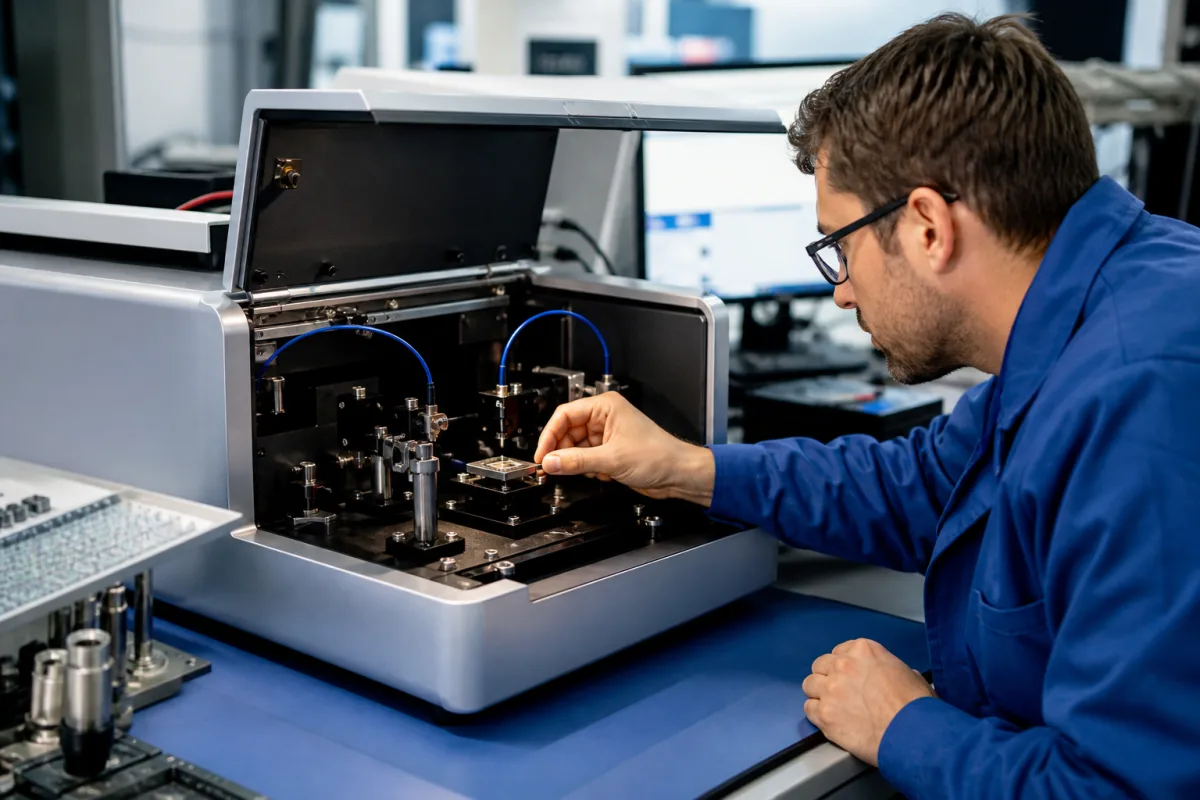
Optical spectrometer (emission and fibre-optic spectrometers)
Optical spectrometers for analysis · Technique (spark OES, ICP-OES, fibre-optic, FTIR, Raman), elements and ranges, spectral range and resolution, detector and signal-to-noise, sample form, analysis time, interface, power and size
An optical spectrometer separates light into its wavelengths and measures the intensity of each — to identify and quantify elements from the light a sample emits when sparked or excited in a plasma, or to measure the spectrum of a light source or sample in absorption, reflection or fluorescence. Settle three things before choosing one: the technique and the elements, ranges or wavelengths you must measure, the resolution, detector and accuracy that set performance, and the sample handling, speed, interfaces and installation.
Optical spectrometers for analysis and measurement: spark optical emission spectrometers for metals, ICP optical emission spectrometers, compact fibre-optic spectrometers, and laboratory FT-IR and Raman spectrometers where suppliers offer them. Mass spectrometers, X-ray fluorescence analysers, RF spectrum analysers and UV-Vis spectrophotometers are outside this page except where compared; spectrum analysers have their own page.
CNFX editorial research · Sources checked October 11, 2026 · 6 sources
ASTM E415 covers the simultaneous determination of 21 alloying and residual elements in carbon and low-alloy steels by spark atomic emission vacuum spectrometry, for routine control in iron and steelmaking and analysis of processed material — for example carbon 0.02–1.1%, manganese 0.03–2.0%, chromium 0.007–8.14%, nickel 0.006–5.0%, sulfur 0.001–0.055% and boron 0.0004–0.007% (quantitative ranges); specimens must be wide enough to seal the spark-stand opening, with 10–38 mm thickness given as the practical range. [1]
ASTM E1479 describes the components of an inductively coupled plasma atomic emission spectrometer (ICP-AES) that are basic to its operation and to the quality of its performance, identifies critical factors affecting accuracy, precision and sensitivity, and advises users to agree a testing protocol with the manufacturer before ordering, since tolerances and performance criteria are unique to each instrument. [2]
Drawell lists optical emission, ICP emission, FT-IR and X-ray fluorescence spectrometers among its analytical instruments [4], and LABOAO lists FT-IR and Raman spectrometers. [5]
Give the supplier the technique, the sample type and form (solid metal, solution, light source, surface), the elements or wavelengths and their concentration ranges, required detection limits and precision, standards to meet (such as ASTM E415), sample throughput and analysis time, spectral range and resolution, interfaces and software, installation conditions (power, gases, vacuum, temperature) and quantity.
02
Set spectral range, resolution, detector and interface
CNI's optic fibre spectrometer lists a Hamamatsu S11510 detector with 2,048 pixels of 14 × 14 µm covering 200–1,100 nm, optical resolution depending on grating line density and slit width (offered in a range of options), signal-to-noise of about 450:1, integration time of 17 ms to 10 s, 450 mA at 5 V DC power, USB 2.0 data transfer with a full scan every 4 ms, five opto-isolated inputs and outputs, and a 149 × 109 × 50 mm, 1 kg body. CNI also lists Raman, fluorescence, multichannel, TE-cooled and laser-induced breakdown spectroscopy (LIBS) systems. [3]
Yuheng Optics lists spectrometer and monochromator series alongside optics teaching and experiment instruments. [6]
Editorial calculation: spreading 200–1,100 nm (900 nm) over 2,048 pixels gives about 0.44 nm per pixel; the optical resolution spans more than one pixel and is set by the slit and grating, so ask for the resolution figure at your slit choice. [3]
03
OES, ICP, fibre, Raman, LIBS and FT-IR instruments on the linked supplier sites
The listings reviewed cover optical emission and ICP spectrometers, compact fibre-optic, Raman and LIBS spectrometers, laboratory FT-IR instruments and teaching spectrometers. Ask each for application data on your samples, detection limits and precision, and the installation requirements. [4][3][5][6]
04
Excitation source, slit, grating, detector and sample stand
Spectral range, resolution at your slit, element limits and power for a spectrometer order
The figures in this table belong to two different instruments: element ranges and vacuum optics from ASTM E415 spark OES, and range, power, mass and size from CNI's 1 kg fibre unit. A spark OES quotation will differ on power, weight and installation.
12 companies list this product among what they make. Company figures are quoted from each
company's own website; every card states where the relationship came from.
Chongqing Drawell Instrument Co., Ltd.
Manufacturing site to be confirmed for the order
Lists optical emission, ICP emission, FT-IR and XRF spectrometers.
Explore company information and manufacturing capabilities, then discuss the scope of your project with a relevant supplier.
Share this page
Compiled and source-reviewed by the CNFX editorial team.
Each manufacturer above links to the page on that company's own website where the product is listed, with the date we checked it. How we source and review
· Page last updated 13 October 2026
Buyer questions
Which standard covers spark OES analysis of steel?
ASTM E415, which determines 21 elements in carbon and low-alloy steel by spark atomic emission vacuum spectrometry. [1]
What range does a compact fibre spectrometer cover?
CNI lists 200–1,100 nm on a 2,048-pixel detector with about 450:1 signal-to-noise. [3]
How should I specify an ICP-OES spectrometer?
ASTM E1479 describes its components and advises agreeing a test protocol with the maker before ordering. [2]
What sample size does spark OES need?
ASTM E415 needs specimens that seal the spark-stand opening, with 10–38 mm thickness given as the practical range. [1]
Sources and what still needs a direct check
Sources checked 2026-10-11. ASTM's summaries of E415 and E1479 and CNI's fibre spectrometer specification are used to show what an optical spectrometer specification covers; Drawell, LABOAO and Yuheng are linked suppliers.