Industry-Verified Manufacturing Data (2026)

Stereo Camera Array

Based on aggregated insights from multiple verified factory profiles within the CNFX directory, the standard Stereo Camera Array used in the Computer, Electronic and Optical Product Manufacturing sector typically supports operational capacities ranging from standard industrial configurations to heavy-duty production requirements.

Technical Definition & Core Assembly

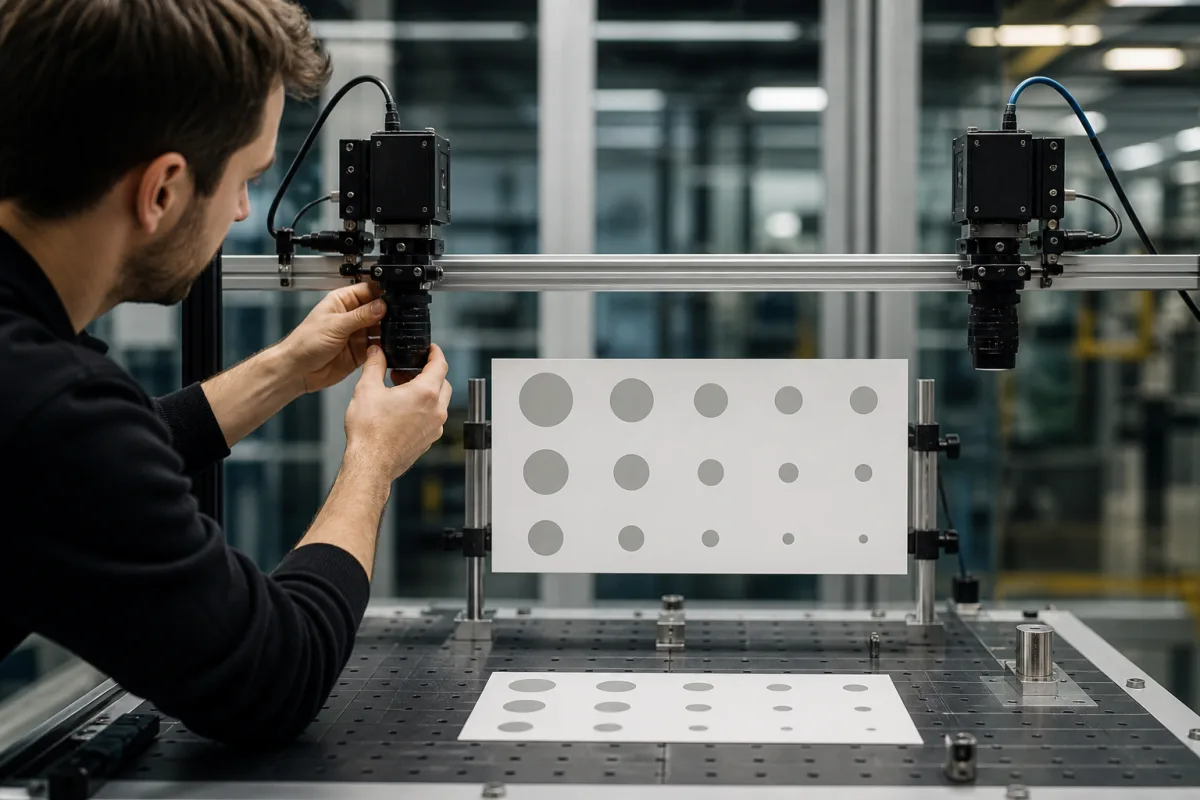
A canonical Stereo Camera Array is characterized by the integration of Camera module and Calibration target mount. In industrial production environments, manufacturers listed on CNFX commonly emphasize Optical-grade glass lenses construction to support stable, high-cycle operation across diverse manufacturing scenarios.

A multi-camera system that captures synchronized images from multiple perspectives to enable 3D depth perception and pattern recognition.
Product Specifications

Technical details and manufacturing context for Stereo Camera Array

Definition
Within a 3D Pattern Scanner, the Stereo Camera Array serves as the primary optical sensing module. It consists of precisely calibrated cameras arranged in a specific geometric configuration to simultaneously capture multiple 2D images of a target object or pattern. By analyzing the parallax differences between these synchronized images, the system reconstructs detailed 3D surface geometry, depth maps, and spatial relationships, forming the foundational data for subsequent pattern analysis, measurement, and digital modeling processes.
Working Principle
The Stereo Camera Array operates on the principle of stereoscopic vision and triangulation. Multiple cameras with known positions and orientations capture synchronized images of the same scene. Image processing algorithms then identify corresponding points across these images. By calculating the disparity (positional difference) of these matched points and applying geometric calibration data, the system computes precise 3D coordinates for each point, effectively transforming 2D pixel data into a 3D point cloud or depth map that represents the scanned object's surface topology.
Common Materials
Optical-grade glass lenses, Aluminum alloy housing, CMOS/CCD image sensors, Precision mounting brackets
Technical Parameters
  • Resolution of individual cameras in the array (megapixels) Customizable
Components / BOM
  • Camera module
    Captures individual 2D images with precise timing and calibration
    Material: Aluminum housing with optical glass elements
  • Calibration target mount
    Holds calibration patterns for geometric alignment and lens correction
    Material: Stainless steel with precision machined surfaces
  • Synchronization controller
    Generates precise timing signals to trigger simultaneous image capture across all cameras
    Material: PCB with timing circuitry and connectors
  • Rigid mounting frame
    Maintains fixed geometric relationships between cameras with minimal vibration or thermal deformation
    Material: Carbon fiber composite or precision-machined aluminum
Engineering Reasoning
0.5-5.0 m
>5 lux ambient light differential between cameras
Design Rationale: Photometric non-uniformity causing disparity map corruption due to Lambertian reflectance model violation at >5 lux differential
Risk Mitigation (FMEA)
Trigger 0.1 mm mechanical misalignment between optical axes
Mode: Epipolar geometry violation causing >3 pixel correspondence error
Strategy: Kinematic mounting with 0.01 mm repeatability using invar alloy thermal compensation
Trigger 15 ms synchronization jitter between camera shutters
Mode: Temporal disparity causing >2% depth measurement error at 1 m/s object velocity
Strategy: IEEE 1588 Precision Time Protocol implementation with <1 μs synchronization accuracy

Industry Taxonomies & Aliases

Commonly used trade names and technical identifiers for Stereo Camera Array.

Applied To / Applications

This component is essential for the following industrial systems and equipment:

Industrial Ecosystem & Supply Chain DNA

Complementary Systems
Downstream Applications
Specialized Tooling

Application Fit & Sizing Matrix

Operational Limits
pressure: Atmospheric (non-pressurized)
other spec: IP67 ingress protection, 0-95% non-condensing humidity
temperature: -10°C to 50°C
Media Compatibility
✓ Indoor air environments ✓ Clear liquid immersion (with protective housing) ✓ Non-reflective solid surfaces
Unsuitable: High-vibration industrial machinery (causes image blur)
Sizing Data Required
  • Required field of view (degrees)
  • Working distance range (meters)
  • Minimum detectable feature size (millimeters)

Reliability & Engineering Risk Analysis

Failure Mode & Root Cause
Lens Contamination and Degradation
Cause: Accumulation of dust, oil mist, or particulates on lens surfaces, combined with UV exposure and thermal cycling, leading to reduced optical clarity, calibration drift, and eventual sensor failure.
Electrical/Data Interface Failure
Cause: Vibration-induced connector loosening, thermal expansion mismatches, or EMI/RFI interference corrupting synchronization signals between cameras, resulting in data misalignment or complete communication loss.
Maintenance Indicators
  • Persistent calibration errors or misalignment warnings in system diagnostics despite software recalibration attempts.
  • Visible condensation, fogging, or particulate buildup on lens surfaces, or audible buzzing/humming from camera housings indicating seal failure or electrical issues.
Engineering Tips
  • Implement positive-pressure, filtered air purging systems in camera housings with desiccant breathers to maintain clean, dry internal environments and prevent contamination.
  • Use vibration-damping mounts with thermal isolation and shielded, strain-relieved cabling routed away from power sources to protect electrical connections and synchronization integrity.

Compliance & Manufacturing Standards

Reference Standards
ISO 12233:2017 (Photography - Electronic still picture imaging - Resolution and spatial frequency responses) ANSI/IES LM-79-19 (Electrical and Photometric Measurements of Solid-State Lighting Products) CE marking for electromagnetic compatibility (EMC Directive 2014/30/EU)
Manufacturing Precision
  • Baseline distance between cameras: +/-0.05mm
  • Optical axis alignment: +/-0.1 degrees
Quality Inspection
  • Stereo calibration test using checkerboard pattern
  • Image synchronization test with high-speed strobe

Factories Producing Stereo Camera Array

Verified manufacturers with capability to produce this product in China

✓ 94% Supplier Capability Match Found

P Project Engineer from United Arab Emirates Feb 26, 2026
★★★★★
"The Stereo Camera Array we sourced perfectly fits our Computer, Electronic and Optical Product Manufacturing production line requirements."
Technical Specifications Verified
S Sourcing Manager from Australia Feb 23, 2026
★★★★★
"Found 53+ suppliers for Stereo Camera Array on CNFX, but this spec remains the most cost-effective."
Technical Specifications Verified
P Procurement Specialist from Singapore Feb 20, 2026
★★★★★
"The technical documentation for this Stereo Camera Array is very thorough, especially regarding Baseline distance (millimeters)."
Technical Specifications Verified
Verification Protocol

“Feedback is collected from verified sourcing managers during RFQ (Request for Quote) and factory evaluation processes on CNFX. These reports represent historical performance data and technical audit summaries from our B2B manufacturing network.”

11 sourcing managers are analyzing this specification now. Last inquiry for Stereo Camera Array from UAE (57m ago).

Supply Chain Compatible Machinery & Devices

Industrial IoT Gateway

Edge computing device connecting industrial equipment to cloud platforms.

Explore Specs →
Modular Industrial Edge Computing Device

Rugged computing platform for industrial data processing at the network edge

Explore Specs →
Industrial Smart Camera Module

Embedded vision system for industrial automation and quality inspection.

Explore Specs →
Industrial Wireless Power Transfer Module

Wireless power transfer module for industrial equipment applications

Explore Specs →

Frequently Asked Questions

What is the primary application of this stereo camera array?

This stereo camera array is designed for 3D depth perception and pattern recognition applications in computer vision, robotics, quality inspection, and automated optical measurement systems.

How does the synchronization controller ensure accurate imaging?

The synchronization controller coordinates all cameras to capture images simultaneously with microsecond accuracy, ensuring precise frame alignment for reliable 3D reconstruction and depth mapping.

What mounting options are available for this camera array?

The system includes precision mounting brackets and a rigid mounting frame that allows for adjustable baseline distances and field of view overlap configuration to suit various industrial applications.

Can I contact factories directly on CNFX?

CNFX is an open directory, not a transaction platform. Each factory profile provides direct contact information and production details to help you initiate direct inquiries with Chinese suppliers.

Get Quote for Stereo Camera Array

Request technical pricing, lead times, or customized specifications for Stereo Camera Array directly from verified manufacturing units.

Your business information is encrypted and only shared with verified Stereo Camera Array suppliers.

Thank you! Your message has been sent. We'll respond within 1–3 business days.

Need to Manufacture Stereo Camera Array?

Connect with verified factories specializing in this product category

Add Your Factory Contact Us
Previous Product
Status Dashboard Interface
Next Product
Storage Array