Industry-Verified Manufacturing Data (2026)

Pulse Generation Circuit

Based on aggregated insights from multiple verified factory profiles within the CNFX directory, the standard Pulse Generation Circuit used in the Computer, Electronic and Optical Product Manufacturing sector typically supports operational capacities ranging from standard industrial configurations to heavy-duty production requirements.

Technical Definition & Core Assembly

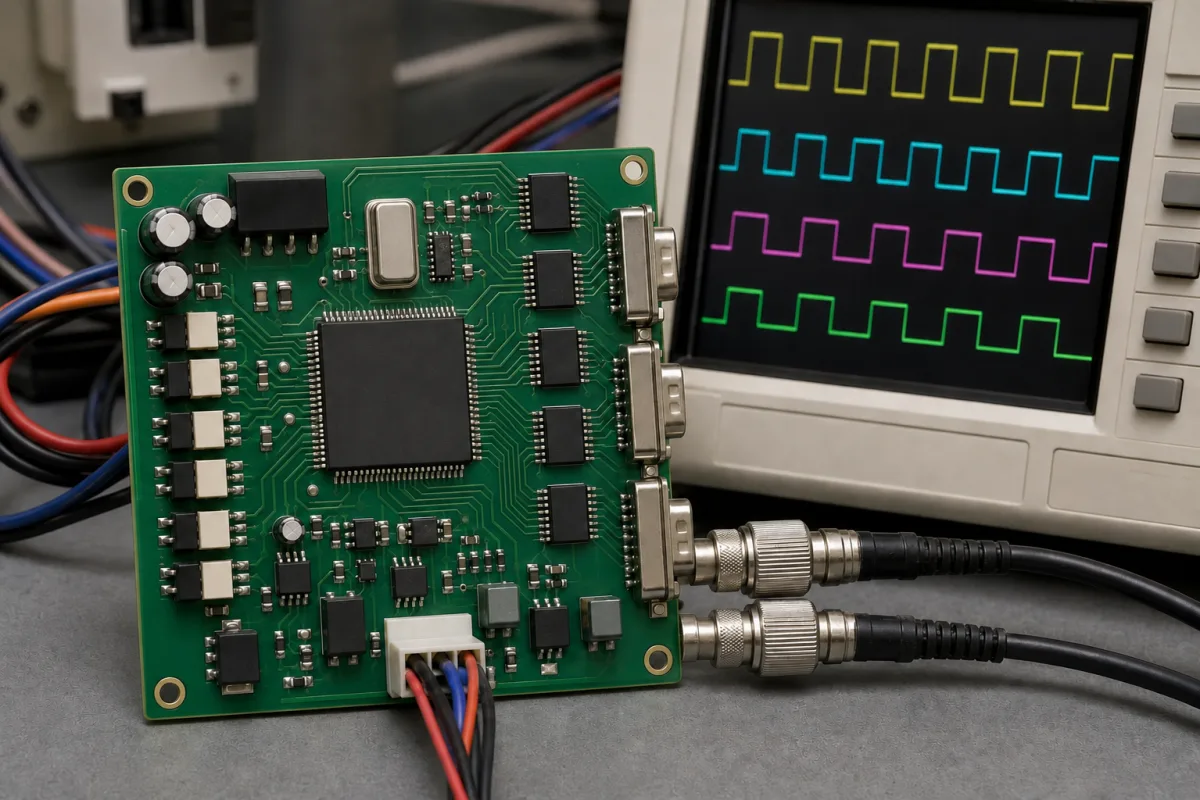
A canonical Pulse Generation Circuit is characterized by the integration of Oscillator IC and Timing Resistors. In industrial production environments, manufacturers listed on CNFX commonly emphasize Printed Circuit Board (PCB) construction to support stable, high-cycle operation across diverse manufacturing scenarios.

Electronic circuit that generates precise timing pulses for motor control

Product Specifications

Technical details and manufacturing context for Pulse Generation Circuit

Definition
A specialized electronic circuit within the Axis Control Module that produces accurate, high-frequency pulse signals used to control the position, speed, and acceleration of motors in automated systems. It converts digital control signals into precise electrical pulses that drive motor drivers or stepper controllers.
Working Principle
The circuit typically uses oscillators, timers, or digital logic components to generate square wave pulses with specific frequency, duty cycle, and amplitude. These pulses are synchronized with control signals and provide the timing reference for motor movement in CNC machines, robotics, and precision positioning systems.
Common Materials
Printed Circuit Board (PCB), Integrated Circuits (ICs), Resistors, Capacitors, Transistors
Technical Parameters
  • Pulse frequency range for motor control applications (kHz) Customizable
Components / BOM
  • Oscillator IC
    Generates the base frequency signal for pulse generation
    Material: Semiconductor silicon
  • Timing Resistors
    Sets the frequency and timing characteristics of the circuit
    Material: Carbon film or metal film
  • Timing Capacitors
    Determines the oscillation frequency and pulse timing
    Material: Ceramic or electrolytic
  • Output Buffer
    Amplifies and conditions the pulse signal for driving external loads
    Material: Transistor or operational amplifier
Engineering Reasoning
3.3-5.0 VDC, 1-100 kHz pulse frequency, -40°C to +85°C ambient temperature
Voltage drop below 2.7 VDC causes timing drift >1%, frequency deviation beyond ±0.5% of setpoint, junction temperature exceeding 125°C
Design Rationale: Thermal runaway in semiconductor junctions due to I²R heating, dielectric breakdown in timing capacitors at >6.3 VDC, electromigration in copper traces at current density >10⁶ A/cm²
Risk Mitigation (FMEA)
Trigger Electrostatic discharge (ESD) event exceeding 8 kV HBM
Mode: Gate oxide breakdown in MOSFET switching transistors
Strategy: Integrated ESD protection diodes with 15 kV IEC 61000-4-2 rating and series resistors on all I/O pins
Trigger Power supply ripple >100 mVpp at switching frequency
Mode: Phase-locked loop (PLL) jitter exceeding 500 ps RMS
Strategy: LC pi-filter with 47 μF tantalum capacitors and 10 μH ferrite beads on all power rails, separated analog/digital grounds

Industry Taxonomies & Aliases

Commonly used trade names and technical identifiers for Pulse Generation Circuit.

Applied To / Applications

This component is essential for the following industrial systems and equipment:

Industrial Ecosystem & Supply Chain DNA

Complementary Systems
Downstream Applications
Specialized Tooling

Application Fit & Sizing Matrix

Operational Limits
voltage: 3.3V to 24V DC
temperature: -40°C to +85°C
output current: ±20mA max
frequency range: 1Hz to 1MHz
operating humidity: 0-85% non-condensing
Media Compatibility
✓ Industrial motor control systems ✓ Precision timing applications ✓ Automated manufacturing equipment
Unsuitable: High-voltage arc environments (>1kV)
Sizing Data Required
  • Required pulse frequency (Hz)
  • Output voltage/current requirements
  • Control signal interface type (e.g., TTL, CMOS, analog)

Reliability & Engineering Risk Analysis

Failure Mode & Root Cause
Capacitor Degradation
Cause: Electrolytic capacitor drying out or ESR increase due to thermal stress, voltage spikes, or aging, leading to pulse amplitude reduction or timing drift.
Transistor/IC Failure
Cause: Overheating from excessive current, voltage transients, or poor heat dissipation, causing short-circuit or open-circuit failures in switching components.
Maintenance Indicators
  • Inconsistent or weak output pulses (measured with oscilloscope)
  • Audible high-frequency whine or clicking from components indicating arcing or stress
Engineering Tips
  • Implement thermal management with heatsinks or forced air cooling for power components, and use derating guidelines (e.g., operate capacitors at ≤80% rated voltage).
  • Add transient voltage suppression (TVS diodes) and filtering at input/output to protect against electrical noise and spikes, and perform regular infrared thermography inspections.

Compliance & Manufacturing Standards

Reference Standards
IEC 61000-4-4 (Electromagnetic compatibility - Electrical fast transient/burst immunity test) ISO 9001 (Quality management systems - Requirements) CE Marking (Conformité Européenne - EU safety, health, and environmental requirements)
Manufacturing Precision
  • Pulse width accuracy: +/-2% of nominal value
  • Output voltage amplitude tolerance: +/-5% across operating temperature range
Quality Inspection
  • Oscilloscope waveform analysis (rise time, fall time, pulse width verification)
  • Environmental stress testing (temperature cycling, humidity, vibration per IEC 60068-2 series)

Factories Producing Pulse Generation Circuit

Verified manufacturers with capability to produce this product in China

✓ 94% Supplier Capability Match Found

S Sourcing Manager from United Arab Emirates Mar 01, 2026
★★★★★
"Reliable performance in harsh Computer, Electronic and Optical Product Manufacturing environments. No issues with the Pulse Generation Circuit so far."
Technical Specifications Verified
P Procurement Specialist from Australia Feb 26, 2026
★★★★☆
"Testing the Pulse Generation Circuit now; the technical reliability results are within 1% of the laboratory datasheet. (Delivery took slightly longer than expected, but technical support was excellent.)"
Technical Specifications Verified
T Technical Director from Singapore Feb 23, 2026
★★★★★
"Impressive build quality. Especially the technical reliability is very stable during long-term operation."
Technical Specifications Verified
Verification Protocol

“Feedback is collected from verified sourcing managers during RFQ (Request for Quote) and factory evaluation processes on CNFX. These reports represent historical performance data and technical audit summaries from our B2B manufacturing network.”

9 sourcing managers are analyzing this specification now. Last inquiry for Pulse Generation Circuit from Poland (15m ago).

Supply Chain Compatible Machinery & Devices

Industrial IoT Gateway

Edge computing device connecting industrial equipment to cloud platforms.

Explore Specs →
Modular Industrial Edge Computing Device

Rugged computing platform for industrial data processing at the network edge

Explore Specs →
Industrial Smart Camera Module

Embedded vision system for industrial automation and quality inspection.

Explore Specs →
Industrial Wireless Power Transfer Module

Wireless power transfer module for industrial equipment applications

Explore Specs →

Frequently Asked Questions

What is the primary application of this pulse generation circuit?

This circuit is designed to generate precise timing pulses specifically for motor control systems in computer, electronic, and optical product manufacturing, ensuring accurate synchronization and operation.

What components are included in the Bill of Materials (BOM)?

The BOM includes an Oscillator IC for pulse generation, an Output Buffer to drive loads, Timing Capacitors to set frequency, and Timing Resistors to adjust pulse width and timing parameters.

How does this circuit ensure precise timing for motor control?

Precision is achieved through carefully selected timing capacitors and resistors that work with the oscillator IC to generate stable, accurate pulses, while quality materials like PCB and integrated circuits maintain reliability in industrial environments.

Can I contact factories directly on CNFX?

CNFX is an open directory, not a transaction platform. Each factory profile provides direct contact information and production details to help you initiate direct inquiries with Chinese suppliers.

Get Quote for Pulse Generation Circuit

Request technical pricing, lead times, or customized specifications for Pulse Generation Circuit directly from verified manufacturing units.

Your business information is encrypted and only shared with verified Pulse Generation Circuit suppliers.

Thank you! Your message has been sent. We'll respond within 1–3 business days.

Need to Manufacture Pulse Generation Circuit?

Connect with verified factories specializing in this product category

Add Your Factory Contact Us
Previous Product
Protocol Transceiver IC
Next Product
Pulse Transformer