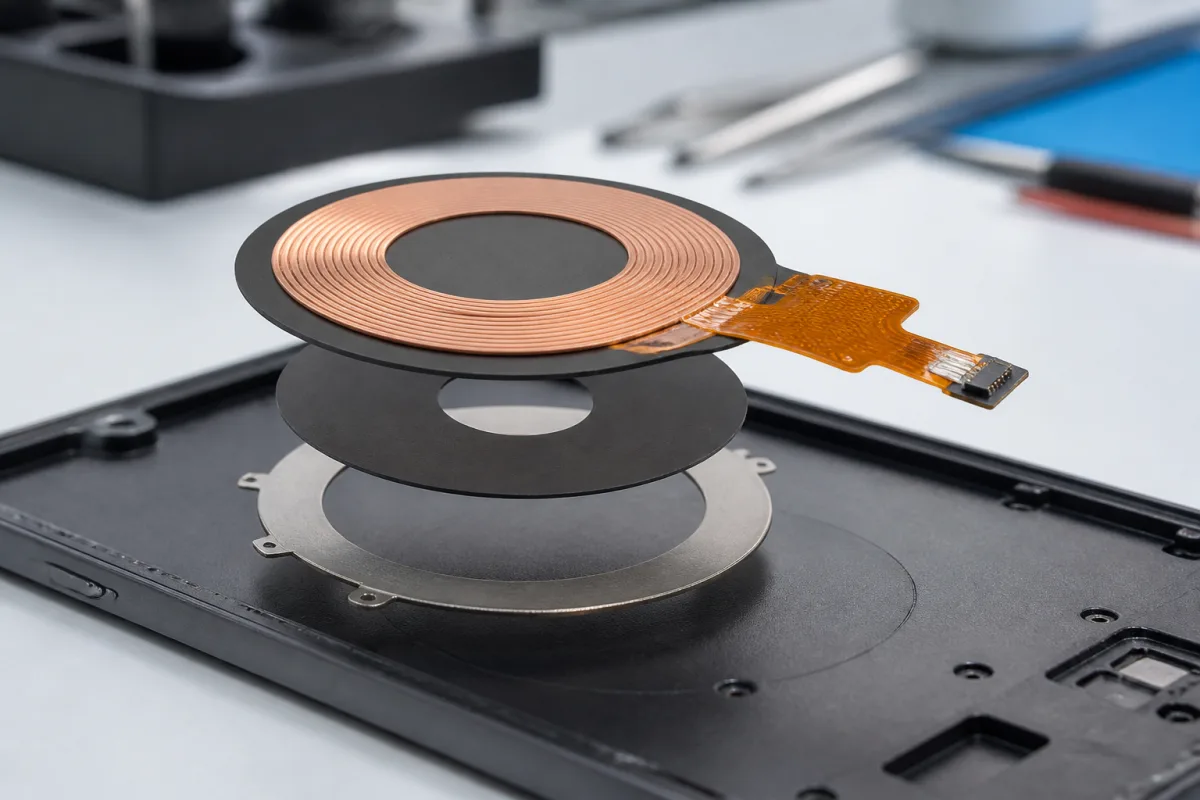
Receiver coil assembly for Qi wireless charging: spiral coil on a ferrite sheet, measured in the device and tuned to 100 kHz
Qi wireless charging receiver coil assemblies · Spiral copper coils on ferrite shield sheets for phones, wearables and small devices, free-space Ls against in-device Ls′, resonant capacitor sizing and battery effects
This page covers receiver coil assemblies for Qi and similar low-power wireless charging: a flat spiral of copper wire or Litz on a thin ferrite shield sheet, with leads or a flexible circuit tail, built into the back of a phone, wearable or small device. Ask three things first: the coil's free-space inductance Ls and its inductance Ls′ measured in your device on the standard test fixture, the DC resistance and quality factor, and how the battery and housing behind the coil change those values.
Receiver coil assemblies for Qi and similar low-power wireless charging in phones, wearables and small devices, including spiral copper or Litz coils, ferrite shield sheets and lead or flexible-circuit terminations. Vehicle-side coils and ground pads for electric vehicle wireless charging are covered on the Automotive wireless power transfer system page. Transmitter coils, MRI receive coils and RFID antennas are outside this page.
CNFX editorial research · Sources checked October 12, 2026 · 3 sources
Free-space Ls against Ls′ measured with the battery and back cover on the WPC fixture
TI's BQ51013B receiver datasheet, following the WPC v1.2 power receiver requirements, measures the coil twice: Ls′ with the coil placed as in the final system, including back cover and battery, on a 50 × 50 × 1 mm TDK PC44 ferrite primary shield with a 3.4 mm gap, and Ls in free space without the fixture, both at 1 Vrms and 100 kHz. Its recommended receiver coils show how far the two differ; Ls′ was measured with a standard battery behind the coil except for the Vishay part, and TI asks designers to repeat all inductance measurements in their own system. [1]
The later BQ51013C datasheet, written to WPC v2.0, lists Würth 760308103215 and XFMRS XFMCC483201-143 coils of 48 × 32 mm at 14.3 µH, the TDK WR483265-15F5-G at 13.3 µH, all for 50–1,000 mA, and a 22 mm round TDK WR222230-26M8-G at 27 µH for 50–500 mA. [2]
Give the supplier the space available (outline, thickness, cut-outs), the output current, the Qi version the receiver must meet, what sits behind the coil (battery, metal frame, NFC antenna), the housing material and thickness over the coil, and the termination (leads or flexible circuit and connector).
02
Series and parallel resonant capacitors from Ls′ and Ls, and a quality factor above 77
TI sizes the series capacitor C1 from Ls′ for a resonance fS of 100 kHz +5/−10%, then the parallel capacitor C2 from Ls and C1 for a second resonance fD of 1 MHz ±10%, and requires a quality factor, 2π·fD·Ls/R with R the coil's DC resistance, above 77. In its worked example a coil with Ls 11 µH, Ls′ 16 µH and 191 mΩ gives C1 = 158.3 nF (range 144–175 nF), built as 68 + 47 + 39 = 154 nF, and C2 = 2.3 nF, built as 2.2 nF plus 100 pF, both rated at least 25 V; Q comes out above 500. [1]
Editorial calculation: C1 = 1 / ((2π × 100 kHz)² × 16 µH) ≈ 158 nF, matching TI's figure; with Ls′ of 18.8 µH, as for the TDK coil above, the same formula gives about 135 nF, so a capacitor bank sized for one coil does not fit another. [1]
03
Ferrite backing between the coil and the battery or electronics
An ITMO University study (arXiv 2408.09852) built a Qi receiver into an AA-size rechargeable battery from a commercial Qi planar coil of 40.5 × 30.5 mm, 14 turns of two parallel 0.4 mm enamelled copper wires, bent to a 7 mm radius and backed with a 41 × 28 mm flexible ferrite sheet 0.1 mm thick to decouple the battery's other components from the transmitter. The coil measured 12 µH and was resonated at 100 kHz with four 68 nF, 25 V capacitors, with a 2.2 nF second-resonance capacitor; its simulations showed that, with the ferrite layer in place, adding the battery's internal components left the field close to that of the ferrite-backed coil alone. [3]
The study's highest measured charging efficiency was 28%, at zero distance and an empty cell, and it fell with distance and state of charge. [3] Editorial note: that figure belongs to a curved coil on a 14 mm cylinder, not to a flat coil in a phone; ask the coil supplier for efficiency or coupling measured on your transmitter and in your housing.
04
Send the space, current and stack-up behind the coil together
Paste it into your enquiry below or into an email to a maker, then replace every bracket.
Space: [outline; thickness; cut-outs]
Electrical: [Ls target; output current; Qi version]
Stack-up: [battery; metal frame; NFC antenna; housing material]
Ferrite: [sheet thickness; material]
Termination: [leads; flexible circuit; connector]
Test: [Ls and Ls′ on WPC fixture; DC resistance]
1 company lists this product among what they make. Company figures are quoted from each
company's own website; every card states where the relationship came from.
Zhengtaifeng Hardware Products Co., Ltd.
Manufacturing site to be confirmed for the order
Lists wireless charging receiving coils and transmitting coil sets.
Explore company information and manufacturing capabilities, then discuss the scope of your project with a relevant supplier.
Share this page
Compiled and source-reviewed by the CNFX editorial team.
Each manufacturer above links to the page on that company's own website where the product is listed, with the date we checked it. How we source and review
· Page last updated 13 October 2026
Buyer questions
What is Ls′ for a Qi receiver coil?
TI defines Ls′ as the coil's inductance measured in its final placement, with back cover and battery, on the WPC test fixture's ferrite shield at a 3.4 mm gap, at 1 Vrms and 100 kHz; Ls is the free-space value. [1]
How much does a battery behind the coil change its inductance?
In TI's recommended coil table, Ls′ measured with a standard battery behind the coil ran 1.20 to 1.43 times the free-space Ls, and one coil measured without a battery read 1.45 times (editorial calculation from TI's values). [1]
Why is there a ferrite sheet behind a wireless charging coil?
It shields the components behind the coil from the transmitter's field; an ITMO study used a 0.1 mm flexible ferrite sheet to decouple a battery's components. [3]
Sources and what still needs a direct check
Sources checked 2026-10-12. TI's receiver datasheets set out WPC coil measurement and tuning; the ITMO study reports one built receiver coil.