Industry-Verified Manufacturing Data (2026)

Shielded Cable Harness

Based on aggregated insights from multiple verified factory profiles within the CNFX directory, the standard Shielded Cable Harness used in the Computer, Electronic and Optical Product Manufacturing sector typically supports operational capacities ranging from standard industrial configurations to heavy-duty production requirements.

Technical Definition & Core Assembly

A canonical Shielded Cable Harness is characterized by the integration of Shielded Individual Cables and Connectors. In industrial production environments, manufacturers listed on CNFX commonly emphasize Copper conductors construction to support stable, high-cycle operation across diverse manufacturing scenarios.

A shielded cable assembly designed to transmit electrical signals while protecting against electromagnetic interference (EMI) and radio frequency interference (RFI).
Product Specifications

Technical details and manufacturing context for Shielded Cable Harness

Definition
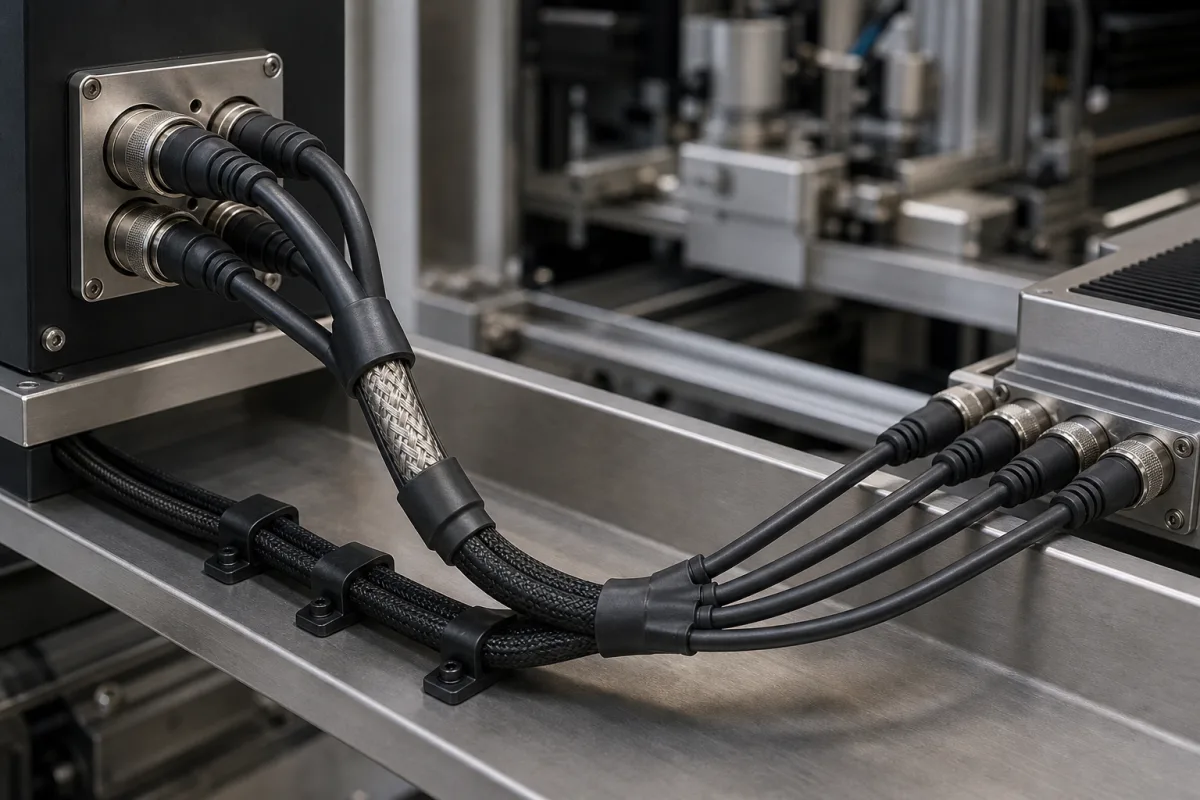
A shielded cable harness is a critical component within vibration sensor arrays that bundles multiple shielded cables together with connectors and protective sheathing. It ensures reliable transmission of sensitive vibration measurement signals from sensors to data acquisition systems by providing electromagnetic shielding, mechanical protection, and organized routing within industrial environments.
Working Principle
The shielded cable harness operates by using conductive shielding layers (typically braided copper or foil) around individual conductors or the entire cable bundle. This shielding creates a Faraday cage effect that blocks external electromagnetic interference from corrupting the sensitive vibration signals. The harness organizes multiple sensor connections into a single, protected assembly that maintains signal integrity while withstanding mechanical stress and environmental conditions.
Common Materials
Copper conductors, Polyethylene/PVC insulation, Copper braid shielding, Aluminum foil shielding, PVC/Nylon outer jacket
Technical Parameters
  • Overall harness diameter including shielding and protective layers (mm) Per Request
Components / BOM
  • Shielded Individual Cables
    Transmit vibration sensor signals with EMI protection
    Material: Copper conductors with foil/braid shielding
  • Connectors
    Interface between sensors, harness, and data acquisition equipment
    Material: Metal/plastic with gold-plated contacts
  • Outer Protective Sheath
    Provide mechanical protection and environmental sealing
    Material: PVC, polyurethane, or nylon
  • Strain Relief
    Prevent cable damage at connection points
    Material: Rubber or molded plastic
Engineering Reasoning
0-600 V DC, -40°C to 125°C, 0-100% relative humidity
Shielding effectiveness drops below 40 dB at 1 GHz, insulation resistance falls below 100 MΩ at 500 V DC, conductor temperature exceeds 150°C
Design Rationale: Shield discontinuity creates EMI leakage paths exceeding skin depth at critical frequencies, dielectric breakdown occurs at 15 kV/mm electric field strength, polymer insulation undergoes glass transition above 150°C
Risk Mitigation (FMEA)
Trigger Shield termination impedance mismatch exceeding 5 Ω differential
Mode: Common-mode noise coupling increases by 20 dB, causing signal-to-noise ratio degradation below 10 dB
Strategy: Implement 360-degree circumferential shield termination with impedance matching to 1 Ω tolerance
Trigger Cable bending radius violation below 8× cable diameter
Mode: Shield braid deformation creates apertures larger than λ/20 at 1 GHz, reducing shielding effectiveness by 30 dB
Strategy: Install strain relief fixtures maintaining minimum 10× cable diameter bend radius with 15 N·m torque limit

Industry Taxonomies & Aliases

Commonly used trade names and technical identifiers for Shielded Cable Harness.

Applied To / Applications

This component is essential for the following industrial systems and equipment:

Industrial Ecosystem & Supply Chain DNA

Complementary Systems
Downstream Applications
Specialized Tooling

Application Fit & Sizing Matrix

Operational Limits
voltage: Up to 600V AC/DC (depending on insulation rating)
frequency: DC to 10 GHz (shielded performance)
temperature: -40°C to +125°C (operational), -55°C to +150°C (storage)
bending radius: Minimum 6x cable diameter (dynamic), 4x cable diameter (static)
shielding efficiency: ≥90 dB attenuation (typical for braided shield)
Media Compatibility
✓ Industrial automation control panels ✓ Medical imaging equipment ✓ Aerospace avionics systems
Unsuitable: High-voltage arc welding environments (extreme EMI/RFI beyond shielding capability)
Sizing Data Required
  • Required signal frequency/bandwidth
  • EMI/RFI attenuation level needed (dB)
  • Environmental exposure (temperature, moisture, chemicals)

Reliability & Engineering Risk Analysis

Failure Mode & Root Cause
Shield Degradation
Cause: Environmental exposure to moisture, chemicals, or UV radiation leading to corrosion or breakdown of the shielding material, compromising electromagnetic interference (EMI) protection and signal integrity.
Insulation Breakdown
Cause: Mechanical stress from vibration, bending, or abrasion against sharp edges, combined with thermal cycling, causing cracks or wear in the insulation, leading to short circuits or ground faults.
Maintenance Indicators
  • Visible shield fraying, corrosion, or exposed braiding at connection points or along the harness length.
  • Intermittent signal noise, data errors, or audible buzzing/humming in connected systems indicating EMI leakage or grounding issues.
Engineering Tips
  • Implement proper strain relief and secure routing away from sharp edges or high-vibration zones using clamps or conduits to minimize mechanical stress.
  • Apply protective coatings or sleeves in harsh environments and ensure all shield terminations are properly grounded to maintain EMI integrity.

Compliance & Manufacturing Standards

Reference Standards
ISO 6722: Road vehicles - 60 V and 600 V single-core cables ANSI/SAE AS50881: Wiring Aerospace Vehicle DIN EN 50382: Railway applications - Railway rolling stock cables
Manufacturing Precision
  • Conductor diameter: +/-0.05mm
  • Shielding coverage: >95%
Quality Inspection
  • Continuity and insulation resistance test
  • Shielding effectiveness test (per MIL-STD-461)

Factories Producing Shielded Cable Harness

Verified manufacturers with capability to produce this product in China

✓ 96% Supplier Capability Match Found

P Project Engineer from Australia Jan 25, 2026
★★★★★
"Standard OEM quality for Computer, Electronic and Optical Product Manufacturing applications. The Shielded Cable Harness arrived with full certification."
Technical Specifications Verified
S Sourcing Manager from Singapore Jan 22, 2026
★★★★★
"Great transparency on the Shielded Cable Harness components. Essential for our Computer, Electronic and Optical Product Manufacturing supply chain."
Technical Specifications Verified
P Procurement Specialist from Germany Jan 19, 2026
★★★★★
"The Shielded Cable Harness we sourced perfectly fits our Computer, Electronic and Optical Product Manufacturing production line requirements."
Technical Specifications Verified
Verification Protocol

“Feedback is collected from verified sourcing managers during RFQ (Request for Quote) and factory evaluation processes on CNFX. These reports represent historical performance data and technical audit summaries from our B2B manufacturing network.”

16 sourcing managers are analyzing this specification now. Last inquiry for Shielded Cable Harness from Brazil (20m ago).

Supply Chain Compatible Machinery & Devices

Industrial Smart Camera Module

Embedded vision system for industrial automation and quality inspection.

Explore Specs →
Industrial Wireless Power Transfer Module

Wireless power transfer module for industrial equipment applications

Explore Specs →
Industrial Smart Sensor Module

Modular industrial sensor with embedded processing and wireless connectivity

Explore Specs →
Surface Mount Resistor

Passive electronic component for current limiting and voltage division in circuits

Explore Specs →

Frequently Asked Questions

What are the key benefits of using a shielded cable harness in electronic manufacturing?

Shielded cable harnesses provide critical protection against electromagnetic interference (EMI) and radio frequency interference (RFI), ensuring signal integrity, reducing data errors, and improving overall system reliability in sensitive electronic applications.

How does the dual shielding (copper braid + aluminum foil) enhance performance?

The combination of copper braid shielding (for high-frequency interference) and aluminum foil shielding (for low-frequency interference) creates comprehensive EMI/RFI protection across a broad frequency spectrum, offering superior performance compared to single-shield designs.

What industries commonly use these shielded cable assemblies?

These harnesses are essential in computer manufacturing, telecommunications equipment, medical devices, industrial automation systems, aerospace electronics, and any application where signal integrity must be maintained in electrically noisy environments.

Can I contact factories directly on CNFX?

CNFX is an open directory, not a transaction platform. Each factory profile provides direct contact information and production details to help you initiate direct inquiries with Chinese suppliers.

Get Quote for Shielded Cable Harness

Request technical pricing, lead times, or customized specifications for Shielded Cable Harness directly from verified manufacturing units.

Your business information is encrypted and only shared with verified Shielded Cable Harness suppliers.

Thank you! Your message has been sent. We'll respond within 1–3 business days.

Need to Manufacture Shielded Cable Harness?

Connect with verified factories specializing in this product category

Add Your Factory Contact Us
Previous Product
Shielded Access Door
Next Product
Shielding Enclosure