Industry-Verified Manufacturing Data (2026)

Vibration Sensor Array

Based on aggregated insights from multiple verified factory profiles within the CNFX directory, the standard Vibration Sensor Array used in the Machinery and Equipment Manufacturing sector typically supports operational capacities ranging from standard industrial configurations to heavy-duty production requirements.

Technical Definition & Core Assembly

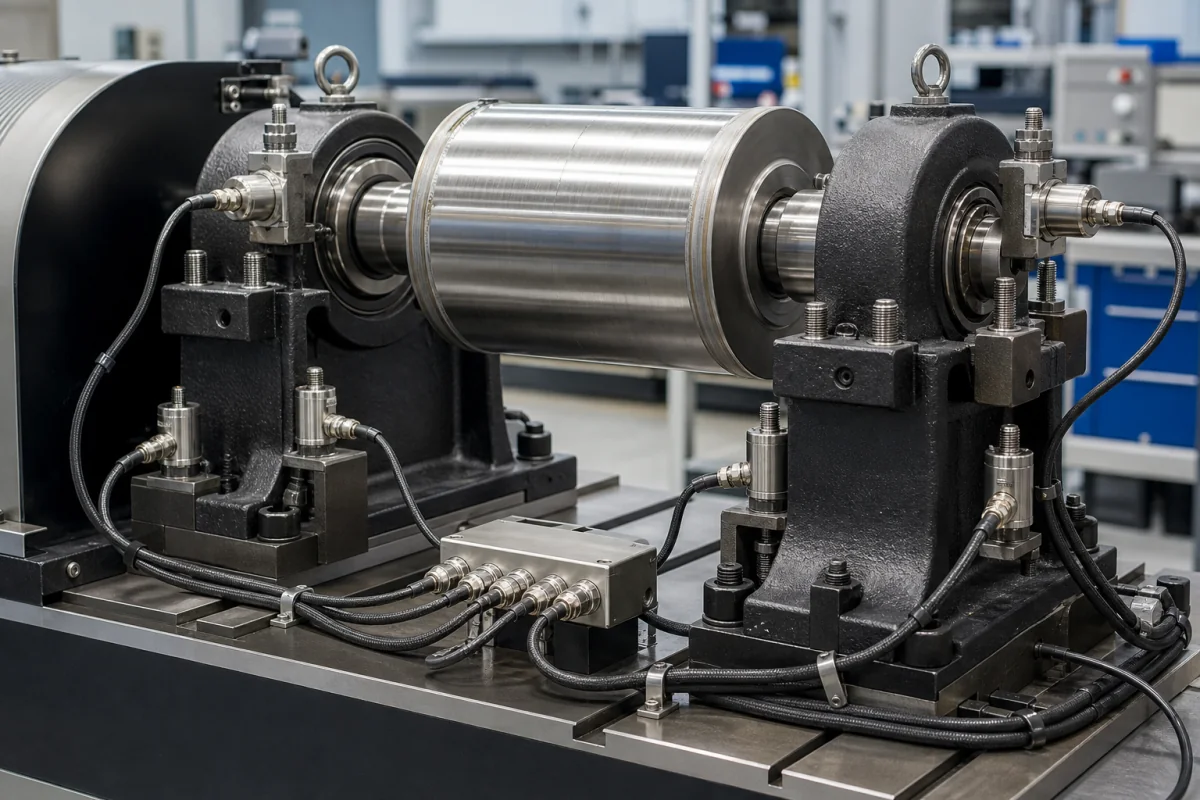
A canonical Vibration Sensor Array is characterized by the integration of Piezoelectric Sensor Elements and Sensor Mounting Brackets. In industrial production environments, manufacturers listed on CNFX commonly emphasize Piezoelectric ceramic elements construction to support stable, high-cycle operation across diverse manufacturing scenarios.

A multi-sensor system for measuring vibration patterns during rotor balancing operations.
Product Specifications

Technical details and manufacturing context for Vibration Sensor Array

Definition
A critical component of an Electric Motor Rotor Balancing Machine that consists of multiple vibration sensors strategically positioned to detect and measure vibration amplitudes and frequencies across different points of a rotating rotor. This array provides comprehensive vibration data necessary for identifying imbalance locations and calculating required counterweights.
Working Principle
The vibration sensor array operates by converting mechanical vibrations from the rotating rotor into electrical signals using piezoelectric or MEMS sensors. Multiple sensors capture vibration data simultaneously from different positions, allowing for phase analysis and precise localization of imbalance points. The signals are processed to determine vibration amplitude, frequency, and phase relationships.
Common Materials
Piezoelectric ceramic elements, Stainless steel housing, Electronic circuit boards, Shielded cables
Technical Parameters
  • Sensor spacing and array configuration dimensions (mm) Standard Spec
Components / BOM
  • Piezoelectric Sensor Elements
    Convert mechanical vibrations into electrical signals
    Material: Piezoelectric ceramic
  • Sensor Mounting Brackets
    Secure sensors in precise positions relative to rotor
    Material: Stainless steel
  • Signal Conditioning Circuitry
    Amplify and filter sensor signals for processing
    Material: Electronic components on PCB
  • Shielded Cable Harness
    Transmit sensor signals to data acquisition system
    Material: Copper conductors with EMI shielding
Engineering Reasoning
0.1-1000 Hz frequency, 0.01-100 g acceleration
Acceleration exceeding 150 g or temperature exceeding 125°C
Design Rationale: Piezoelectric crystal depolarization at Curie temperature (125°C for PZT-5A) or mechanical resonance-induced structural fatigue at 150 g
Risk Mitigation (FMEA)
Trigger Electromagnetic interference from adjacent 480V AC motor drives
Mode: Signal aliasing causing false vibration amplitude readings
Strategy: Shielded twisted-pair cabling with ferrite cores and differential signal processing
Trigger Thermal expansion mismatch between aluminum housing (23×10⁻⁶/°C) and piezoelectric element (4×10⁻⁶/°C)
Mode: Permanent preload loss reducing sensitivity by >15%
Strategy: Invar alloy (1.2×10⁻⁶/°C) mounting interface with Belleville washers maintaining 20 N preload

Industry Taxonomies & Aliases

Commonly used trade names and technical identifiers for Vibration Sensor Array.

Industrial Ecosystem & Supply Chain DNA

Complementary Systems
Downstream Applications
Specialized Tooling

Application Fit & Sizing Matrix

Operational Limits
pressure: 0 to 10 bar
temperature: -40°C to +85°C
vibration range: 0.1 to 1000 Hz
acceleration range: ±50 g
operating humidity: 0-95% non-condensing
Media Compatibility
✓ Industrial machinery rotors ✓ Turbine shafts ✓ Electric motor assemblies
Unsuitable: Submerged or high-pressure washdown environments without IP68/IP69K rating
Sizing Data Required
  • Rotor diameter and weight
  • Required measurement frequency range
  • Number of measurement points per rotor

Reliability & Engineering Risk Analysis

Failure Mode & Root Cause
Sensor Drift/Calibration Loss
Cause: Environmental factors like temperature fluctuations, moisture ingress, or aging electronic components causing signal inaccuracies and false readings.
Mechanical Mounting Failure
Cause: Loosening of mounting hardware due to vibration, improper installation, or corrosion leading to poor sensor coupling and unreliable data.
Maintenance Indicators
  • Erratic or inconsistent vibration readings compared to baseline data
  • Audible buzzing or rattling from the sensor housing indicating loose internal components
Engineering Tips
  • Implement regular calibration checks using certified reference sources and maintain environmental control around sensor locations
  • Use thread-locking compounds on mounting hardware and perform periodic torque verification to ensure proper mechanical coupling

Compliance & Manufacturing Standards

Reference Standards
ISO 10816: Mechanical vibration - Evaluation of machine vibration by measurements on non-rotating parts ANSI/ASA S2.70: Guide for the Measurement and Evaluation of Vibration of Machines DIN 45669: Measurement and evaluation of mechanical vibration of machines
Manufacturing Precision
  • Frequency Response: +/-5% across specified range
  • Mounting Surface Flatness: 0.05mm maximum deviation
Quality Inspection
  • Environmental Stress Screening (ESS) for temperature and humidity resistance
  • Calibration Verification against NIST-traceable reference standards

Factories Producing Vibration Sensor Array

Verified manufacturers with capability to produce this product in China

✓ 93% Supplier Capability Match Found

T Technical Director from Germany Feb 19, 2026
★★★★★
"The technical documentation for this Vibration Sensor Array is very thorough, especially regarding technical reliability."
Technical Specifications Verified
P Project Engineer from Brazil Feb 16, 2026
★★★★☆
"Reliable performance in harsh Machinery and Equipment Manufacturing environments. No issues with the Vibration Sensor Array so far. (Delivery took slightly longer than expected, but technical support was excellent.)"
Technical Specifications Verified
S Sourcing Manager from Canada Feb 13, 2026
★★★★★
"Testing the Vibration Sensor Array now; the technical reliability results are within 1% of the laboratory datasheet."
Technical Specifications Verified
Verification Protocol

“Feedback is collected from verified sourcing managers during RFQ (Request for Quote) and factory evaluation processes on CNFX. These reports represent historical performance data and technical audit summaries from our B2B manufacturing network.”

18 sourcing managers are analyzing this specification now. Last inquiry for Vibration Sensor Array from Poland (45m ago).

Supply Chain Compatible Machinery & Devices

Heavy-Duty CNC Plasma Cutting Machine

Industrial machine for precision metal cutting using plasma arc technology

Explore Specs →
Automated Assembly Line System

Integrated production system for sequential component assembly operations

Explore Specs →
Automated Powder Coating System

Integrated industrial system for applying dry powder coatings to metal substrates.

Explore Specs →
Centrifugal Pump Impeller

Rotating component that transfers energy to fluid in centrifugal pumps.

Explore Specs →

Frequently Asked Questions

What makes this vibration sensor array suitable for rotor balancing operations?

The array uses multiple piezoelectric ceramic sensors to capture comprehensive vibration patterns across different points simultaneously, providing detailed data essential for precise rotor balancing in industrial machinery.

How durable is the stainless steel housing in industrial environments?

The stainless steel housing provides excellent corrosion resistance and mechanical protection, ensuring reliable performance in harsh manufacturing environments with exposure to oils, coolants, and mechanical stress.

What signal conditioning features are included with the sensor array?

The system includes electronic circuit boards with signal amplification, filtering, and noise reduction capabilities, along with shielded cable harnesses to ensure clean, accurate vibration data transmission in electrically noisy industrial settings.

Can I contact factories directly on CNFX?

CNFX is an open directory, not a transaction platform. Each factory profile provides direct contact information and production details to help you initiate direct inquiries with Chinese suppliers.

Get Quote for Vibration Sensor Array

Request technical pricing, lead times, or customized specifications for Vibration Sensor Array directly from verified manufacturing units.

Your business information is encrypted and only shared with verified Vibration Sensor Array suppliers.

Thank you! Your message has been sent. We'll respond within 1–3 business days.

Need to Manufacture Vibration Sensor Array?

Connect with verified factories specializing in this product category

Add Your Factory Contact Us
Previous Product
Vibration Sensor
Next Product
Vibration Sensor Module