Industry-Verified Manufacturing Data (2026)

Synchronization Interface

Based on aggregated insights from multiple verified factory profiles within the CNFX directory, the standard Synchronization Interface used in the Computer, Electronic and Optical Product Manufacturing sector typically supports operational capacities ranging from standard industrial configurations to heavy-duty production requirements.

Technical Definition & Core Assembly

A canonical Synchronization Interface is characterized by the integration of Clock Generator Circuit and Sync Connector. In industrial production environments, manufacturers listed on CNFX commonly emphasize Printed Circuit Board (PCB) construction to support stable, high-cycle operation across diverse manufacturing scenarios.

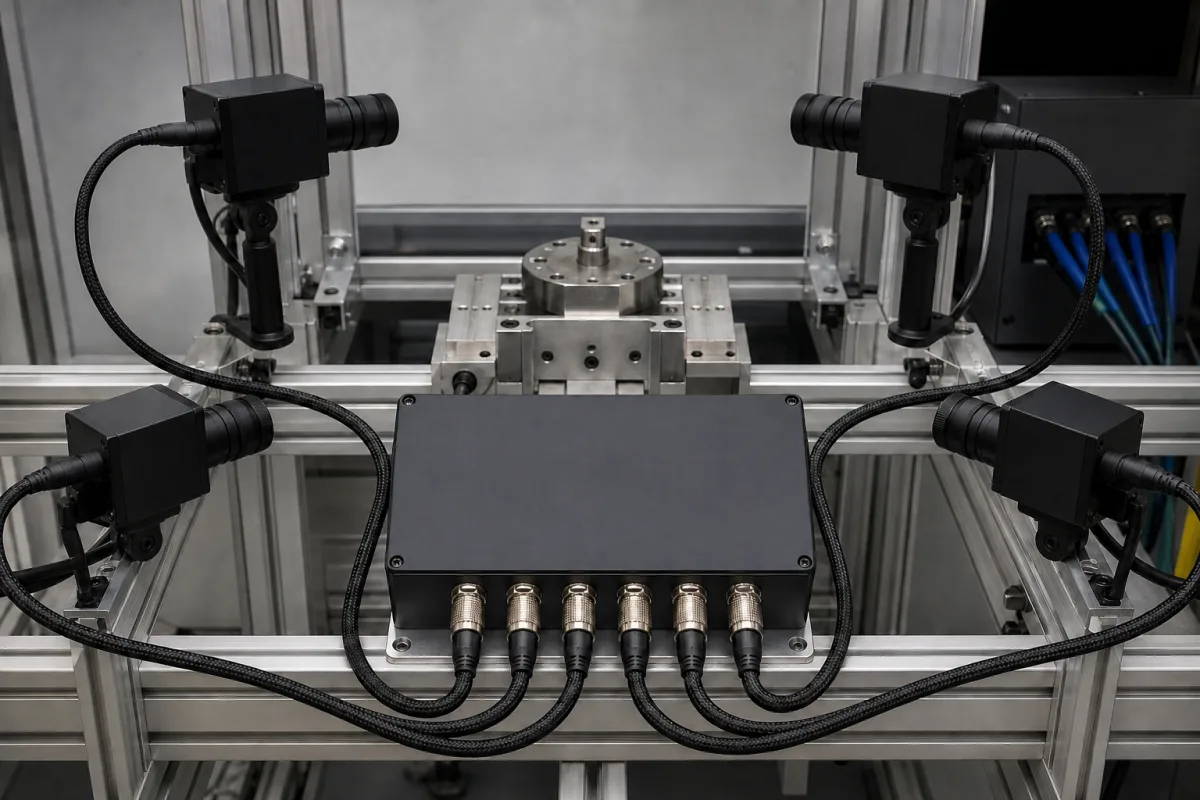
Electronic interface that coordinates timing and data transfer between multiple cameras in an array system
Product Specifications

Technical details and manufacturing context for Synchronization Interface

Definition
A synchronization interface is a critical component within a high-resolution camera array system that ensures precise temporal alignment and coordinated data acquisition across multiple camera modules. It manages clock signals, trigger pulses, and data handshaking protocols to enable simultaneous or precisely sequenced image capture, which is essential for applications requiring multi-view imaging, 3D reconstruction, or panoramic stitching.
Working Principle
The synchronization interface operates by distributing a master clock signal or trigger command to all connected camera modules. It uses either hardware-based synchronization (through dedicated sync cables and connectors) or software-based protocols to ensure all cameras capture images at exactly the same moment or in a precisely defined sequence. The interface may also handle data buffering and transfer coordination to prevent data collisions when multiple cameras send image data simultaneously.
Common Materials
Printed Circuit Board (PCB), Copper connectors, Plastic housing
Technical Parameters
  • Synchronization clock frequency determining timing precision (MHz) Customizable
Components / BOM
  • Clock Generator Circuit
    Generates precise timing signals for camera synchronization
    Material: Silicon semiconductor
  • Sync Connector
    Physical interface for connecting sync cables to camera modules
    Material: Gold-plated copper alloy
  • Signal Buffer
    Amplifies and conditions sync signals for reliable transmission
    Material: PCB with integrated circuits
Engineering Reasoning
3.3-5.0 VDC, 0-70°C ambient temperature, 0-95% relative humidity (non-condensing)
Voltage drop below 3.0 VDC for >10 ms, temperature exceeding 85°C junction temperature, clock jitter >200 ps RMS
Design Rationale: Semiconductor junction thermal runaway at >150°C, electromigration in copper traces at >10^5 A/cm² current density, dielectric breakdown at >10 MV/m electric field
Risk Mitigation (FMEA)
Trigger Clock signal phase drift exceeding ±5° due to temperature coefficient mismatch in crystal oscillators
Mode: Frame synchronization loss between cameras, resulting in timestamp misalignment >1 ms
Strategy: Phase-locked loop with 0.1 ppm stability, temperature-compensated crystal oscillator with ±2.5 ppm accuracy from -40°C to 85°C
Trigger Electromagnetic interference coupling >10 V/m at 100-1000 MHz frequencies onto synchronization lines
Mode: Data packet corruption with bit error rate >10^-6, triggering automatic retransmission timeout
Strategy: Differential signaling with 100 Ω impedance matching, shielded twisted-pair cabling with >30 dB attenuation at 1 GHz, ferrite bead filters with 100 Ω impedance at 100 MHz

Industry Taxonomies & Aliases

Commonly used trade names and technical identifiers for Synchronization Interface.

Applied To / Applications

This component is essential for the following industrial systems and equipment:

Industrial Ecosystem & Supply Chain DNA

Complementary Systems
Downstream Applications
Specialized Tooling

Application Fit & Sizing Matrix

Operational Limits
voltage: 5V DC ±5%
temperature: -10°C to +60°C
environmental: IP40 rating, non-condensing humidity only
signal integrity: Max cable length: 50m per camera, Max latency: 1ms
Media Compatibility
✓ Industrial GigE Vision cameras ✓ GenICam compliant cameras ✓ Synchronized multi-camera arrays
Unsuitable: High-voltage electromagnetic interference environments (e.g., near arc welding stations)
Sizing Data Required
  • Number of cameras in array
  • Required synchronization accuracy (in microseconds)
  • Data transfer bandwidth per camera (Gbps)

Reliability & Engineering Risk Analysis

Failure Mode & Root Cause
Misalignment-induced wear
Cause: Improper installation or thermal expansion causing shaft misalignment, leading to excessive friction and component degradation in gears or couplings.
Lubrication failure
Cause: Contaminated, degraded, or insufficient lubricant resulting in increased friction, overheating, and accelerated wear of synchronizing components.
Maintenance Indicators
  • Unusual grinding or clicking noises during engagement/disengagement
  • Visible oil leaks or excessive vibration at the interface housing
Engineering Tips
  • Implement laser alignment during installation and periodic checks to ensure shafts remain within tolerance under operating conditions.
  • Establish a strict lubrication schedule using manufacturer-specified fluids and conduct regular oil analysis to detect contamination early.

Compliance & Manufacturing Standards

Reference Standards
ISO 1940-1:2003 (Mechanical vibration - Balance quality requirements for rotors in a constant (rigid) state) ANSI/ASME B46.1-2019 (Surface Texture: Surface Roughness, Waviness, and Lay) DIN 5480-1:2006 (Splined connections with involute splines based on reference diameters - Part 1: Principles)
Manufacturing Precision
  • Shaft Diameter: +/-0.01mm
  • Concentricity: 0.005mm TIR
Quality Inspection
  • Coordinate Measuring Machine (CMM) Dimensional Verification
  • Hardness Testing (e.g., Rockwell C scale)

Factories Producing Synchronization Interface

Verified manufacturers with capability to produce this product in China

✓ 95% Supplier Capability Match Found

P Project Engineer from Brazil Jan 09, 2026
★★★★★
"Reliable performance in harsh Computer, Electronic and Optical Product Manufacturing environments. No issues with the Synchronization Interface so far."
Technical Specifications Verified
S Sourcing Manager from Canada Jan 06, 2026
★★★★★
"Testing the Synchronization Interface now; the technical reliability results are within 1% of the laboratory datasheet."
Technical Specifications Verified
P Procurement Specialist from United States Jan 03, 2026
★★★★★
"Impressive build quality. Especially the technical reliability is very stable during long-term operation."
Technical Specifications Verified
Verification Protocol

“Feedback is collected from verified sourcing managers during RFQ (Request for Quote) and factory evaluation processes on CNFX. These reports represent historical performance data and technical audit summaries from our B2B manufacturing network.”

14 sourcing managers are analyzing this specification now. Last inquiry for Synchronization Interface from USA (1h ago).

Supply Chain Compatible Machinery & Devices

Industrial IoT Gateway

Edge computing device connecting industrial equipment to cloud platforms.

Explore Specs →
Modular Industrial Edge Computing Device

Rugged computing platform for industrial data processing at the network edge

Explore Specs →
Industrial Smart Camera Module

Embedded vision system for industrial automation and quality inspection.

Explore Specs →
Industrial Wireless Power Transfer Module

Wireless power transfer module for industrial equipment applications

Explore Specs →

Frequently Asked Questions

What is the primary function of this synchronization interface?

This interface coordinates precise timing and data transfer between multiple cameras in array systems, ensuring synchronized operation for applications in computer, electronic, and optical product manufacturing.

What materials are used in the construction of this synchronization interface?

The interface is built with a Printed Circuit Board (PCB) for electronic components, copper connectors for reliable signal transmission, and a plastic housing for durability and protection in industrial environments.

What key components are included in the Bill of Materials (BOM)?

The BOM includes a Clock Generator Circuit for timing signals, a Signal Buffer for data integrity, and a Sync Connector for interfacing with multiple cameras in array configurations.

Can I contact factories directly on CNFX?

CNFX is an open directory, not a transaction platform. Each factory profile provides direct contact information and production details to help you initiate direct inquiries with Chinese suppliers.

Get Quote for Synchronization Interface

Request technical pricing, lead times, or customized specifications for Synchronization Interface directly from verified manufacturing units.

Your business information is encrypted and only shared with verified Synchronization Interface suppliers.

Thank you! Your message has been sent. We'll respond within 1–3 business days.

Need to Manufacture Synchronization Interface?

Connect with verified factories specializing in this product category

Add Your Factory Contact Us
Previous Product
Synchronization Controller
Next Product
Syndrome Calculator