Industry-Verified Manufacturing Data (2026)

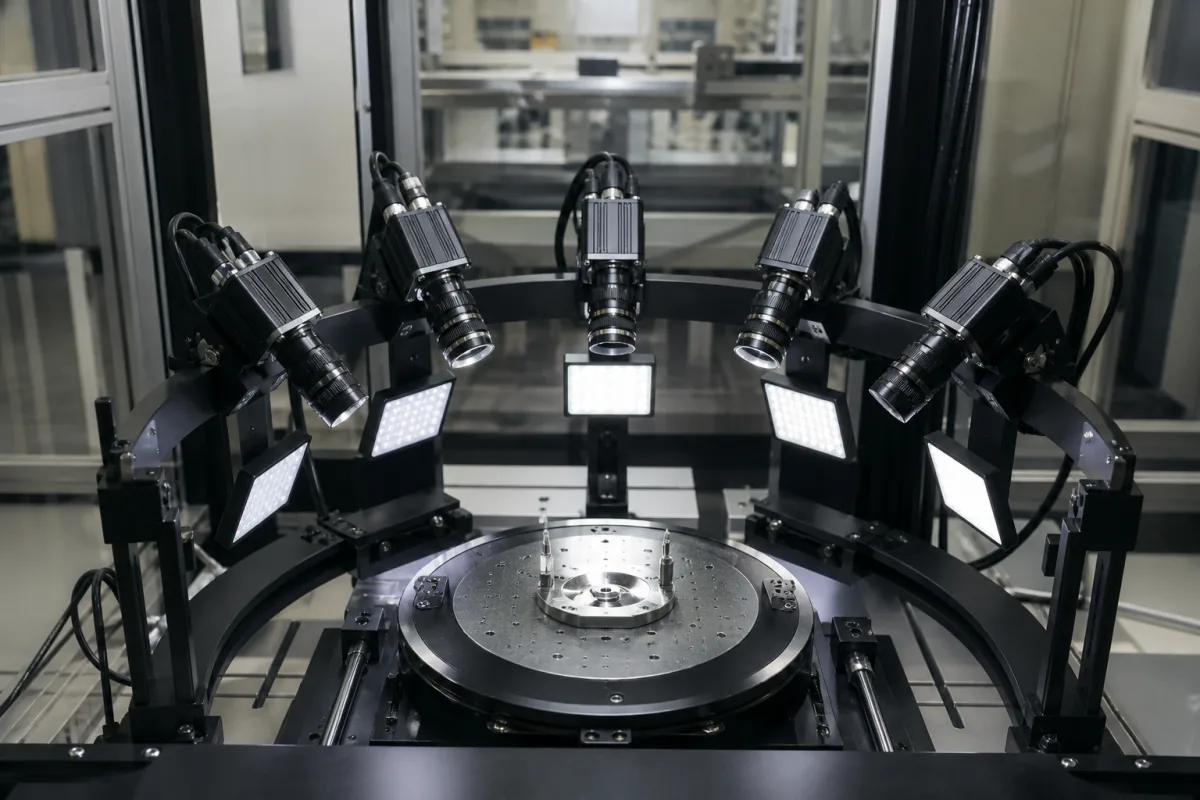
High-Resolution Camera Array

Based on aggregated insights from multiple verified factory profiles within the CNFX directory, the standard High-Resolution Camera Array used in the Computer, Electronic and Optical Product Manufacturing sector typically supports operational capacities ranging from standard industrial configurations to heavy-duty production requirements.

Technical Definition & Core Assembly

A canonical High-Resolution Camera Array is characterized by the integration of Image Sensor and Lens Assembly. In industrial production environments, manufacturers listed on CNFX commonly emphasize Optical-grade glass lenses construction to support stable, high-cycle operation across diverse manufacturing scenarios.

A multi-camera imaging system designed for capturing detailed visual data of printed circuit boards during optical inspection.

Product Specifications

Technical details and manufacturing context for High-Resolution Camera Array

Definition
A critical component within an Automated Printed Circuit Board (PCB) Optical Inspection System, the High-Resolution Camera Array consists of multiple synchronized, high-precision cameras arranged to capture comprehensive, high-fidelity images of PCBs. Its primary role is to provide the raw visual data necessary for automated defect detection algorithms to identify manufacturing flaws such as solder bridging, missing components, misalignment, and trace defects.
Working Principle
The array operates by synchronizing multiple high-resolution cameras, often with specialized lenses and lighting, to capture overlapping or tiled images of a PCB as it moves through the inspection station. These images are stitched together or analyzed individually by software to create a complete, detailed digital representation of the board's surface for automated analysis against design specifications.
Common Materials
Optical-grade glass lenses, Aluminum alloy housing, CMOS/CCD image sensors, Copper wiring
Technical Parameters
  • The resolution of individual cameras within the array, determining the level of detail captured per image frame. (megapixels) Customizable
Components / BOM
  • Image Sensor
    Converts optical images into electronic signals
    Material: Silicon
  • Lens Assembly
    Focuses light onto the image sensor with minimal distortion
    Material: Optical glass, aluminum
  • Camera Housing
    Protects internal components and provides mounting interface
    Material: Aluminum alloy
  • Synchronization Interface
    Coordinates trigger signals across all cameras in the array
    Material: Copper, plastic
Engineering Reasoning
0.5-2.0 m focal distance, 400-700 nm wavelength sensitivity, 20-30°C operating temperature
Lens thermal expansion exceeding 15 μm at 50°C, CMOS sensor temperature exceeding 85°C, image distortion exceeding 0.1% pixel displacement
Design Rationale: Coefficient of thermal expansion mismatch between borosilicate glass lenses (3.25×10⁻⁶/K) and aluminum housing (23.1×10⁻⁶/K) causing mechanical stress and focal plane shift
Risk Mitigation (FMEA)
Trigger Ambient temperature fluctuation exceeding 5°C/min
Mode: Thermal lensing effect causing 0.05 mm focal shift
Strategy: Active thermal stabilization with Peltier elements maintaining ±0.1°C control
Trigger Vibration at 120 Hz resonance frequency exceeding 0.5 g acceleration
Mode: Image blur exceeding 3 pixels RMS at 5 ms exposure
Strategy: Viscous damping mounts with 0.7 critical damping ratio and 40 Hz natural frequency isolation

Industry Taxonomies & Aliases

Commonly used trade names and technical identifiers for High-Resolution Camera Array.

Industrial Ecosystem & Supply Chain DNA

Complementary Systems
Downstream Applications
Specialized Tooling

Application Fit & Sizing Matrix

Operational Limits
pressure: Atmospheric only (non-pressurized system)
other spec: Illumination: 500-700 nm wavelength, 1000-3000 lux intensity; Vibration tolerance: <0.5G at 10-100 Hz
temperature: 15°C to 35°C (operating), 0°C to 50°C (storage)
Media Compatibility
✓ Clean room environments (ISO Class 5-7) ✓ PCB assembly lines with controlled lighting ✓ Automated optical inspection (AOI) stations
Unsuitable: High-vibration industrial environments (e.g., stamping presses, heavy machinery adjacent)
Sizing Data Required
  • PCB maximum dimensions (length x width)
  • Required inspection resolution (microns/pixel)
  • Production line speed (boards/minute)

Reliability & Engineering Risk Analysis

Failure Mode & Root Cause
Image Sensor Degradation
Cause: Thermal stress from continuous operation leading to pixel defects, dark current increase, and reduced sensitivity; accelerated by poor thermal management and environmental contaminants.
Lens System Contamination
Cause: Accumulation of dust, moisture, or chemical deposits on optical surfaces due to inadequate sealing, improper environmental controls, or maintenance-induced contamination during cleaning.
Maintenance Indicators
  • Persistent image artifacts (e.g., dead pixels, streaks, or blurring) unresponsive to recalibration or cleaning
  • Unusual audible noises (e.g., grinding from cooling fans or lens motors) or overheating indicated by thermal alarms
Engineering Tips
  • Implement predictive maintenance via thermal monitoring and periodic image quality metrics analysis to detect early degradation trends
  • Establish controlled environment protocols with proper filtration, humidity control, and strict cleaning procedures using approved optical-grade materials

Compliance & Manufacturing Standards

Reference Standards
ISO 12233:2017 (Photography - Electronic still-picture imaging - Resolution and spatial frequency responses) ANSI/IEC 60747-5-5 (Optoelectronic devices - Photocouplers) DIN EN 60950-1 (Information technology equipment - Safety)
Manufacturing Precision
  • Lens alignment: +/-0.005° angular deviation
  • Sensor flatness: 0.02mm across array surface
Quality Inspection
  • MTF (Modulation Transfer Function) testing for optical resolution
  • Thermal cycling test (-20°C to +70°C) for environmental durability

Factories Producing High-Resolution Camera Array

Verified manufacturers with capability to produce this product in China

✓ 98% Supplier Capability Match Found

P Procurement Specialist from Singapore Jan 15, 2026
★★★★★
"The High-Resolution Camera Array we sourced perfectly fits our Computer, Electronic and Optical Product Manufacturing production line requirements."
Technical Specifications Verified
T Technical Director from Germany Jan 12, 2026
★★★★★
"Found 35+ suppliers for High-Resolution Camera Array on CNFX, but this spec remains the most cost-effective."
Technical Specifications Verified
P Project Engineer from Brazil Jan 09, 2026
★★★★★
"The technical documentation for this High-Resolution Camera Array is very thorough, especially regarding technical reliability."
Technical Specifications Verified
Verification Protocol

“Feedback is collected from verified sourcing managers during RFQ (Request for Quote) and factory evaluation processes on CNFX. These reports represent historical performance data and technical audit summaries from our B2B manufacturing network.”

8 sourcing managers are analyzing this specification now. Last inquiry for High-Resolution Camera Array from Brazil (1h ago).

Supply Chain Compatible Machinery & Devices

Industrial IoT Gateway

Edge computing device connecting industrial equipment to cloud platforms.

Explore Specs →
Modular Industrial Edge Computing Device

Rugged computing platform for industrial data processing at the network edge

Explore Specs →
Industrial Smart Camera Module

Embedded vision system for industrial automation and quality inspection.

Explore Specs →
Industrial Wireless Power Transfer Module

Wireless power transfer module for industrial equipment applications

Explore Specs →

Frequently Asked Questions

What is the primary application of this high-resolution camera array?

This camera array is specifically designed for optical inspection of printed circuit boards (PCBs) in electronics manufacturing, capturing detailed visual data to detect defects, verify component placement, and ensure quality control during production.

How does the multi-camera synchronization improve PCB inspection?

The synchronization interface ensures all cameras capture images simultaneously, providing consistent, time-aligned visual data across the entire PCB surface. This eliminates timing discrepancies that could cause inspection errors and allows for comprehensive coverage of large or complex circuit boards.

What advantages do optical-grade glass lenses provide for electronic component inspection?

Optical-grade glass lenses deliver superior clarity, minimal distortion, and precise light transmission, enabling the detection of microscopic defects on PCBs such as solder bridges, component misalignment, and trace imperfections that lower-quality lenses might miss.

Can I contact factories directly on CNFX?

CNFX is an open directory, not a transaction platform. Each factory profile provides direct contact information and production details to help you initiate direct inquiries with Chinese suppliers.

Get Quote for High-Resolution Camera Array

Request technical pricing, lead times, or customized specifications for High-Resolution Camera Array directly from verified manufacturing units.

Your business information is encrypted and only shared with verified High-Resolution Camera Array suppliers.

Thank you! Your message has been sent. We'll respond within 1–3 business days.

Need to Manufacture High-Resolution Camera Array?

Connect with verified factories specializing in this product category

Add Your Factory Contact Us
Previous Product
High-Purity Silicon Wafer Substrate
Next Product
High-Resolution Medical Display