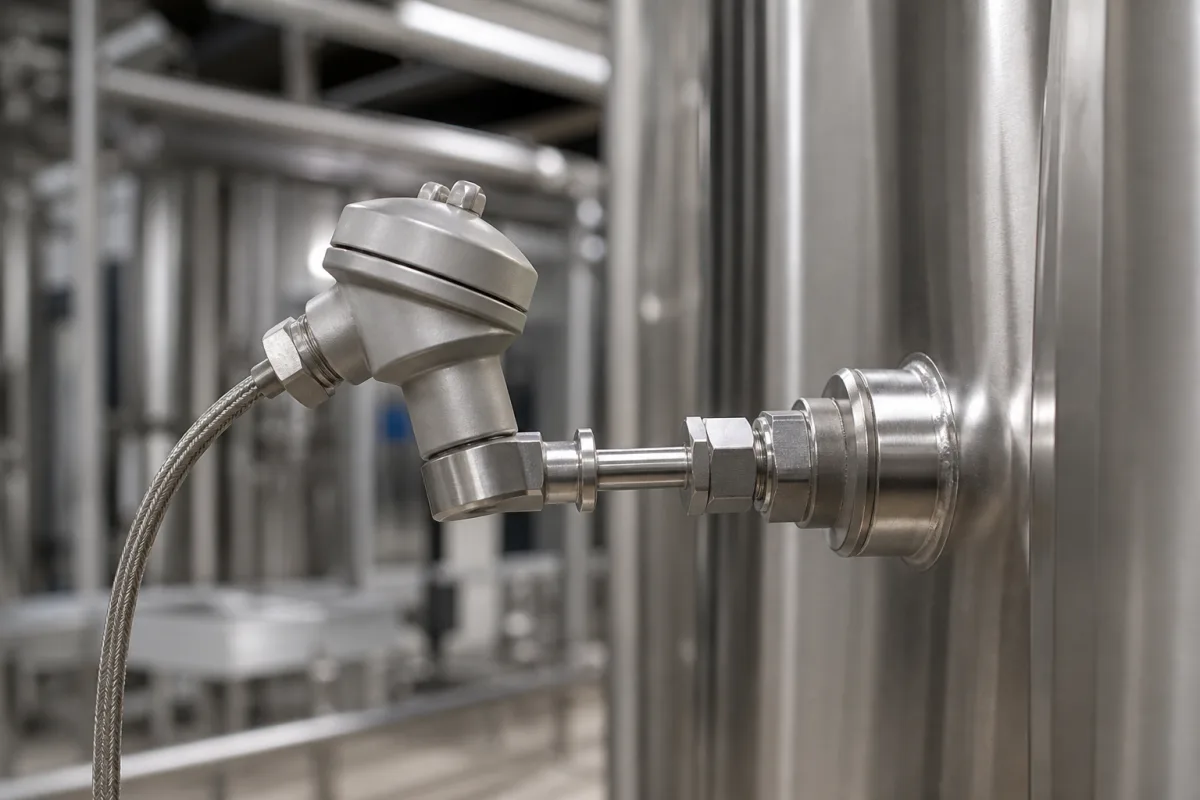
Temperature sensor probes · Pt100 tolerance class, response time with and without thermowell, immersion length, 2- vs 4-wire
A temperature sensor probe places a sensing element, such as a Pt100 platinum resistance (RTD) in a stainless steel sheath, in a process or space and converts temperature into a resistance or signal; process probes like the one pictured add a terminal head and may be fitted in a thermowell. Ask three things first: which tolerance class the element meets and over what range, how fast the probe responds as it will be installed, and whether the immersion length and wiring method allow the stated accuracy.
Resistance thermometer (Pt100 RTD) probes and assemblies with terminal heads or cables for process, machinery and building use, and temperature probes with NTC elements or wireless transmitters. Thermocouples, infrared thermometers, temperature controllers and stand-alone thermowells are outside this page.
CNFX editorial research · Sources checked October 19, 2026 · 4 sources
IEC 60751 Class AA, A or B, and why 4-wire connection matters
Endress+Hauser's technical information for its TMT162R RTD assembly lists IEC 60751 tolerances for wire-wound Pt100 elements: Class AA (formerly 1/3 Class B) ±(0.10 + 0.0017|t|) °C from 0 to 250 °C, Class A ±(0.15 + 0.002|t|) °C and Class B ±(0.3 + 0.005|t|) °C from −200 to +600 °C, where |t| is the absolute temperature value in °C. It notes that 4-wire connection makes the measurement independent of cable properties and is presumed for Class A and 1/3 DIN B accuracy. [1]
Editorial calculation: at 100 °C those classes allow ±0.27 °C (AA), ±0.35 °C (A) and ±0.8 °C (B); at 300 °C, Class A allows ±0.75 °C and Class B ±1.8 °C. The figures are for the element; installation and the transmitter add their own errors.
The TST90 datasheet shows the effect of 2-wire connection: lead resistance to compensate of 0.06 Ω per metre of each conductor for the straight-tip insert (0.12 Ω/m for the reduced tip). Editorial calculation: 10 m of 2-wire connection on the straight tip adds about 2 × 10 × 0.06 = 1.2 Ω in series with the sensor unless compensated, which is why 3- or 4-wire connection is preferred for accuracy. [2]
Give the supplier the measuring range, required accuracy (tolerance class) at your operating temperature, sensor element and number of elements, wiring (2, 3 or 4 wire), response time needed, immersion and insertion lengths, sheath diameter and material, thermowell and process connection, process pressure, flow and vibration, head or cable, transmitter output, ingress protection and hazardous-area approvals.
02
Check response time and immersion as installed
Endress+Hauser quotes response times in water flowing at 0.4 m/s per IEC 60751. Its TST40N assembly reaches 90% of a step (t90) in 8 s with a 6 mm sheath and 6 s with 3 mm. Its TST90 assembly, with a 6 mm insert inside a thermowell, needs t90 = 72 s with a straight-tip thermowell but 20.5 s with a reduced tip (t50 = 24 s and 7.5 s). The TMT162R assembly without thermowell and transmitter gives t90 = 8 s for a 10 K step. [3][2][1]
The TST90 and TST40N datasheets state that for correct measurement the immersion length must be 20 times the thermowell or insert diameter, to avoid errors from heat conducted away through the process connection; shorter lengths need external insulation of the connection, neck and head. The TMT162R information adds that in pipes with a small cross-section the sensor tip should reach or extend slightly past the pipe centreline, and that thermowell load limits depend on pressure, flow velocity, density, temperature and immersion. [2][3][1]
Editorial calculation: a 9 mm thermowell needs about 20 × 9 = 180 mm immersion by that rule, and a 6 mm insert used without a thermowell about 120 mm; in a small pipe that may require an elbow or tilted installation.
03
Limit self-heating from the measuring current
The current that reads an RTD also heats it. A 2025 study by Otomański, Pawłowski and Szlachta (Polish universities of technology, Sensors) measured the thermal resistance between sensor and surroundings as the slope of indicated temperature against heating power, in still air. They recommend choosing the measuring current so that self-heating does not exceed 25% of the sensor's declared tolerance, and they note that the external thermal resistance depends on heat transfer between the sheath and its medium, so it should be found in situ. [4]
Editorial calculation: Class A allows ±0.15 °C at 0 °C, so the 25% rule leaves 0.0375 °C for self-heating; with the steel-cased Pt100's 0.061 K/mW in still air, that permits about 0.61 mW, or about 2.5 mA through 100 Ω. [1][4] Editorial note: the same sensor in flowing liquid has a lower external thermal resistance than in still air, so ask the supplier for the self-heating coefficient in your medium and the transmitter's excitation current.
Pt100 process assemblies against NTC and wireless probes
The Endress+Hauser data on this page describe Pt100 assemblies to IEC 60751 tolerance classes [1]; the linked makers also offer NTC thermistor probes and Zigbee wireless sensors with external probes, which are specified by thermistor curve or by the radio device rather than by an IEC 60751 class. Ask which element is inside before comparing accuracy.
For each probe ask for the sensing element and its tolerance class or curve, the response time and its test conditions, insulation resistance, and the sheath material and diameter.
05
Element, mineral-insulated insert, sheath, thermowell and head
Explore company information and manufacturing capabilities, then discuss the scope of your project with a relevant supplier.
Share this page
Compiled and source-reviewed by the CNFX editorial team.
Each manufacturer above links to the page on that company's own website where the product is listed, with the date we checked it. How we source and review
· Page last updated 13 October 2026
Buyer questions
What is the accuracy of a Class A Pt100?
Endress+Hauser lists ±(0.15 + 0.002|t|) °C under IEC 60751, about ±0.35 °C at 100 °C (editorial calculation). [1]
How much does a thermowell slow a probe?
Endress+Hauser's TST90 reaches 90% of a step in 72 s with a straight-tip thermowell and 20.5 s with a reduced tip. [2]
How deep should a temperature probe be immersed?
Endress+Hauser's datasheets call for an immersion length of 20 times the thermowell or insert diameter. [2][3]
How much measuring current can a Pt100 take?
Otomański et al. recommend keeping self-heating under 25% of the tolerance; a steel-cased Pt100 in still air read 0.006 °C high at 1 mA and 1 °C high at 12.8 mA. [4]
Sources and what still needs a direct check
Sources checked 2026-10-19. Endress+Hauser is a process instrument maker; its technical information sheets give tolerance classes to IEC 60751 and response and installation data for its own assemblies. A 2025 peer-reviewed study from Polish universities of technology gives measured self-heating data.