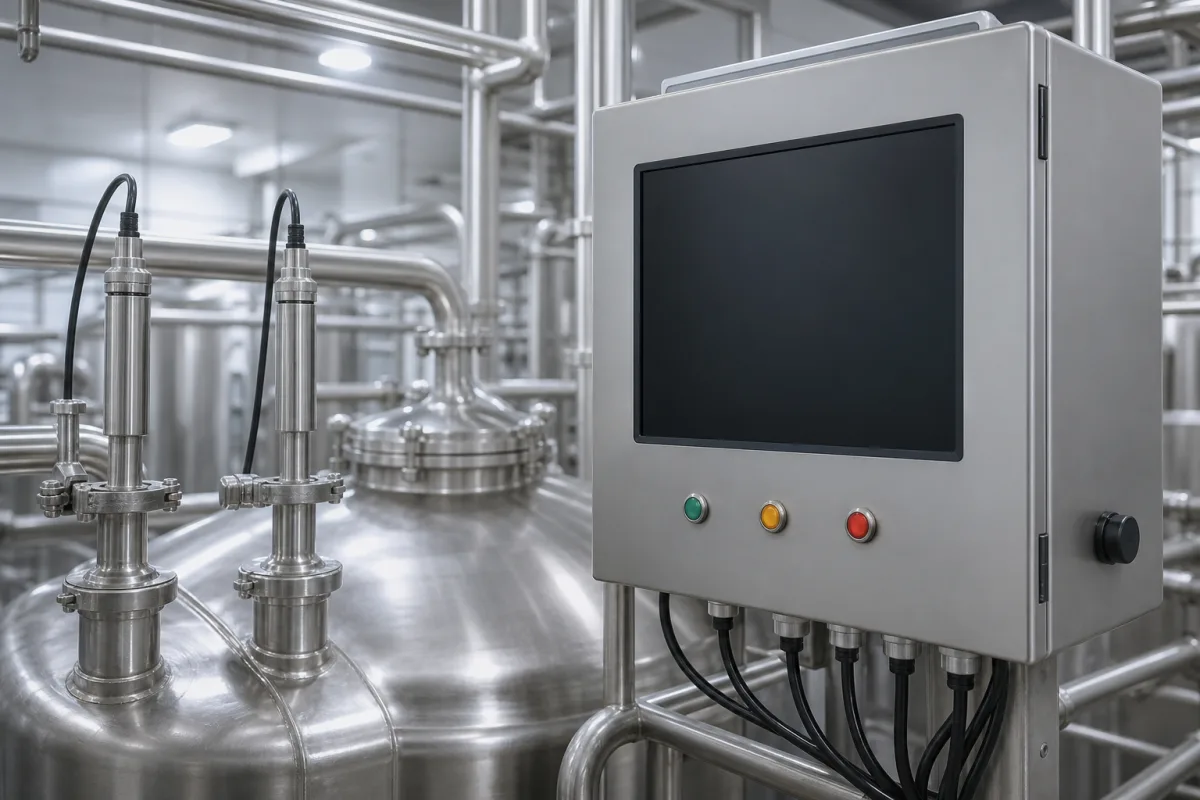
Temperature monitoring system (hygienic temperature measuring points that check their own drift on food and dairy lines)
Temperature monitoring points on hygienic food, dairy and pharma lines · sensor drift between calibrations, in-process self-calibration against a Curie-point reference at 118 °C or 39 °C, 316L builds and hygienic certificates with expiry dates, and calibration records for audits
On a hygienic process line the temperature reading can be the evidence that a product was pasteurised or a plant was cleaned. The monitoring system is the set of sensors, their connections and the records behind them. Specify it by the risk you are covering: how long a drifting sensor could go unnoticed, whether the sensor can be checked without removing it, what hygienic build and certificates it carries, and how calibration results reach the batch record.
Temperature measuring points on hygienic food, dairy, beverage and pharmaceutical lines, specified for drift detection, in-process calibration, hygienic construction and calibration records. General Pt100 probe selection is covered on the Temperature sensor probes (Pt100 RTD assemblies) page; process RTD and thermocouple assemblies on the Industrial temperature probe page; thermowells on the Thermowell page; stand-alone loggers on the Data logger page; cryogenic chilling control on meat grinders on the Industrial meat grinder with cryogenic cooling page; relay trip units on the Temperature alarm module page.
CNFX editorial research · Sources checked October 12, 2026 · 4 sources
Drift between calibrations, and sensors that check themselves in the process
Endress+Hauser's TrustSens brochure states that "All temperature sensors, including Pt100, are subject to aging and drift", and that when a deviation is found at a periodic check the plant faces the question of when it started and which batches are affected. Its iTHERM TrustSens places a reference sensor beside the Pt100; the exact Curie temperature of that reference, "118 or 39 °C / 244 or 102 °F", is determined for each device and documented in its calibration certificate. "Every time the process temperature passes the integrated Curie reference point, e.g. after every cleaning process, the device performs a fully traceable, certified self-calibration." [1]
Reinraum.de's report on the launch quotes Endress+Hauser that the sensor "primarily helps plant operators minimize the risk of undetected measurement deviations of the Pt100 sensor", and describes the comparison: when the Curie temperature is reached the reference sends a signal, and if the Pt100 reads within tolerance at that moment it counts as calibrated. [2]
Reference point
Where the brochure places it
When it calibrates
Source
118 °C (244 °F)
UHT milk; SIP; autoclaves
When the UHT process stops before CIP, "typically with every batch"
For each measuring point, state the process temperatures it passes through during production and cleaning, so the supplier can show whether a reference point will be crossed and how often.
02
Hygienic build and certificates you can check
Anderson-Negele builds its hygienic temperature sensors entirely in stainless steel, 1.4404 (316L) for food and beverage and 1.4435 (316L) for pharmaceutical use, with electropolished finishes available, single or dual Pt100 elements, accuracy "up to ±0.1 K (model dependent)", insertion lengths from 1 1/8" to 43 1/2", and "Reduced measuring tips (3 mm or 4 mm) for faster t50 and t90 response times". Front-flush versions keep the flow unobstructed; thermowell versions let the sensor be removed without opening the process. [3]
Hygienic certificates carry dates. The EHEDG certificate EHEDG-C2000057 for JUMO's dTRANS T100 and T1000 sensors, DELOS T switch and hygienic thermowells type 902812 for RTD probes type 902810 was issued on 28 September 2020 and is "Valid until: 31 December 2021". [4] Endress+Hauser lists hygienic, food-safety and installation approvals for TrustSens in its brochure. [1]
Ask for the certificate number and its valid-until date for the exact sensor, connection and thermowell ordered, and for t50/t90 with the test medium and flow stated.
03
Getting calibration results into the record
Endress+Hauser pairs TrustSens with a Memograph M RSG45 data manager for "Automated recording of self- calibration events", tamper-proof certificate creation and storage and up to 20 HART devices, and with Field Data Manager software for batch reports and calibration history; a RIA15 indicator shows the calibration counter and the last measured deviation. [1]
For legal pasteurisation, Anderson-Negele offers an FD digital reference thermometer described as PMO compliant and suitable for retort cookers, and an FH digital gauge as a replacement for mercury-in-glass thermometers. [3]
04
Hygienic temperature point details
Paste it into your enquiry below or into an email to a maker, then replace every bracket.
Process: [pasteuriser; UHT; CIP; SIP; tank]
Temperatures: [operating; cleaning; reference point crossed]
Sensor: [Pt100 single/dual; accuracy; tip diameter; t90 test basis]
Build: [316L grade; finish; front-flush or thermowell]
Certificates: [3-A; EHEDG number and validity; FDA]
Calibration: [self-calibration; interval; certificate]
Records: [data manager; HART; batch report]
Explore company information and manufacturing capabilities, then discuss the scope of your project with a relevant supplier.
Share this page
Compiled and source-reviewed by the CNFX editorial team.
Each manufacturer above links to the page on that company's own website where the product is listed, with the date we checked it. How we source and review
· Page last updated 13 October 2026
Buyer questions
How can a sensor calibrate itself?
TrustSens compares its Pt100 with a reference whose Curie temperature (118 °C or 39 °C) is fixed and certified, each time the process passes that point. [1][2]
How often does that happen?
Endress+Hauser gives "typically with every batch" for 118 °C UHT and SIP, and "typically several times a week" for 39 °C CIP. [1]
Which stainless grades are used?
Anderson-Negele uses 1.4404 (316L) for food and beverage and 1.4435 (316L) for pharmaceutical sensors. [3]
Is an EHEDG certificate permanent?
No; the JUMO certificate EHEDG-C2000057 shows a valid-until date of 31 December 2021. [4]
Sources and what still needs a direct check
Sources checked 2026-10-12. Endress+Hauser publishes the iTHERM TrustSens brochure; reinraum.de reported its launch; Anderson-Negele publishes its hygienic temperature sensor range; EHEDG publishes equipment certificates.