Industry-Verified Manufacturing Data (2026)

Test Probe Assembly

Based on aggregated insights from multiple verified factory profiles within the CNFX directory, the standard Test Probe Assembly used in the Computer, Electronic and Optical Product Manufacturing sector typically supports operational capacities ranging from standard industrial configurations to heavy-duty production requirements.

Technical Definition & Core Assembly

A canonical Test Probe Assembly is characterized by the integration of Probe Tip and Spring Mechanism. In industrial production environments, manufacturers listed on CNFX commonly emphasize Beryllium Copper construction to support stable, high-cycle operation across diverse manufacturing scenarios.

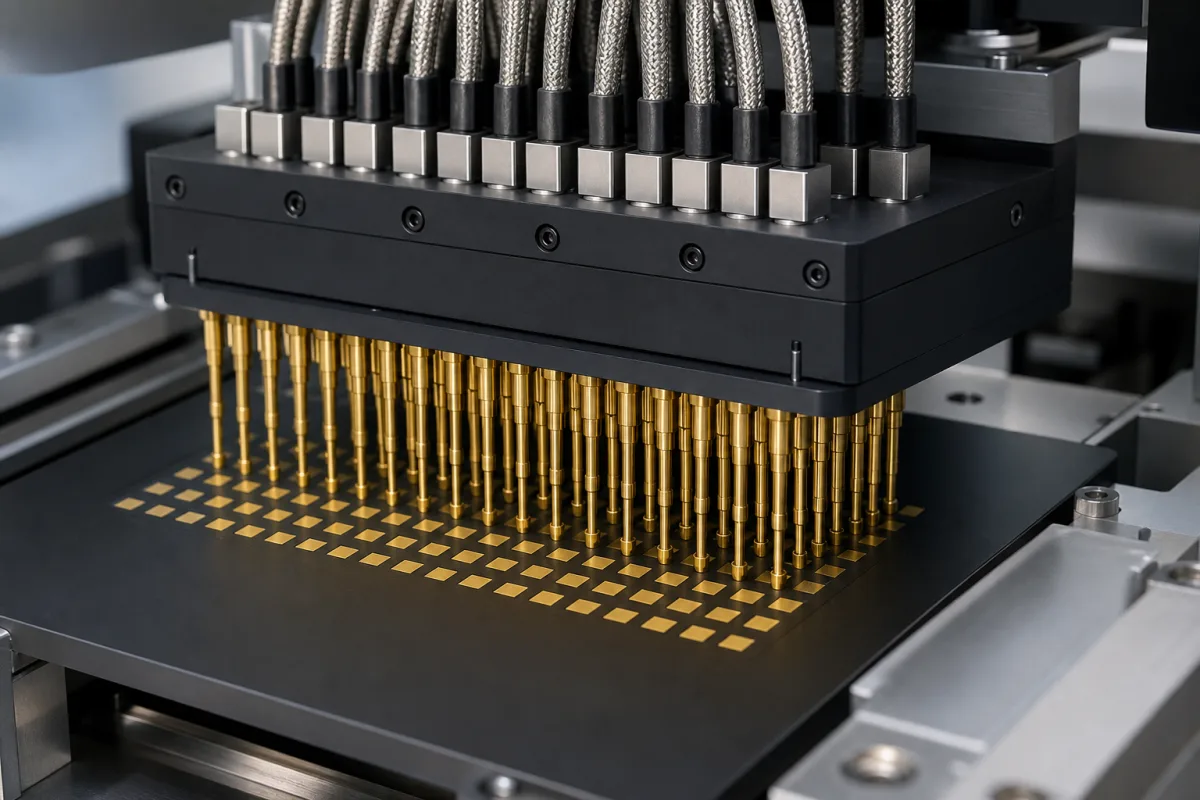
A precision assembly of electrical probes used for making temporary electrical connections to test points on electronic devices or circuits.
Product Specifications

Technical details and manufacturing context for Test Probe Assembly

Definition
A critical component within the Electrical Testing Module that consists of multiple spring-loaded or fixed-position probes arranged in a specific configuration to interface with test points on printed circuit boards (PCBs), semiconductor wafers, or other electronic assemblies during electrical testing procedures.
Working Principle
The assembly makes physical and electrical contact with designated test points on a device under test (DUT). When pressed against the DUT, the probes complete electrical circuits, allowing test equipment to measure voltage, current, resistance, or signal integrity at specific locations.
Common Materials
Beryllium Copper, Phosphor Bronze, Tungsten Carbide, Gold-plated Tips
Technical Parameters
  • Probe tip diameter and pitch spacing between probes (mm) Per Request
Components / BOM
  • Probe Tip
    Makes direct electrical contact with test point on device under test
    Material: Tungsten Carbide or Gold-plated Beryllium Copper
  • Spring Mechanism
    Provides consistent contact force and allows vertical compliance
    Material: Stainless Steel or Beryllium Copper
  • Probe Body/Housing
    Holds probe components in precise alignment and provides electrical insulation
    Material: Ceramic or High-temperature Plastic
  • Mounting Plate/PCB
    Secures multiple probes in specific pattern and provides electrical connections to test equipment
    Material: FR4 PCB or Aluminum Plate
Engineering Reasoning
0.1-10 N contact force, 0.5-1000 VDC, -40°C to 125°C ambient temperature
Contact resistance exceeding 50 mΩ at 1 A test current, probe tip wear exceeding 0.05 mm from original geometry, insulation breakdown at 1500 VAC
Design Rationale: Electromigration at probe tips due to current density exceeding 10⁶ A/cm², mechanical fatigue from cyclic loading during repeated insertions, dielectric breakdown at 3×10⁶ V/m electric field strength
Risk Mitigation (FMEA)
Trigger Electrostatic discharge exceeding 8 kV human body model
Mode: Insulation breakdown between adjacent probe pins
Strategy: Integrated spark gap protection with 500 μm gap spacing on probe substrate
Trigger Probe tip oxidation at temperatures above 85°C in humid environments (>60% RH)
Mode: Contact resistance increase beyond 100 mΩ
Strategy: Gold plating with minimum 0.5 μm thickness over nickel underplate

Industry Taxonomies & Aliases

Commonly used trade names and technical identifiers for Test Probe Assembly.

Applied To / Applications

This component is essential for the following industrial systems and equipment:

Industrial Ecosystem & Supply Chain DNA

Complementary Systems
Downstream Applications
Specialized Tooling

Application Fit & Sizing Matrix

Operational Limits
pressure: 0 to 5 N per probe tip
other spec: Contact resistance: <50 mΩ, Insulation resistance: >100 MΩ
temperature: -40°C to +125°C
Media Compatibility
✓ PCB test points ✓ IC pins and pads ✓ Conductive surfaces (gold, tin, copper)
Unsuitable: Corrosive or abrasive slurry environments
Sizing Data Required
  • Target test point pitch/diameter (mm)
  • Required number of simultaneous contact points
  • Maximum allowable contact force per probe (N)

Reliability & Engineering Risk Analysis

Failure Mode & Root Cause
Contact wear/deformation
Cause: Repeated mechanical stress from insertion/removal cycles, material fatigue, or improper alignment causing localized pressure points
Signal degradation/electrical noise
Cause: Oxidation/corrosion of contact surfaces, contamination buildup (dust, oils), or insulation breakdown from environmental exposure (moisture, chemicals)
Maintenance Indicators
  • Inconsistent or fluctuating measurement readings during testing
  • Visible physical damage (bent pins, cracked housing) or audible clicking/grinding during probe insertion
Engineering Tips
  • Implement regular cleaning protocols with appropriate solvents and contact conditioning treatments to prevent oxidation buildup
  • Establish calibrated insertion force limits and alignment guides to prevent mechanical overstress during assembly/disassembly cycles

Compliance & Manufacturing Standards

Reference Standards
ISO 9001:2015 Quality Management Systems ASTM E1255-21 Standard Practice for Radioscopy CE Marking (EU Directive 2014/35/EU for Electrical Equipment)
Manufacturing Precision
  • Tip Diameter: +/-0.01mm
  • Spring Force: +/-5% of nominal value
Quality Inspection
  • Electrical Continuity and Resistance Test
  • Dimensional Verification with Coordinate Measuring Machine (CMM)

Factories Producing Test Probe Assembly

Verified manufacturers with capability to produce this product in China

✓ 97% Supplier Capability Match Found

P Project Engineer from Canada Jan 25, 2026
★★★★★
"Testing the Test Probe Assembly now; the technical reliability results are within 1% of the laboratory datasheet."
Technical Specifications Verified
S Sourcing Manager from United States Jan 22, 2026
★★★★★
"Impressive build quality. Especially the technical reliability is very stable during long-term operation."
Technical Specifications Verified
P Procurement Specialist from United Arab Emirates Jan 19, 2026
★★★★★
"As a professional in the Computer, Electronic and Optical Product Manufacturing sector, I confirm this Test Probe Assembly meets all ISO standards."
Technical Specifications Verified
Verification Protocol

“Feedback is collected from verified sourcing managers during RFQ (Request for Quote) and factory evaluation processes on CNFX. These reports represent historical performance data and technical audit summaries from our B2B manufacturing network.”

13 sourcing managers are analyzing this specification now. Last inquiry for Test Probe Assembly from Brazil (1h ago).

Supply Chain Compatible Machinery & Devices

Industrial Smart Camera Module

Embedded vision system for industrial automation and quality inspection.

Explore Specs →
Industrial Wireless Power Transfer Module

Wireless power transfer module for industrial equipment applications

Explore Specs →
Industrial Smart Sensor Module

Modular industrial sensor with embedded processing and wireless connectivity

Explore Specs →
Surface Mount Resistor

Passive electronic component for current limiting and voltage division in circuits

Explore Specs →

Frequently Asked Questions

What materials are used in this test probe assembly and why?

This assembly uses Beryllium Copper and Phosphor Bronze for excellent spring properties and conductivity, Tungsten Carbide for durable probe tips, and gold-plated tips to prevent oxidation and ensure reliable electrical connections during testing.

What are the main components of this test probe assembly?

The assembly consists of four key components: Probe Tip for making electrical contact, Spring Mechanism for consistent pressure, Probe Body/Housing for structural integrity, and Mounting Plate/PCB for secure installation in test fixtures.

How does this test probe assembly benefit electronic manufacturing testing?

It provides precise, temporary electrical connections to test points on electronic devices and circuits, enabling accurate testing during manufacturing. The durable materials and spring mechanism ensure consistent performance and longevity in production environments.

Can I contact factories directly on CNFX?

CNFX is an open directory, not a transaction platform. Each factory profile provides direct contact information and production details to help you initiate direct inquiries with Chinese suppliers.

Get Quote for Test Probe Assembly

Request technical pricing, lead times, or customized specifications for Test Probe Assembly directly from verified manufacturing units.

Your business information is encrypted and only shared with verified Test Probe Assembly suppliers.

Thank you! Your message has been sent. We'll respond within 1–3 business days.

Need to Manufacture Test Probe Assembly?

Connect with verified factories specializing in this product category

Add Your Factory Contact Us
Previous Product
Test Probe Array
Next Product
Test Probe Fixture