Industry-Verified Manufacturing Data (2026)

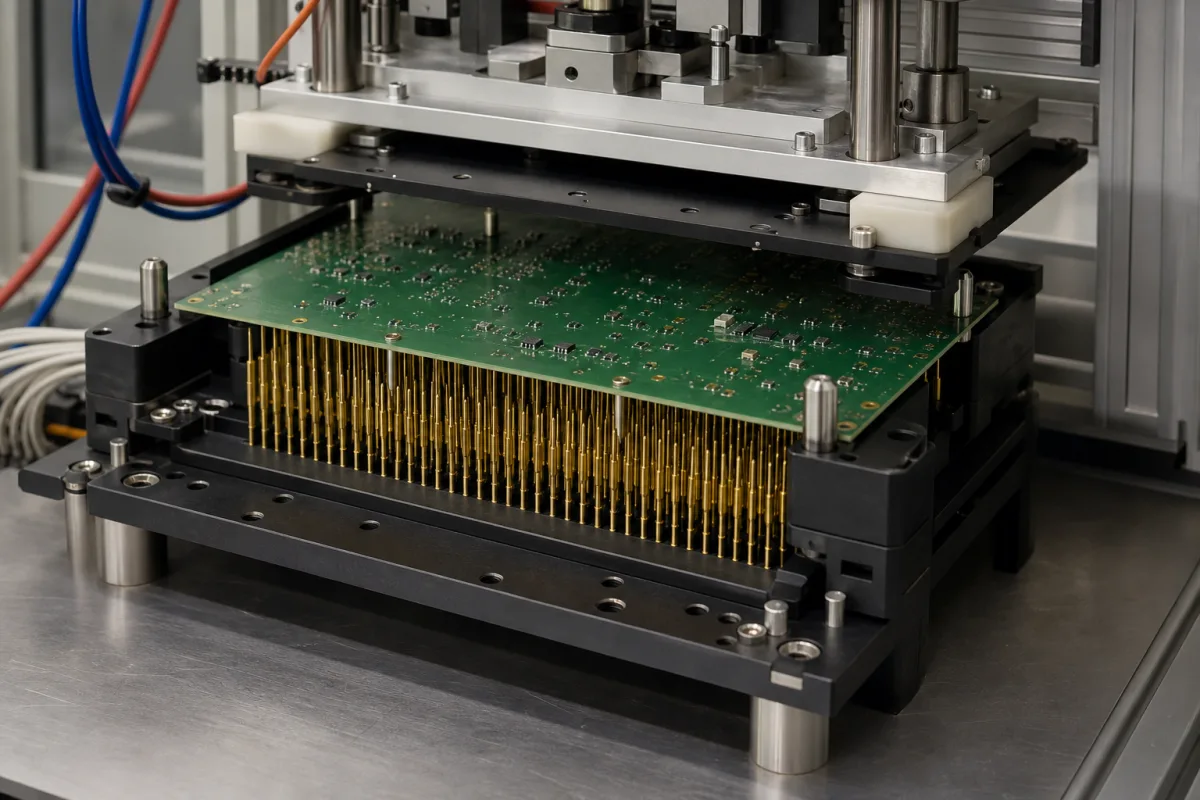
Test Probe Array

Based on aggregated insights from multiple verified factory profiles within the CNFX directory, the standard Test Probe Array used in the Computer, Electronic and Optical Product Manufacturing sector typically supports operational capacities ranging from standard industrial configurations to heavy-duty production requirements.

Technical Definition & Core Assembly

A canonical Test Probe Array is characterized by the integration of Probe Tip and Probe Body. In industrial production environments, manufacturers listed on CNFX commonly emphasize Beryllium Copper construction to support stable, high-cycle operation across diverse manufacturing scenarios.

A structured arrangement of electrical test probes designed for simultaneous contact with multiple test points on electronic devices or components.
Product Specifications

Technical details and manufacturing context for Test Probe Array

Definition
A critical component of an Electrical Test Station, the Test Probe Array consists of multiple precisely positioned electrical probes arranged in a specific pattern to interface with test points on printed circuit boards (PCBs), integrated circuits (ICs), or other electronic assemblies. It enables efficient, high-throughput electrical testing by providing simultaneous contact for signal transmission, power delivery, and measurement during functional testing, continuity checks, or parametric analysis.
Working Principle
The array aligns with predefined test points on the device under test (DUT). When engaged, each probe makes electrical contact, allowing test signals to be sent from the test station's instrumentation through the probes to the DUT, and responses to be measured back through the same probes. This parallel testing capability significantly reduces test time compared to sequential probing.
Common Materials
Beryllium Copper, Phosphor Bronze, Tungsten Carbide, PEEK (Polyether Ether Ketone)
Technical Parameters
  • Pitch distance between adjacent probes in the array (mm) Customizable
Components / BOM
  • Probe Tip
    Makes direct electrical contact with test points on the device under test
    Material: Tungsten Carbide or Beryllium Copper
  • Probe Body
    Houses the spring mechanism and provides structural support
    Material: Phosphor Bronze or Stainless Steel
  • Spring Mechanism
    Provides controlled contact force and allows for vertical compliance
    Material: Spring Steel
  • Mounting Plate
    Holds all probes in precise alignment and positions the array relative to the test fixture
    Material: Aluminum or PEEK
Engineering Reasoning
0.1-2.0 N per probe contact force, 0.5-5.0 mm probe travel distance, 10-1000 Ω contact resistance
Contact force exceeds 3.0 N causing substrate deformation >50 μm, probe travel exceeds 6.0 mm causing spring plastic deformation, contact resistance exceeds 5000 Ω at 10 mA test current
Design Rationale: Hooke's law violation in probe springs beyond elastic limit (Young's modulus 190 GPa for beryllium copper), Hertzian contact stress exceeding substrate yield strength (e.g., 300 MPa for FR-4), oxide layer formation (Arrhenius rate doubling per 10°C above 85°C ambient)
Risk Mitigation (FMEA)
Trigger Electrochemical migration due to ionic contamination (Na⁺, K⁺, Cl⁻ > 1.0 μg/cm²) under humidity >60% RH
Mode: Short circuit between adjacent probes (resistance <10 Ω at 5 V bias)
Strategy: Conformal coating with parylene-C (2.5 μm thickness, dielectric strength 275 kV/mm) and nitrogen purging during storage
Trigger Probe tip wear exceeding 15 μm radius increase from initial 25 μm hemispherical geometry
Mode: Increased contact resistance (>200 Ω variation across array) and inconsistent test signal integrity (jitter >5 ns)
Strategy: Rhodium-over-nickel plating (50 μm Rh, hardness 800 HV) with automated probe force calibration every 10⁴ cycles

Industry Taxonomies & Aliases

Commonly used trade names and technical identifiers for Test Probe Array.

Applied To / Applications

This component is essential for the following industrial systems and equipment:

Industrial Ecosystem & Supply Chain DNA

Complementary Systems
Downstream Applications
Specialized Tooling

Application Fit & Sizing Matrix

Operational Limits
pressure: Max 5 N per probe
other spec: Contact resistance: <50 mΩ, Insulation resistance: >100 MΩ
temperature: -40°C to +125°C
Media Compatibility
✓ PCB test pads ✓ BGA solder balls ✓ Gold-plated contacts
Unsuitable: Corrosive chemical environments
Sizing Data Required
  • Number of test points
  • Pitch spacing between contacts
  • Required contact force per probe

Reliability & Engineering Risk Analysis

Failure Mode & Root Cause
Contact degradation
Cause: Oxidation or contamination buildup on probe tips due to exposure to environmental contaminants, moisture, or incompatible materials, leading to increased electrical resistance and signal loss.
Mechanical fatigue
Cause: Repeated insertion/retraction cycles or excessive mechanical stress causing bending, cracking, or breakage of probe shafts, often from misalignment, over-travel, or improper handling.
Maintenance Indicators
  • Inconsistent or intermittent electrical readings during testing
  • Visible physical damage such as bent probes, discolored tips, or debris accumulation
Engineering Tips
  • Implement regular cleaning with appropriate solvents and use protective caps when not in operation to prevent contamination and oxidation
  • Establish alignment verification procedures and use insertion guides to minimize mechanical stress during probe engagement

Compliance & Manufacturing Standards

Reference Standards
ISO 9001:2015 - Quality Management Systems ANSI/ESD S20.20 - Electrostatic Discharge Control Program DIN 4000-1 - Tabular Layouts of Article Characteristics
Manufacturing Precision
  • Tip Diameter: +/-0.005mm
  • Array Pitch Uniformity: +/-0.01mm
Quality Inspection
  • Electrical Continuity and Resistance Test
  • Dimensional Verification via Coordinate Measuring Machine (CMM)

Factories Producing Test Probe Array

Verified manufacturers with capability to produce this product in China

✓ 97% Supplier Capability Match Found

S Sourcing Manager from Canada Feb 06, 2026
★★★★★
"The Test Probe Array we sourced perfectly fits our Computer, Electronic and Optical Product Manufacturing production line requirements."
Technical Specifications Verified
P Procurement Specialist from United States Feb 03, 2026
★★★★☆
"Found 24+ suppliers for Test Probe Array on CNFX, but this spec remains the most cost-effective. (Delivery took slightly longer than expected, but technical support was excellent.)"
Technical Specifications Verified
T Technical Director from United Arab Emirates Jan 31, 2026
★★★★★
"The technical documentation for this Test Probe Array is very thorough, especially regarding technical reliability."
Technical Specifications Verified
Verification Protocol

“Feedback is collected from verified sourcing managers during RFQ (Request for Quote) and factory evaluation processes on CNFX. These reports represent historical performance data and technical audit summaries from our B2B manufacturing network.”

15 sourcing managers are analyzing this specification now. Last inquiry for Test Probe Array from Brazil (1h ago).

Supply Chain Compatible Machinery & Devices

Industrial IoT Gateway

Edge computing device connecting industrial equipment to cloud platforms.

Explore Specs →
Modular Industrial Edge Computing Device

Rugged computing platform for industrial data processing at the network edge

Explore Specs →
Industrial Smart Camera Module

Embedded vision system for industrial automation and quality inspection.

Explore Specs →
Industrial Wireless Power Transfer Module

Wireless power transfer module for industrial equipment applications

Explore Specs →

Frequently Asked Questions

What are the advantages of using beryllium copper in test probe arrays?

Beryllium copper offers excellent electrical conductivity, high strength, and good spring properties, making it ideal for durable, reliable probe contacts that maintain consistent performance over repeated use.

How does the spring mechanism in test probe arrays improve testing accuracy?

The spring mechanism provides consistent contact force, compensates for surface variations, and ensures reliable electrical connection across all test points simultaneously, reducing false readings and improving test repeatability.

What applications are test probe arrays commonly used for in electronics manufacturing?

Test probe arrays are essential for PCB testing, semiconductor wafer probing, connector verification, and functional testing of electronic assemblies where multiple test points need simultaneous electrical contact.

Can I contact factories directly on CNFX?

CNFX is an open directory, not a transaction platform. Each factory profile provides direct contact information and production details to help you initiate direct inquiries with Chinese suppliers.

Get Quote for Test Probe Array

Request technical pricing, lead times, or customized specifications for Test Probe Array directly from verified manufacturing units.

Your business information is encrypted and only shared with verified Test Probe Array suppliers.

Thank you! Your message has been sent. We'll respond within 1–3 business days.

Need to Manufacture Test Probe Array?

Connect with verified factories specializing in this product category

Add Your Factory Contact Us
Previous Product
Test Leads
Next Product
Test Probe Assembly