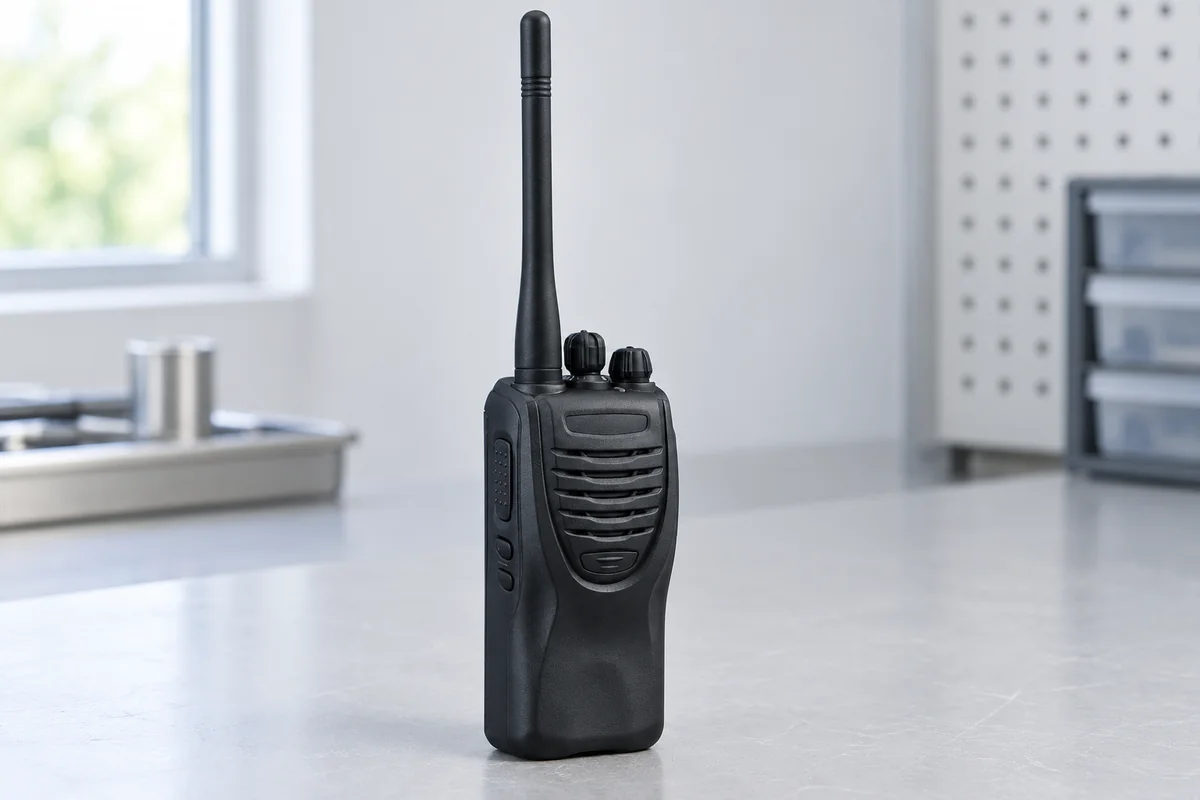
Portable two-way radio (walkie-talkie) · FRS or professional bands, VHF/UHF range, output power, analog or DMR digital, channels, ingress protection
A two-way radio is a handheld transceiver that lets a group talk on shared radio channels by pressing to talk. Ask three things first: whether Family Radio Service-type or professional radios suit the users and the country's rules, which band and output power cover the site, and whether analog, digital DMR or both modes are required.
Handheld two-way radios (walkie-talkies) for business, industrial and consumer voice communication, analog and DMR digital. Repeaters and base stations, vehicle-mounted radios, marine VHF radios, radio modules and push-to-talk-over-cellular handsets are outside this page.
CNFX editorial research · Sources checked October 11, 2026 · 6 sources
In the United States, 47 CFR 95.563 allots the Family Radio Service (FRS) 22 channels, each 12.5 kHz wide, at centre frequencies from 462.5500 to 462.7250 MHz and 467.5625 to 467.7125 MHz, shared with the General Mobile Radio Service (GMRS). Under § 95.567, FRS radios may radiate no more than 0.5 W ERP on channels 8–14 and 2.0 W ERP on channels 1–7 and 15–22. [1][2]
§ 95.587 requires FRS radios to transmit only on those channels, with a non-removable integral antenna whose gain does not exceed a half-wave dipole and which is vertically polarised in normal use; § 95.531 describes FRS as primarily short-distance two-way voice communication, with permitted location data and brief text messages. [3][4]
Professional radios can cover wider bands: AnyTone's AT-D890UV, for example, covers VHF 136–174 MHz, UHF 400–480 MHz and a 66–88 MHz low band, outside the FRS channel list. [6][1]
Give the supplier the country of use and licence held, frequency band and channel plan, analog or DMR mode and tier, output power, number of channels and zones, encryption, GPS or Bluetooth needs, ingress rating, battery capacity and runtime, accessories, programming software and certifications required.
02
Choose band, output power and analog or DMR mode
AnyTone lists the AT-D890UV at 7 W VHF and 6 W UHF with selectable 7/5/2.5/0.2 W levels, ETSI DMR Tier I and II compliance with one frequency carrying two simultaneous talk paths, analog scrambler and compander, air-band AM reception, a 1.77-inch colour display, USB-C and IP54. [6]
The DMR Association states DMR splits one channel into two, doubling capacity without new repeater sites or frequencies, and that its mission is to support ETSI in developing the DMR standard, focusing on commercial Tier II and Tier III. [5]
Editorial calculation: the FRS 2.0 W ERP limit is four times the 0.5 W limit on channels 8–14 (about 6 dB); the AT-D890UV's 7 W VHF maximum is 35 times its 0.2 W lowest setting. [2][6]
03
Compare what suppliers offer
The suppliers linked to this page list two-way radios or walkie-talkies; their cards link to the pages reviewed.
Ask any supplier for the frequency range and channel spacing, RF output power settings, analog and digital modes with DMR tier, channel and zone capacity, encryption, receiver sensitivity, battery capacity and runtime, ingress rating, dimensions and weight, programming software and radio-type approval for your country.
04
Trace what each part does
This is a functional reference built from the sources cited; it is not one maker's specification.
Fill the specification fields with values for your order
A two-way radio quotation needs values for your users. The table explains each field, gives published values where a reviewed source states them, and says what to obtain from the supplier.
Field
What it means and published values
Ask the supplier for
Frequency range (MHz)
FRS 462.55–467.7125; e.g. VHF 136–174, UHF 400–480. [1][6]
Explore company information and manufacturing capabilities, then discuss the scope of your project with a relevant supplier.
Compiled and source-reviewed by the CNFX editorial team.
Published product pages show what a company offers, not tested performance. Confirm the legal seller, factory and scope for your order. How we source and review
· Page last updated 11 October 2026
FCC rules cap FRS at 0.5 W ERP on channels 8–14 and 2.0 W ERP on the others. [2]
What does DMR add over analog?
The DMR Association says DMR splits one channel into two, doubling capacity. [5]
Sources and what still needs a direct check
Sources checked 2026-10-11. 47 CFR Part 95 is the US rule for the Family Radio Service; the DMR Association supports the ETSI DMR standard; AnyTone makes professional radios.